
Every global team eventually reaches the same moment: the quote arrives… and translation rates don’t feel as straightforward as they should. It’s a fair reaction—pricing in our industry carries layers most people never see.
This guide opens them up. We’ll break down what actually drives cost, where teams unintentionally overspend, and how to create room for quality without stretching your budget. And because 76% of consumers prefer buying in their own language, these choices matter. So, let’s walk through the mechanics and make sense of the entire picture.
Per-Word Translation Pricing: The Logic Behind the Industry’s Favorite Model
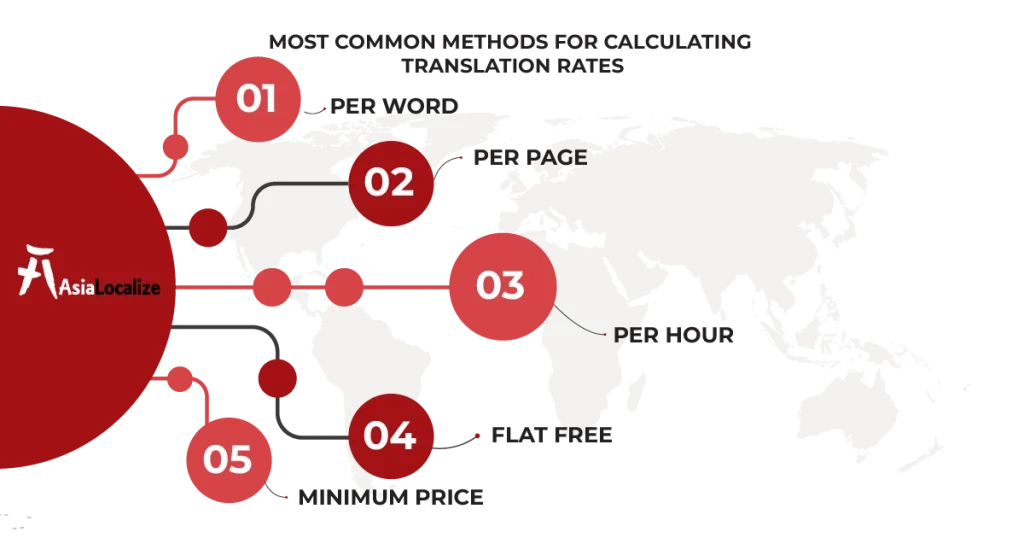
Per-word rates are the foundation most teams recognize. It looks simple, and that’s exactly why it works. You get a predictable structure, transparent math, and a starting point to compare quotes without guesswork. But there’s more happening behind the scenes: minimum fees, language tiers, specialization levels, and the situations where per-page or hourly billing makes far more sense.
Across the industry, it remains the dominant approach, with 91% of language service providers still relying on per-word pricing.
Alongside the per-word model, you’ll often see minimum fees. These protect the linguist’s time on very small tasks where admin, project setup, QA, and delivery might take longer than the translation itself.
Minimum fees typically apply to micro-tasks such as product labels, short UI strings, or certification statements.
Turn terminology and TM leverage into real savings with the right CAT tools.
Some content, however, doesn’t fit neatly into word-based billing.
You may see per-page pricing for:
- Official certificates
- Passports and legal documents
- Banking statements
- Scanned PDF or handwritten forms
In these cases, layout complexity—not word count—is the time sink.
Meanwhile, hourly pricing becomes the fairest model when the task is less about translation and more about:
- Linguistic QA (LQA)
- Subtitling timing for SRT/VTT
- Engineering fixes
- DOCX, IDML/INDD, XLIFF/JSON normalization
- Table or diagram reconstruction
The Real Factors Behind Every Translation Quote
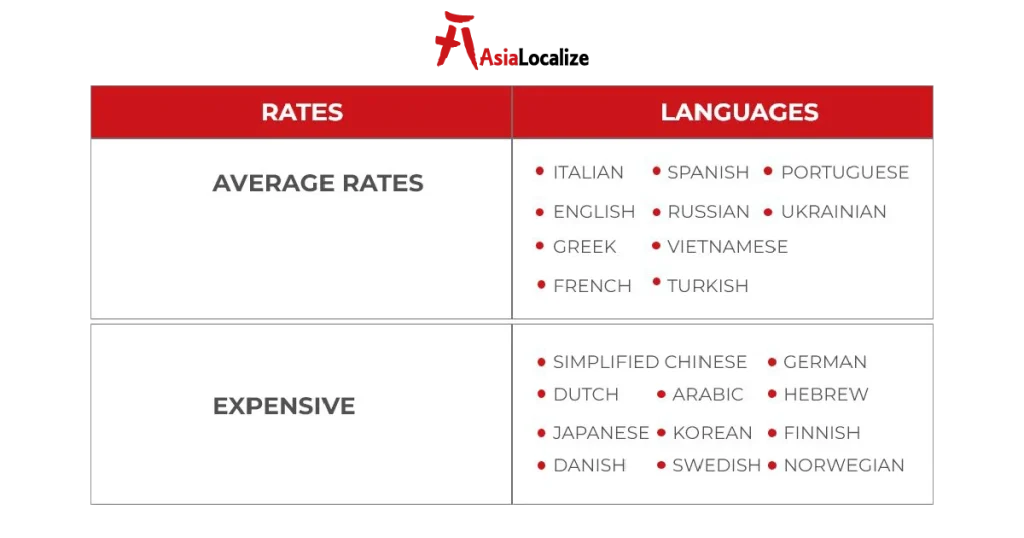
Once you move beyond per-word pricing, the real picture starts to unfold. Translation cost reflects the depth of work. Subject matter, file formats, visual elements, and certification layers all shift the level of expertise required. Add turnaround expectations and project-management scope, and the quote begins to take its true shape.
Here’s how each of these elements contributes to the full cost:
Subject Matter Complexity
Subject-matter complexity (legal, medical, technical) shifts the cost because high-stakes content needs certified expertise. Misinterpretation carries risk—operational, legal, or compliance-related—so linguists must work within ISO 17100 standards, supported by a TEP workflow (translator–editor–proofreader), style
File Formatting, Layout, and DTP Work
Translation rarely lives in plain text. When files include structured layouts, brand templates, tables, infographics, or product packaging, the team must preserve layout fidelity while adapting the content.
You may see an added cost when the project requires:
- Desktop publishing (DTP)
- IDML/INDD formatting
- Rebuilding charts, diagrams, or screenshots
- Localizing visual callouts
- Handling multimedia/subtitles
These steps ensure visual accuracy, which is essential for marketing, technical manuals, and multilingual packaging.
Images, Tables, and Non-Editable Elements
Text embedded in images, diagrams, engineering schematics, or scanned PDFs requires manual extraction or recreation. This adds time on the DTP and engineering side before translation even begins.
It matters because every visual element carries linguistic weight—if it can’t be edited, it must be rebuilt.
Certification and Compliance Requirements
Certified translations follow a different workflow: verified linguists, affidavit signing, agency stamps, and traceable revision steps. This naturally introduces additional layers of admin and QA.
Regulated sectors—such as immigration, finance, and healthcare—often require notarization, sworn translators, or ISO-certified processes that align with risk standards.
Turnaround Expectations
Time is a cost driver.
- Standard turnaround offers the most efficient pricing.
- Expedited delivery compresses the timeline and may require multiple linguists working in parallel.
- Rush projects can involve overnight or weekend work, real-time review cycles, and dedicated PM hours.
Project Management Scope
The translation itself is only one piece. PM hours cover:
- Content preparation
- Resource allocation
- QA coordination
- Glossary updates
- Cross-file consistency checks
- Final delivery and versioning
As volume, file types, and workflows grow, PM scope expands accordingly.
Bring structure to every release! Explore our translation management system guide.
What You’re Paying for in Certified Translation
Certified translations follow a different rhythm from standard work. Instead of counting words, costs are tied to the structure of the page itself because what matters here is official acceptance. The process involves mirrored layouts, stamps, seals, and a certificate of accuracy that stands up to review by embassies, courts, and government authorities. So when a quote is per-page, it’s pricing the full package.
What Per-Page Certified Translation Usually Includes
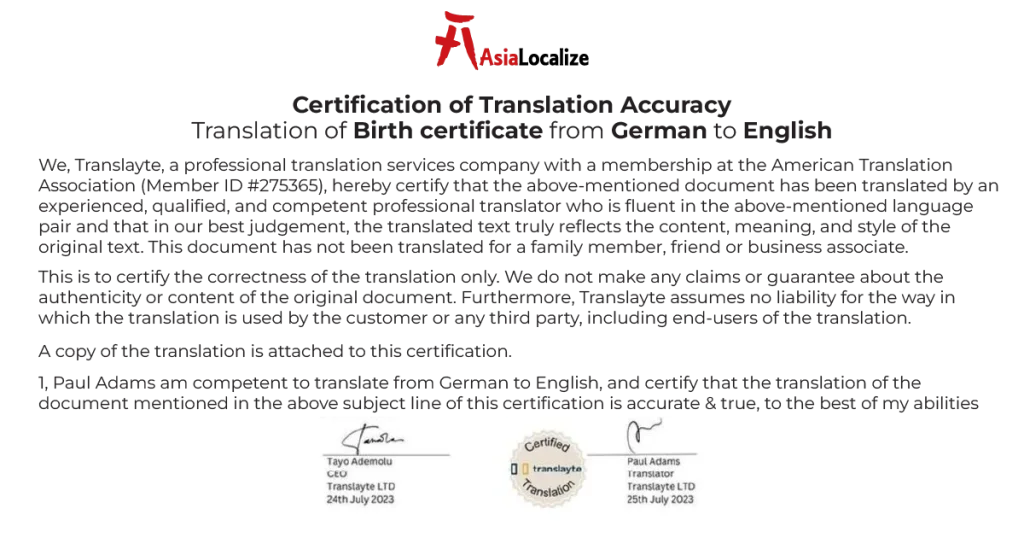
Certified translation rates are set per page because the deliverable is standardized. Each page is treated as an official document with a fixed structure, containing:
- A certificate of accuracy signed and issued by the translation provider
- A mirrored layout of the original page, including stamps, seals, tables, and signatures
- Linguistic fidelity checks, since certification leaves no margin for interpretive choices
- Acceptance notes aligning with the requirements of the requesting institution
This structure ensures the translation can be reviewed and approved without back-and-forth; a key requirement for immigration, academic, legal, and government-related submissions.
Make approvals smoother with our certified, ISO-aligned document translation services.
Why Page Mirroring Matters
Most official entities—from immigration offices to academic boards—expect the translated document to resemble the original in form.
Mirroring entails:
- Recreating stamps/seals visually (not altering them)
- Placing signatures exactly where they appear
- Preserving tables, rows, and numeric formatting
- Rebuilding elements from scanned or low-resolution files
Typical Page Structure in Certified Translations
A certified page usually includes:
- Header with translation provider info
- Body text rendered line-by-line or paragraph-by-paragraph
- Footnotes clarifying illegible details, torn edges, or incomplete scans
- Certificate of accuracy attached as a separate page or appended at the end
When Notarization May Apply
Not every certified translation requires notarization.
You may need notarization when the requesting authority asks for:
- A sworn translator’s signature
- A notarized affidavit verifying identity and signature
- Additional legal validation for use abroad
Notarization fees are separate because they involve an external party (a notary public) and scheduling requirements.
Rush Translation Pricing
Speed reshapes translation pricing more than most people expect. Once the timeline tightens, the workflow changes—linguists work in parallel, reviews compress, and project managers coordinate in real time.
Standard Delivery Tier
Most teams choose this tier whenever possible because it preserves quality and cost efficiency.
Standard timelines allow:
- Single-linguist workflows
- Full TEP cycles (translation → editing → proofreading)
- Smooth QA checks and glossary updates
- Predictable project management
Expedited Delivery Tier
Expedited timelines reduce buffer time but keep the core steps intact.
Here’s what typically changes:
- Some tasks overlap instead of running sequentially
- Two linguists may split files to accelerate throughput
- Review cycles shorten
- PM involvement intensifies
Rush Delivery Tier
Rush projects operate on compressed schedules where evenings, weekends, or overnight cycles come into play. This tier may involve:
- Multiple linguists translating simultaneously
- Continuous PM coverage
- Real-time QA and rapid engineering support
- Immediate review responses and tight feedback loops
Rush multipliers often range from 1.5× to 2.5× depending on:
- Volume
- Domain complexity
- Time zone coordination
- Weekend or holiday scheduling
Weekend & Holiday Surcharges
When projects require weekend or holiday coverage, additional fees reflect the off-hours staffing involved.
These are separate from rush multipliers and vary based on:
- Linguist availability
- Required specialization
- Duration of weekend involvement
- Mandatory double-review for regulated content
Staged Deliveries (Rolling Batches)
For large volumes under tight deadlines, staged deliveries offer a practical middle ground.
They allow:
- Early access to completed sections
- Parallel development for product, web, or engineering teams
- Faster approvals and incremental QA
This approach shortens go-live time even when the full project can’t be completed instantly.
Understanding translation rates is ultimately about seeing the full workflow. Every project carries its own mix of language requirements, subject-matter expertise, timelines, tools, and quality steps. When teams know how these elements work together, decisions become clearer, budgets stretch further, and multilingual releases run with far fewer surprises.
If your next project needs a structure that feels steady and well-managed, we’re at AsiaLocalize to help you map it out in a way that fits your timelines and your team’s reality.
Shape market-ready experiences with localization services tuned for every region.