

Quick definition
What Is Machine Translation?
Machine translation (MT) is the automatic translation of text by software. Modern neural MT engines and large language models translate whole sentences in context and can follow tone, terminology and formatting instructions. With the right engine, terminology control and human review, MT lets you translate more content, faster, at a lower cost per word.
Machine translation at a glance
- Engines: neural MT and large language models, tested against your content.
- Control: glossaries, do-not-translate lists and translation memory.
- Human review: light, standard or full post-editing (MTPE).
- AI data: collection, annotation, prompt and search evaluation.
- Languages: 120+ languages, specialized in Asian markets.
- Track record: 10M+ words across 8,000+ projects.
Published: · Last reviewed:
Our MT and AI services
Which AI Data and Language Services Do We Offer?
Human-in-the-loop services that improve translation quality and the data your AI systems learn from.
MTPE Services
Human post-editing of machine translation for accuracy and fluency.
Explore →
Machine Translation Evaluation
Side-by-side evaluation of translations generated by AI models.
Explore →
AI Data Annotation
Expert labeling of datasets to improve machine learning accuracy.
Explore →
Data Collection
Diverse datasets collected to fit your project needs.
Explore →
Search Evaluation
Expert ratings that improve search relevance and quality.
Explore →
Prompt Evaluation
Expert reviews of AI prompts and responses.
Explore →
Prompt Engineering
Prompts designed and optimized for better AI performance.
Explore →
Ad Evaluation
Analysis of AI-generated ads for relevance and effectiveness.
Explore →
AI Content Creation
Human-reviewed AI content tailored to your audience.
Explore →
AI Transcription
Audio and video transcription with human review.
Explore →
Choosing an approach
When Should You Use Machine Translation?
MT is a strong fit for high-volume, low-risk content and first drafts. For brand, legal, medical and safety-critical content, a native linguist should post-edit or translate from scratch.
| Recommended approach | Why | |
|---|---|---|
| Internal documentation and knowledge bases | Raw MT or light post-editing | High volume; readers need the meaning more than the style |
| Support tickets, product catalogues and listings | Light or standard post-editing | Speed matters, but terminology must stay consistent |
| User-generated content | Raw MT | Volumes are too high for human review and content is short-lived |
| Marketing and brand messaging | Human translation or transcreation | The value sits in tone, wording and cultural fit |
| Legal, medical and regulatory documents | Human translation with independent review | Errors carry legal or clinical consequences |
| Safety-critical instructions | Human translation with review | Mistakes can cause harm |
Machine translation post-editing
How Does Machine Translation With Human Post-Editing (MTPE) Work?
For most businesses the answer is a hybrid: AI produces the draft, then a native linguist corrects and refines it. Choose the level of review your content needs.

Light Post-Editing
Accuracy and clarity
Fixes meaning, terminology and obvious errors so content is understandable.
- Internal documents and knowledge bases
- Support content and large catalogs
Full Post-Editing
Publication quality
Edits style, fluency and consistency to match professional human translation.
- Customer-facing web and product content
- Content that carries your brand name
Human Translation
Brand-critical content
For marketing, legal and medical content, we recommend professional human translation instead.
- Transcreation for campaigns and slogans
- Independent review for regulated documents
Learn more about our MTPE services, professional translation and transcreation for marketing.
Our MT workflow
How Do We Choose and Tune the Right MT Engine?
MT quality varies by language pair and subject, so we build each workflow around your content instead of defaulting to one engine.
01
Engine Selection
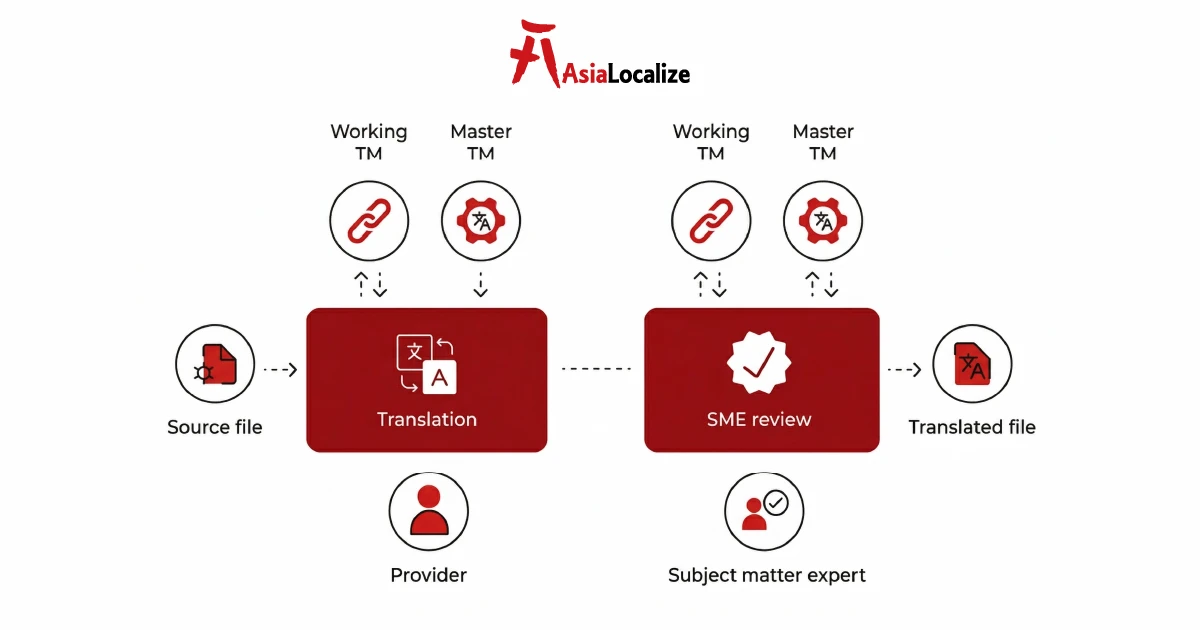
We test neural MT and LLM engines against your content and language pairs.
02
Terminology and Style Control
Glossaries, brand terms and do-not-translate lists keep output on-brand.
03
Translation Memory First
Approved translation memory is reused, so signed-off wording is never re-translated.
04
Quality Evaluation
We assess raw output on a sample before quoting, so the effort and price reflect reality.
05
Human Review
Native linguists edit to your chosen quality tier, backed by ISO 17100 certified processes.
Asian language expertise
Why Is Machine Translation Harder for Asian Languages?
Asian language pairs are where raw MT struggles most, and where human review matters most. We know which pairs can lean on automation and which need a linguist’s hand.
Word Segmentation
Chinese, Japanese and Thai do not separate words with spaces, so segmentation errors cascade through the sentence.
Politeness and Honorifics
Japanese and Korean encode politeness levels that engines often flatten, so text reads as rude or oddly casual.
Chinese Script Variants
Traditional and Simplified Chinese are not interchangeable across markets such as Taiwan, Hong Kong and mainland China.
Tones and Diacritics
Vietnamese and Thai rely on tonal and diacritic precision that small MT errors can destroy.
Our Achievements

Ready to Scale Translation With MT and AI?
Tell us about your content, languages and quality goals. We will test MT on a sample and recommend the right mix of machine translation, post-editing and human review.
Machine Translation FAQ
What is machine translation?
Machine translation is the automatic translation of text by software. Today’s neural and AI systems translate in context, making them far more fluent than earlier rule-based tools.
Is AI translation accurate enough to publish?
For low-risk, high-volume content it often is. For marketing, legal, medical or brand-critical material, raw output should be post-edited by a native linguist before publication.
What is the difference between machine translation and MTPE?
Machine translation is the automated draft; MTPE adds a human linguist who corrects and refines that draft to an agreed quality level.
How do you decide whether my content can use machine translation?
We review the content type, audience and risk, then test MT output on a sample in your language pair. If the quality and risk allow it, we recommend raw MT or a post-editing level; if not, we recommend human translation.
Does machine translation save money?
Usually yes, because the linguist edits rather than writes from scratch. Actual savings depend on how well the engine performs on your language pair and content, which is why we evaluate a sample before quoting.
Which languages do you support?
120+ languages, including all major Asian languages — Japanese, Korean, Chinese (Simplified and Traditional), Thai, Vietnamese, Bahasa, Hindi, Tagalog and more.
Which AI data services do you offer?
Beyond translation, we provide multilingual AI data services: data collection, data annotation, prompt evaluation, prompt engineering, search evaluation and machine translation evaluation.

