Updated November 1, 2026
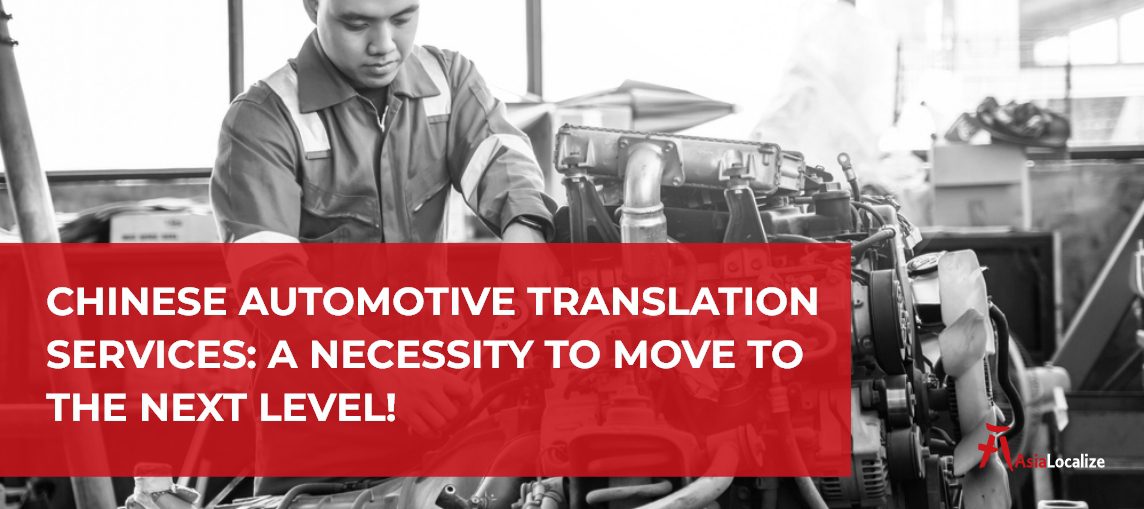
Chinese automotive translation services adapt vehicle software, technical documentation, safety information, marketing, training, and aftersales content for Chinese-speaking users and global programs involving Chinese OEMs. The work is not limited to replacing English words with Chinese characters. It must keep terminology, warnings, digital interfaces, manuals, voice functions, and model-specific content accurate and synchronized across every release.
For automakers, EV brands, Tier 1 suppliers, mobility platforms, importers, and dealer networks, language quality affects usability, safety, brand credibility, regulatory documentation, and launch speed. A successful program combines native automotive linguists, controlled terminology, localization engineering, in-context testing, and lifecycle version control.
What Is Chinese Automotive Translation?
Chinese automotive translation is the specialized transfer and localization of automotive content between Chinese and other languages. It can support a foreign manufacturer entering Mainland China, Taiwan, Hong Kong, or Singapore; a Chinese OEM expanding internationally; or a global supply chain in which engineers, production teams, dealers, and customers work in different languages.
The service covers the complete vehicle lifecycle—from engineering and supplier communication to the digital cockpit, owner documentation, dealer training, maintenance, campaigns, recalls, and software updates. Each content type has different risks. A slogan may require transcreation, while a high-voltage warning or braking-system message requires tightly controlled technical meaning.
Why the Chinese Automotive Market Matters in 2026
China remains central to the global transition toward electric and software-defined vehicles. The International Energy Agency’s Global EV Outlook 2026 reports that more than 13 million electric cars were sold in China in 2025, representing close to 55% of the country’s new-car sales and six out of every ten electric cars sold worldwide.
China was also responsible for nearly 75% of global electric-car production in 2025. Chinese EV exports doubled to more than 2.5 million vehicles, while overseas markets increasingly received Chinese-built vehicles, digital services, mobile apps, and aftersales systems. This creates localization demand in both directions: international companies need Chinese content for local users, and Chinese manufacturers need multilingual content for destination markets.

The opportunity is large, but competition is intense. Drivers compare not only range, charging, and price but also the quality of the digital experience. Unnatural dashboard text, untranslated system messages, unclear voice commands, or inconsistent manuals can make an advanced vehicle feel unfinished.

What Content Requires Automotive Translation and Localization?
| Content area | Examples | Primary quality risk |
|---|---|---|
| Vehicle software | Instrument cluster, HMI, infotainment, navigation, ADAS messages, settings, charging screens | Truncation, missing context, unsafe ambiguity |
| Connected services | Companion apps, cloud portals, account flows, notifications, voice assistants, OTA notes | Version drift and inconsistent terminology |
| Owner content | Owner manuals, quick-start guides, emergency procedures, warranty information | Incorrect instructions or safety language |
| Engineering and production | Specifications, CAD annotations, work instructions, test reports, supplier documentation | Component and process terminology errors |
| Service and aftersales | Diagnostic software, repair manuals, service bulletins, parts catalogs, training | Incorrect diagnosis, repair, or part selection |
| Market entry | Homologation files, compliance reports, labels, certificates, recall notices | Incomplete or market-inappropriate documentation |
| Marketing and sales | Websites, brochures, configurators, launch campaigns, dealer content | Weak brand voice or unsupported claims |
A centralized terminology and content strategy should connect all these channels. The same feature may appear in an engineering specification, HMI string, owner manual, service procedure, training module, campaign, and support article. If teams translate each item separately, drivers and technicians can encounter several names for one function.
Simplified or Traditional Chinese? Choose the Correct Locale
“Chinese” is not a single target locale. Script, vocabulary, technical terminology, tone, and regulatory context differ by market. The project brief should specify both language and destination rather than requesting generic Chinese translation.
| Target market | Typical locale | Key consideration |
|---|---|---|
| Mainland China | Simplified Chinese, zh-CN | Mainland terminology, local platforms, regulations, maps, and user expectations |
| Taiwan | Traditional Chinese, zh-TW | Taiwan-specific automotive terms and writing conventions |
| Hong Kong | Traditional Chinese, zh-HK | Cantonese-influenced terminology and bilingual usage where relevant |
| Singapore | Simplified Chinese, zh-SG | Local terminology and multilingual market context |
Converting characters does not create a market-ready translation. For a deeper comparison, see our guide to Traditional versus Simplified Chinese. Voice interfaces may also require regional accent, pronunciation, and intent testing beyond written localization.
Six High-Risk Chinese Automotive Localization Challenges
1. Safety-critical terminology
Terms for braking, steering, batteries, charging, driver assistance, restraints, high voltage, and emergency procedures must be unambiguous. Translators need approved definitions and product context. Literal translation can be dangerous when a term has an established engineering or market-specific equivalent.
2. HMI space, readability, and driver workload
Clusters and infotainment displays impose character, timing, and layout constraints. Text must remain legible at a glance without obscuring values or controls. Reviewers should see screenshots or a functioning build because an isolated string rarely reveals whether it is a label, warning, setting, or command.
3. ADAS and automation expectations
Words used for driver-assistance functions can change how users understand system capability. Marketing, HMI, warnings, and manuals must communicate limitations consistently. Terms suggesting full automation should not replace language that describes an assisted function.

4. Software, OTA updates, and release synchronization
Software-defined vehicles change after launch. UI strings, voice responses, app content, digital manuals, and release notes must move together. UN Regulation No. 156 addresses vehicle software-update and software-update management systems. Localization teams should connect language approvals to software build and release controls rather than treating content as a static manual.
5. Structured technical content and variants
One platform may have many trims, powertrains, markets, and model years. DITA, XML, resource files, and content-management systems can reuse modules, but reuse must respect product configuration. A sentence approved for one battery system or feature set may be wrong for another.
6. Confidentiality and connected-vehicle data
Pre-launch specifications, unreleased model information, software strings, screenshots, and test builds are sensitive. Translation vendors need controlled access, secure transfer and storage, defined retention, and clear rules for AI tools. Cybersecurity and localization teams should coordinate when content describes connected features, permissions, data collection, or incident response.
A Reliable Chinese Automotive Translation Workflow
1. Define the market, users, content, and risk
Specify the vehicle program, target locale, countries, audiences, platforms, file formats, model variants, milestones, and responsible reviewers. Identify safety-critical content and any market-entry documentation that needs specialist or legal review.
2. Audit the source and localization readiness
Check source clarity, hard-coded strings, concatenated messages, placeholders, character limits, screenshots, duplicate content, and change history. Externalize UI text and provide developers with internationalization requirements before translation begins.
3. Build a controlled automotive termbase
Record approved Chinese and source-language terms, definitions, abbreviations, product context, forbidden alternatives, and applicable markets. Align terminology across engineering, UI, manuals, parts, service, dealer, and marketing teams. A maintained translation memory can reuse approved content across model years while highlighting changed segments.
4. Translate with automotive specialists
Assign native linguists with relevant technical expertise. High-risk material benefits from independent editing or subject-matter review. Marketing copy may require transcreation, while engineering specifications require controlled, source-faithful language.
5. Integrate and publish multilingual content
Connect the translation workflow to repositories, a translation management system, content systems, and build pipelines. Support formats such as XML, DITA, JSON, XLIFF, software resource files, InDesign, CAD exports, Office files, subtitles, and audio scripts. Translate only the meaningful changes while preserving approved material.
6. Test in context
Run linguistic, visual, functional, and locale testing on representative devices and screen sizes. Verify truncated text, fonts, line wrapping, variables, units, dates, navigation, voice recognition, speech output, search, notifications, and fallbacks. Safety-related messages require extra attention and traceable defect resolution.
7. Approve and control each release
Record the source version, target locale, build, translators, reviewers, issues, approvals, and publication date. When software or product configurations change, perform an impact assessment and regression test affected languages.

Automotive Localization Testing Checklist
- Language: accurate terminology, grammar, tone, completeness, and market-appropriate Chinese.
- Safety: warnings, severity, user actions, limitations, and emergency procedures match approved meaning.
- HMI: no clipping, overlap, incorrect line breaks, missing glyphs, or unreadable abbreviations.
- Dynamic content: numbers, variables, component names, and status messages display correctly.
- Voice: wake words, accents, intents, prompts, confirmations, and error recovery work in realistic conditions.
- Cross-channel consistency: UI, manual, app, dealer training, website, and support use the same approved terms.
- Variants: language and content match the correct trim, powertrain, market, and model year.
- Regression: changed code or content has not broken previously approved screens and tasks.
Can AI Translate Chinese Automotive Content?
AI and machine translation can accelerate first drafts, terminology extraction, consistency checks, and high-volume low-risk content. They should not act as the final authority for safety-critical or legally significant material. Chinese automotive terminology is context-sensitive, and fluent output can still describe the wrong component, capability, or user action.
A controlled AI workflow defines eligible content, approved systems, data-retention rules, terminology constraints, human-review levels, and final accountability. Confidential pre-release data should never enter an unapproved public tool. Critical warnings, driver-assistance descriptions, service procedures, and compliance documents require qualified human verification.
Business Benefits of a Controlled Localization Program
A well-managed Chinese automotive translation program improves more than readability. Consistent HMI and manual terminology reduces user confusion, helps service teams locate the correct procedures, and gives dealers reliable language for customer questions. Earlier localization involvement also exposes unclear source content and software constraints before they delay a launch.
Centralized terminology, translation memory, and structured content reuse reduce repeated work across vehicle platforms, trims, and model years. Continuous localization shortens the time between source changes and approved target-language builds. In-context testing protects the customer experience by catching defects that a bilingual file review cannot reveal.
For Chinese OEMs expanding abroad, professional localization makes product capability easier to understand in each destination market. For international manufacturers entering China, it supports a locally credible experience across digital touchpoints, documentation, dealers, and aftersales service. The result is a more consistent launch, a stronger brand impression, and fewer avoidable support issues.
How to Choose a Chinese Automotive Translation Company
- Automotive subject expertise: linguists understand vehicles, EV systems, manufacturing, software, service, and your specific content type.
- In-market Chinese expertise: the provider distinguishes Mainland, Taiwan, Hong Kong, and Singapore requirements.
- Terminology governance: termbases, definitions, prohibited terms, translation memory, and client approval are built into the process.
- Localization engineering: support includes software files, structured content, DTP, voice, multimedia, and automated workflows.
- In-context QA: translators can review functioning HMIs, apps, digital manuals, and vehicle-specific builds.
- Security: access control, secure hosting, NDAs, retention, and AI-use policies protect pre-launch data.
- Traceability: every release connects sources, translations, reviewers, defects, approvals, and builds.
- Scalability: the provider can coordinate many languages, variants, suppliers, and fast software releases.
AsiaLocalize provides professional Chinese translation services and automotive translation services for Asian and global markets. Our ISO 17100-certified workflows combine qualified linguists, terminology management, translation technology, localization engineering, and quality assurance.
Cost and Timeline Factors
Automotive translation pricing depends on more than word count. Key factors include the target locale, content risk, file formats, number of vehicle variants, software readiness, terminology quality, review requirements, DTP, audio, test environments, integrations, release frequency, and how much approved content can be reused.
A representative pilot helps expose source, terminology, UI, and workflow problems before a full vehicle program. Providing editable files, screenshots, string context, prior translations, and stable source content reduces rework and improves the estimate.
Chinese Automotive Translation FAQs
Do automotive manuals require specialist translators?
Yes. Manuals contain technical systems, warnings, procedures, units, diagrams, and market-specific terminology. Native language skill alone does not provide the automotive knowledge required to translate them reliably.
Is Simplified Chinese enough for every Chinese-speaking market?
No. Mainland China generally uses Simplified Chinese, while Taiwan and Hong Kong use Traditional Chinese with different regional terminology. Singapore commonly uses Simplified Chinese but has its own multilingual market context. Select a precise locale for every launch.
How is HMI translation different from document translation?
HMI strings are short, dynamic, and dependent on screen context, software logic, and user action. They require character-limit control, build integration, visual review, and functional testing. Documents offer more context but bring structure, diagrams, pagination, and variant-management challenges.
How do teams keep translations consistent across model years?
They maintain approved terminology and translation memory, compare new sources with prior versions, isolate changed content, control product variants, and connect language approval to configuration and release management.
How early should localization begin?
Begin during content and software design. Early internationalization, terminology, and test planning prevent hard-coded strings, layout failures, ambiguous source text, and late release delays.
Prepare Your Automotive Program for Chinese and Global Markets
Chinese automotive translation succeeds when language, engineering, safety, product configuration, and release management work as one system. Whether you are entering China or taking a Chinese-built vehicle overseas, AsiaLocalize can assess your content, terminology, software, languages, and launch schedule.
Contact AsiaLocalize to plan a secure, scalable automotive localization workflow for your next vehicle, EV, connected service, or aftersales program.