
Chinese legal translation is the translation of contracts, filings, evidence and compliance documents between Chinese and another language, carried out by linguists who understand both legal systems involved. It is a specialist discipline: a fluent general translator is not enough, because legal terms rarely have exact equivalents across systems.
Why Chinese Legal Translation Carries More Risk
Mainland China follows a civil law tradition, while many of your counterparties operate under common law. Concepts such as “consideration”, “trust”, “discovery” or “without prejudice” have no clean one-to-one Chinese equivalent, and the reverse is equally true. A translator who renders the words but not the legal function can quietly change what a clause does.
Add to that the practical realities: Chinese contracts often rely on context and relationship framing, numbers and dates follow different conventions, and company names must match official registrations exactly. Small inaccuracies in these areas cause filings to be rejected or clauses to be disputed.
Which Chinese Do You Actually Need?
“Chinese” is not one target. Choosing the wrong variety is one of the most common and most avoidable mistakes in legal projects.
| Jurisdiction | Script | Typical legal use |
|---|---|---|
| Mainland China | Simplified Chinese | Contracts, SAMR/company filings, court documents, compliance |
| Hong Kong | Traditional Chinese | Bilingual (Chinese/English) contracts, court and regulatory filings |
| Taiwan | Traditional Chinese | Local contracts, IP filings, regulatory submissions |
| Singapore | Simplified Chinese | Supporting documents; English usually governs |
Script and wording differ between these markets, so a document prepared for Beijing should not simply be reused in Taipei. If you are unsure which variety applies, our guide to Chinese translation services explains how we scope this at the start of a project.
Documents That Commonly Need Chinese Legal Translation
- Commercial contracts, NDAs, distribution and joint-venture agreements
- Articles of association, board resolutions and corporate filings
- Patents, trademarks and other intellectual property documents
- Litigation and arbitration material, evidence bundles and judgments
- Regulatory, compliance and due-diligence documentation
- Employment agreements and HR policies for China-based staff
Five Places Chinese Legal Translation Goes Wrong
- Literal rendering of legal terms. The words are right; the legal effect is not.
- Mixed script or variety. Simplified text submitted where Traditional is expected, or Mainland phrasing used for Taiwan.
- Inconsistent terminology. The same defined term translated three ways across one agreement, creating ambiguity.
- Entity and name mismatches. Company or party names that do not match official registration records.
- Unreviewed machine output. Raw engine output on legal text is fast and genuinely risky; it should always be post-edited by a legal linguist.
Not everything is a contract or a filing. For certificates, transcripts, licences and financial statements, see our broader guide to Chinese document translation, which covers certification levels, seals and formatting in more detail.
Certified and Notarised Chinese Legal Translation
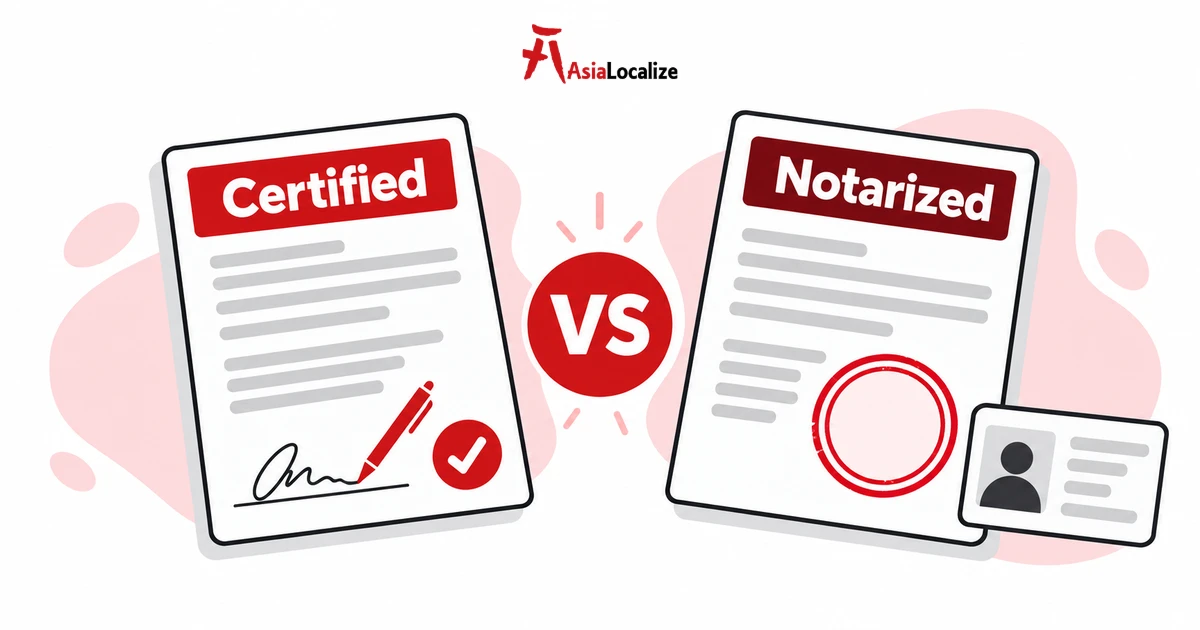
Requirements vary by receiving authority. Some accept a translation accompanied by a certificate of accuracy from the language provider; others require notarisation, and cross-border use may additionally call for legalisation or an apostille. Because the rules depend on the specific court, registry or agency, confirm the exact requirement with the receiving body before the translation is produced — it is far cheaper than redoing a filing.
How to Choose a Chinese Legal Translation Provider
- Legal subject-matter linguists, not generalists, translating into their native variety
- A managed glossary and translation memory so defined terms stay consistent
- A second-linguist review step on anything contractual or filed
- Documented confidentiality handling for sensitive matters
- Clear handling of Simplified vs Traditional and jurisdiction-specific wording
AsiaLocalize delivers Chinese legal work through native legal linguists under ISO-certified quality processes, with 24/7 support across 120+ languages. Explore our legal translation services and document translation services, or see how pricing is structured in our guide to legal translation rates.
Chinese Legal Translation FAQ
What is Chinese legal translation?
It is the translation of legal documents between Chinese and another language by linguists trained in law, so that the legal effect of each provision is preserved — not just the wording.
Should I use Simplified or Traditional Chinese?
Simplified for Mainland China and Singapore; Traditional for Hong Kong and Taiwan. Wording differs between these markets too, so documents should be prepared for the specific jurisdiction.
Do Chinese legal translations need to be certified?
It depends on the receiving authority. Some accept a provider’s certificate of accuracy, others require notarisation or legalisation. Always confirm with the court, registry or agency first.
Can machine translation be used for Chinese legal documents?
Not on its own. It can accelerate a first draft, but legal content should be post-edited and reviewed by a qualified legal linguist before use.
How long does Chinese legal translation take?
It depends on volume, complexity and whether certification is required. We provide a schedule with every quote and can scale teams for urgent filings.
Need Chinese legal documents translated accurately? Get a free quote for Chinese legal translation →