

Languages spoken in the Philippines reflect one of Southeast Asia’s richest linguistic landscapes. Across the archipelago, Filipino and English serve as official languages, while regional languages such as Cebuano, Ilocano, Hiligaynon, Waray, and Bikol remain central to daily communication. For businesses entering the Philippine market, this diversity matters. The right language choice can affect how people understand your message, trust your brand, and respond to your products, services, or campaigns.
Given this unique linguistic diversity, it’s no surprise that the Philippines is one of the most linguistically diverse countries in the world. But it’s not just about culture-with a population of 116.2 million and a strong economy, the Philippines is a promising destination for foreign investments.
If you want to explore these opportunities, you’re in the right place. Today’s blog will uncover the diverse and fascinating languages spoken in the Philippines.
Quick Answer: What Languages Are Spoken in the Philippines?
The main languages spoken in the Philippines include Filipino, English, Cebuano, Ilocano, Hiligaynon, Waray, Bikol, Kapampangan, Pangasinan, and many other regional languages. Filipino and English are the country’s official languages, while regional languages remain important for local communication, education, media, and business engagement.
Official Languages of the Philippines
Filipino and English are the official languages of the Philippines for communication and instruction. Regional languages also serve as auxiliary official languages in their respective regions.
English, with its official status since the country’s colonization by the United States from 1898 to 1946, holds a significant place in the Philippines. It’s a language of governance, newspapers, and publications.
Filipino – The National Language
The development of Filipino as the national language of the Philippines is deeply rooted in the history and evolution of Tagalog, its primary basis. Tagalog, one of the major languages spoken in the Philippines, has been a critical medium of communication among various groups long before colonial influences shaped the country’s linguistic landscape.
The journey to standardizing Filipino began in the mid-20th century when the need for a unifying language became apparent amid the linguistic diversity of the Philippine islands. In 1937, President Manuel L. Quezon established Tagalog as the basis for the national language, recognizing its widespread use and cultural significance.
The Institute of National Language, which was formed in 1936, further developed the standardized form of Filipino. It involved the incorporation of vocabulary from various Philippine languages, such as Cebuano, Ilocano, and Hiligaynon, to ensure that Filipino would be inclusive and reflective of the nation’s cultural plurality.
The linguistic evolution of Filipino continued. The Philippines’ complex colonial history introduced significant foreign influences, mainly from Spanish, English, Sanskrit, Chinese, Arabic, and Malay.
English – A Legacy of Colonialism and a Tool for Global Communication
The historical influence of American colonization on the widespread use of English in the Philippines is significant and multifaceted. Following the Spanish-American War in 1898, the United States established control over the Philippines, marking the beginning of a new colonial influence. This period prompted profound changes in various sectors, particularly education, governance, and communication.
One of the most impactful moves made by the American colonial government was the establishment of an English-based education system. The introduction of the public school system in the early 1900s emphasized English as the medium of instruction, leading to a dramatic increase in English proficiency among Filipinos.
| More than 14 million Filipinos are speaking English at some level! |
The use of English was further institutionalized in government and the legal system. English became the language of legislation, judicial proceedings, and official documentation, solidifying its status as one of the country’s official languages.
Major Regional Languages Spoken in the Philippines
Cebuano (Bisaya)
Cebuano, which is also known as Bisaya, belongs to the Austronesian language family. Spoken by 18.5 million people in the Philippines and used mainly in cinema and newspapers, it’s spoken across many regions, in eastern Cebu, Negros, western Leyte, the Camotes Islands, Bohol, and the northern and western coasts of Mindanao.
Often, Cebuano is grouped with Hiligaynon (Ilonggo) and Waray-Waray languages as part of the Visayan (Bisayan) dialect family since they have numerous commonalities.
Ilocano
Ilocano, also known as Iloco, is also a part of the Austronesian language family. Spoken by almost 10 million people in the Philippines, It’s one of the major languages there.
Ilocano speakers are found in the Ilocos Norte, Ilocos Sur, La Union, the southern Philippine island of Mindanao, and Hawaii.
Hiligaynon (Ilonggo)
Hiligaynon, also known as Ilonggo, Binisaya, or Inilonggo, belongs to the Bisayan language family. Spoken by 9.1 million people, its speakers are found in Iloilo, Guimaras, Negros Occidental, Capiz, Soccsksargen’s South Cotabato, Sultan Kudarat, and North Cotabato.
Most of its speakers originate from the Hiligaynon ethnic group, one of the largest ethnic groups in the Philippines.
The Spanish Legacy and its Linguistic Footprint
When Spain began its colonization of the Philippines in the late 16th century, Spanish was the official language of government, education, and the Catholic Church for 300 years. Official documents, legal proceedings, and religious texts were primarily written in Spanish, which solidified its prominence in both formal and informal aspects of life.
The need for communication between Spanish colonizers and the indigenous populations led to the creation of a pidgin form of Spanish, which gradually evolved into a Creole language known as Chavacano. The language incorporates a significant amount of vocabulary from Spanish, but its grammar and structure have been heavily influenced by local Philippine languages such as Tagalog, Cebuano, and others.
However, according to the 1935 Constitution, Spanish was designated as an “optional and voluntary language” in 1987.
The Philippines has more Spanish speakers than the other Asian countries, with only 0.5% of the population.
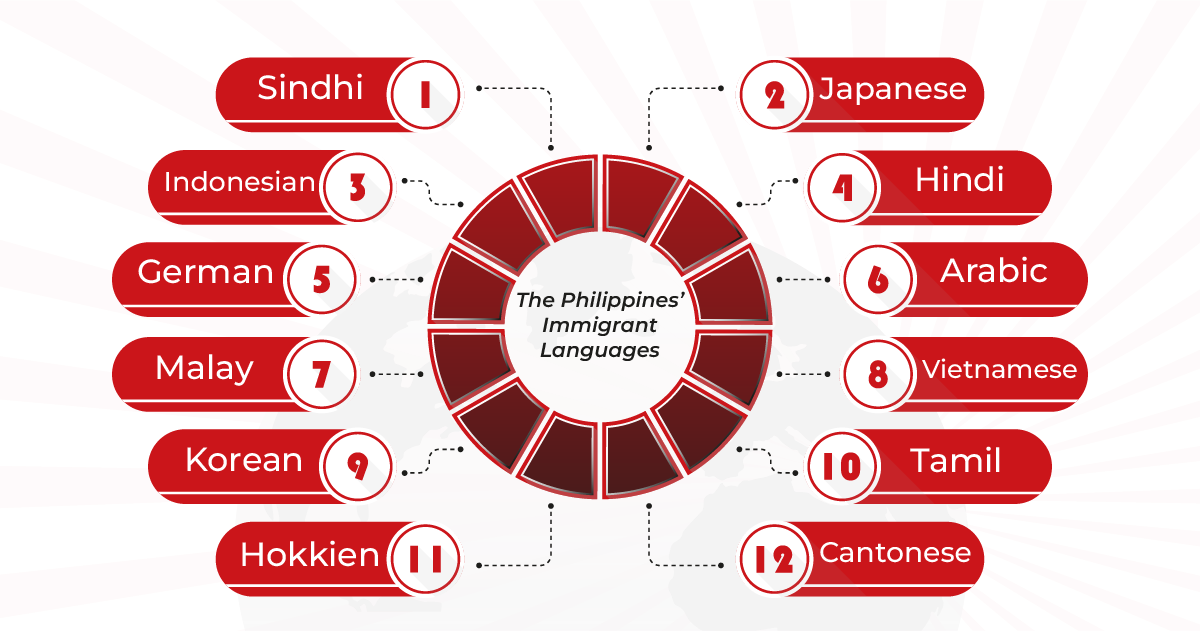
Immigrant Languages in the Republic of the Philippines
The Philippines is a melting pot of cultures, highly influenced by migration. Over the years, various immigrant communities have settled in the archipelago, each contributing their own languages and cultural influences.
A Quick Look at the Endangered Languages spoken in the Philippines
There are now 35 endangered Philippine languages, and 11 are on the brink of extinction. Many Philippine languages, such as Kapampangan, Pangasinan, Bikol, Ilokano, Ibanag, Itawis, and Sambal, are experiencing a decline.
That’s because local languages aren’t generally spoken in public venues but are still present in family gatherings, sari-sari stores, and barangay halls. Even the Filipinos who move from rural areas to urban centers for any reason speak Tagalog when they arrive in the big city.
| Having an eye on Singapore’s market? Take a moment to read more about the languages spoken in Singapore! |
Practical Implications for Businesses: Localizing for the Philippine Market
Importance of Language Selection
In such a linguistically diverse nation, it’s crucial to strategically select the appropriate language(s) that resonate with your intended region. For example, if central Visayas is your targeted destination, it’s better to go for Cebuano. And businesses aiming to reach this Ilocos Region should consider utilizing Ilocano in their communications.
Beyond Translation: Cultural Adaptation is Key
For businesses aiming to thrive in the Philippines, cultural sensitivity and adaptation should be at the forefront of their strategies, be it in marketing, product development, and customer service.
By understanding and embracing local customs, preferences, and values, companies can create authentic experiences that resonate with Filipino consumers.
Tagalog Translation & Localization
Since the Philippines is home to 170 languages, getting professional translation and localization help should be one of your priorities on your way to the Philippines market. Expert in-country translation companies will support you with a vast network of native speakers in your target region, delivering translated content as if it was initially intended for the target audience.
Multilingual Marketing Strategies
Multilingual campaigns are more likely to capture attention and elicit responses from audiences. Content delivered in a familiar language tends to resonate better, leading to higher levels of engagement, whether through social media interactions, email responses, or website visits.
Tagalog and Filipino Translation for Business Growth
Understanding the languages spoken in the Philippines is only the first step. For businesses entering the Philippine market, the bigger challenge is choosing the right language, tone, and content format for each audience.
Professional Tagalog translation services can help businesses adapt websites, product pages, marketing campaigns, training materials, legal documents, and customer support content for Filipino-speaking audiences.
For brands using video, eLearning, social media, or campaign content, multimedia localization services can also help adapt subtitles, voice-over, on-screen text, scripts, and visual references so the message feels natural to local viewers.
For companies expanding across Southeast Asia, a broader APAC localization strategy can help keep brand messaging consistent while adapting content for each local market.
In fact, localized content has six times more engagement than globalized content. And 86% of the localized advertising campaigns outperformed English campaigns regarding click-throughs and conversions.
Planning to enter the Philippine market? AsiaLocalize’s team is well-prepared to make it happen in the most optimum and fastest manner.
We have thousands ofnative Tagalog experts alongside all other Philippine language linguists to support the most complex projects with the highest quality, offering 100% reliable Tagalog translation services. Also, our project managers are available 24/7 to make sure everything goes as planned and expected from your side.

FAQs About Languages and Localization in the Philippines
What are the official languages of the Philippines?
Filipino and English are the official languages of the Philippines. Regional languages also serve as auxiliary official languages in their respective regions.
What are the major regional languages spoken in the Philippines?
Major regional languages include Cebuano, Ilocano, Hiligaynon, Waray, Bikol, Kapampangan, Pangasinan, and others used across different islands and regions.
Is Filipino the same as Tagalog?
Filipino is the national language of the Philippines and is based mainly on Tagalog, but it also includes influence from other Philippine and foreign languages.
Why does localization matter for businesses entering the Philippines?
Localization helps businesses adapt language, tone, visuals, customer support, multimedia content, and digital experiences to Filipino audiences across different regions.