Global growth rarely fails because companies choose the wrong markets. It fails because the content pipeline cannot keep pace with the business’s speed.
A product update ships. Marketing launches a new campaign. UI strings change overnight. Suddenly, dozens—or hundreds—of files move between product teams, translators, reviewers, and developers. If the process behind that movement is unclear, the cracks appear quickly: broken variables in the interface, inconsistent terminology across pages, and last-minute fixes before launch. What should be a straightforward release turns into rework.
That is where a localisation workflow quietly determines whether multilingual content scales smoothly or spirals into delays. At its core, it’s the structured path that content follows from preparation to translation, review, QA, and delivery. When that structure is missing—or patched together with spreadsheets, emails, and manual file transfers—context gets lost and quality problems surface late in the cycle.
The stakes are high. A 2020 CSA Research survey of 8,709 consumers found that 76% of online shoppers prefer to buy products with information in their native language, and 40% never buy from websites in other languages.
Poor localization costs conversions, particularly when messaging feels unnatural, inconsistent, or culturally misaligned.
In the following sections, we will break down where localization workflows tend to fail, why those failures become more expensive than most teams expect, and how high-performing localization programs build workflows that actually scale.
Build a smarter translation process for global content.
What Is a Localisation Workflow? (And How It Differs From a Translation Process)
A localisation workflow describes the full operational path that multilingual content follows from the moment source material is prepared until localized assets are deployed and validated in the final product. It includes stakeholder coordination, technology integrations, terminology management, quality assurance gates, and post-release verification.
Localisation Workflow vs Translation Process vs Localization Management
Although these concepts overlap, each one operates at a different level of the localization operation.
Translation Process
The translation process focuses on the linguistic conversion itself. It describes the steps professional linguists follow to transform a source text into another language while preserving meaning, tone, and accuracy.
A typical translation process includes stages such as translation, editing, proofreading, and sometimes additional linguistic validation. These steps form the backbone of professional translation quality standards such as ISO 17100, where translation and revision are performed by separate specialists.
Localisation Workflow
A localisation workflow operates at a much wider level. Instead of focusing only on linguistic tasks, it orchestrates how multilingual content moves through teams, tools, and systems.
A mature localisation workflow typically includes:
- Source content preparation and string extraction
- Context sharing (screenshots, developer notes, UI constraints)
- Terminology and style guide alignment
- Translation and linguistic review
- Automated QA checks and formatting validation
- Integration back into products or platforms
- In-product testing and post-deployment QA
Localization Management
While workflows handle the operational path, localization management governs the program itself.
Localization management focuses on questions such as:
- Which markets should launch first?
- Which content types require human translation versus MTPE?
- How budgets, timelines, and vendor ecosystems are structured
- How terminology remains consistent across departments
- How localization performance is measured and reported
This layer turns localization from a tactical service into a scalable global strategy. It also ensures that localization aligns with product roadmaps, marketing expansion plans, and customer experience goals.
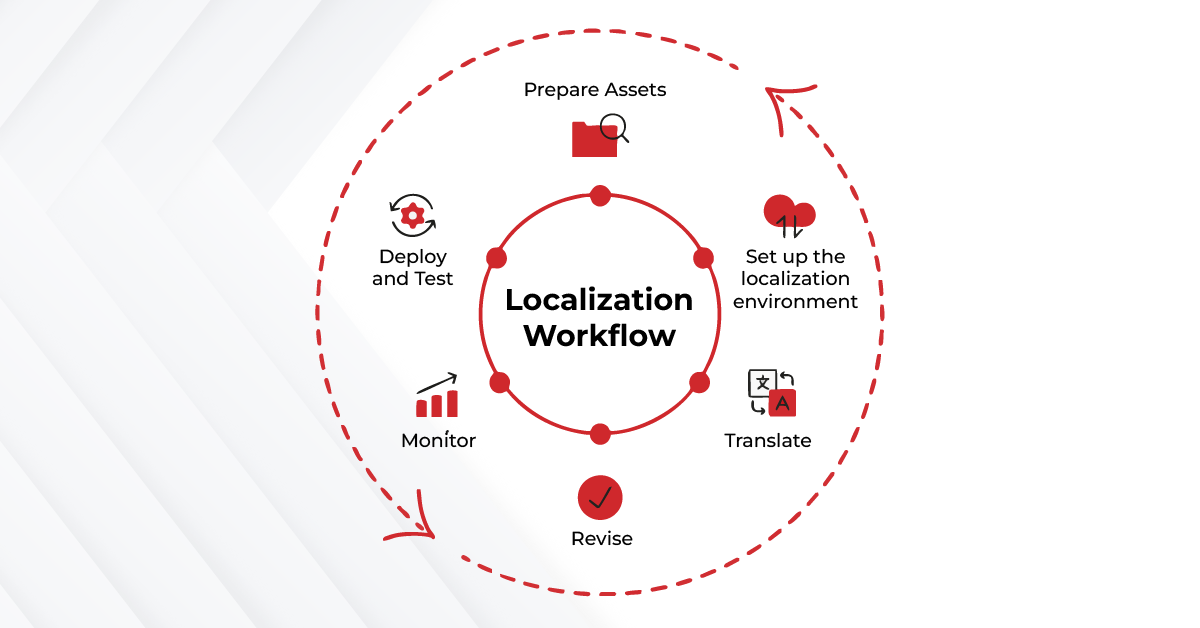
Localization Workflow Best Practices: The 8-Step Flow Teams Can Repeat
Many teams approach localization reactively. A release approaches, content gets exported, files move through translation, and someone checks the result shortly before launch. The process technically works. Yet, each release feels improvised, with new issues emerging every cycle—such as terminology drift, UI text overflow, or delayed feedback from regional teams.
High-performing localization programs operate differently. They rely on repeatable workflows that move content through clearly defined stages—from scoping and preparation to QA, deployment, and post-release monitoring.
That structure matters because multilingual content now plays a direct role in growth.
The eight-step framework below reflects the workflow many mature localization teams use to scale multilingual releases. It works equally well for websites, mobile apps, SaaS products, documentation portals, and marketing campaigns, and it can be dropped directly into a localization process document.
Step 1 — Scope & Target Languages
Teams define what content belongs inside the release and what remains out of scope. Product teams confirm the target locales, including regional variations such as Spanish (Mexico) versus Spanish (Spain) or Portuguese (Brazil) versus Portuguese (Portugal).
Ownership also becomes clear during this stage. Product managers approve the scope. Localization managers define timelines. Engineering prepares the integration path. Without this alignment early in the process, projects often expand mid-cycle, creating delays and confusion.
At this point, teams typically confirm:
- Target languages and regional locales
- Content types included in the release
- Owners for translation, review, and QA
- Deadlines aligned with product releases
Step 2 — Prepare Localization Files and File Formats
Developers extract localizable strings from source code or design files and place them into structured formats such as JSON, XML, YAML, or XLIFF. Proper file preparation ensures that translators work with clean resources rather than raw code.
One major objective during this step involves preventing hard-coded strings. Text embedded directly inside code creates extra work later because engineers must manually locate and replace those strings for each language.
Preparation also includes:
- separating translatable content from code
- protecting placeholders and variables
- defining string IDs and metadata
- organizing resources by feature or component
Step 3 — Context & Briefing
Linguists need to understand where a string appears, how much space it has in the interface, and what tone the product requires. Without that context, even accurate translations can produce awkward or misleading results.
Localization teams, therefore, prepare a briefing package that may include:
- screenshots or design prototypes
- character limits for UI elements
- brand voice guidelines
- target audience descriptions
- examples of existing localized content
Step 4 — Translate + Terminology Control
Professional linguists work within translation environments that include translation memory (TM) and terminology databases (termbases). These tools maintain consistency across releases and help translators reuse previously approved segments.
Terminology control plays a major role in brand clarity. A product term translated three different ways across languages can create confusion for users and support teams alike.
During this step, translators typically follow:
- translation memory suggestions for consistency
- terminology databases for approved terms
- style guides for tone and formatting
- CAT tools that support structured file formats
Step 5 — Review (Bilingual + In-Context)
Once translation is complete, the content moves through review stages.
Bilingual reviewers compare the translated text against the source language to confirm accuracy, tone, and terminology alignment. In many cases, regional stakeholders also review the content to ensure cultural relevance.
In-context review adds another layer. Reviewers examine how translated text behaves inside the interface, checking for truncation, layout shifts, or misaligned formatting.
Step 6 — Quality Assurance in Localization Projects
Localization QA combines linguistic checks with functional testing.
Linguistic Quality Assurance (LQA) evaluates translation quality based on predefined criteria, such as grammar accuracy, terminology adherence, and stylistic consistency.
Functional QA focuses on the product itself. Teams verify that localized text behaves correctly inside the interface.
Typical checks include:
- broken UI strings
- text overflow or truncation
- placeholder or variable errors
- date, currency, and number formatting
- right-to-left layout validation
Step 7 — Build, Deploy, and Release Notes
After QA approval, localized assets return to the product environment.
Developers integrate translated resources into the application build or website deployment pipeline. Localization teams also prepare release notes summarizing language updates, new markets supported, and any changes that may affect regional teams.
Modern development environments increasingly automate this stage through continuous localization pipelines, where updated strings move automatically between repositories and localization platforms.
Step 8 — Monitor, Iterate, and Scale
After release, teams monitor feedback from users, support teams, and regional stakeholders. Analytics may reveal where terminology causes confusion or where localized content drives engagement in specific markets.
This feedback loop helps teams improve future releases.
High-maturity organizations adopt continuous localization, where updates flow through the workflow continuously instead of waiting for large release batches. This approach allows multilingual products to evolve at the same pace as their primary language versions.
Turn your website into a truly global experience.
Our website localization services help your content resonate across markets.
Translation Management System (TMS): How to Run Localization Management in Real Time
Global content rarely moves through a single team anymore. Product managers update features, marketing launches campaigns across regions, developers push interface changes, and linguists work across dozens of languages at once. When all of that coordination happens through spreadsheets, shared folders, and email threads, localization slows down quickly.
This challenge explains why many organizations rely on a translation management system (TMS) to run localization programs at scale.
A translation management system centralizes the entire localization workflow in one environment. Instead of content moving between disconnected tools, a TMS connects files, translators, reviewers, project managers, terminology resources, and quality checks in a single system. Teams gain real-time visibility into project status, while automation handles repetitive tasks such as file preparation, translation memory matching, and QA validation.
In practical terms, a TMS helps localization teams:
- centralize multilingual content and project assets
- assign roles and responsibilities across translators, reviewers, and managers
- apply automated QA checks during translation
- maintain translation memory and terminology databases
- track project progress in real time
Scaling your app internationally?
Explore our app localization services.
Localization Team and Project Managers: Roles, Ownership, and Handoffs
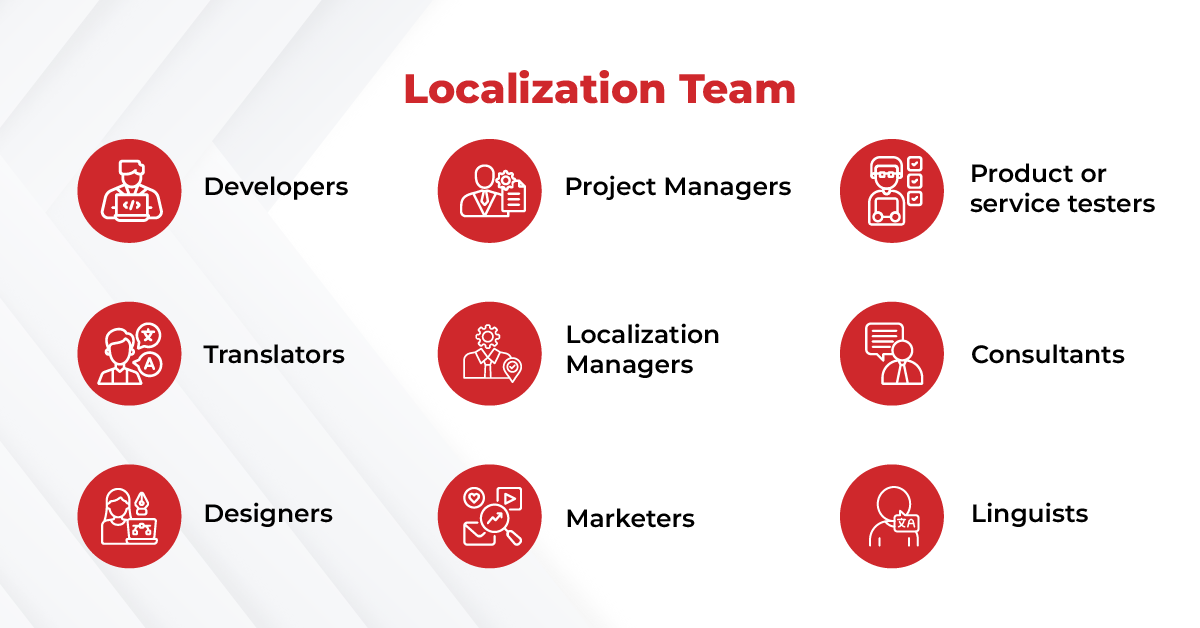
A product team requests translation. A vendor receives the files. Review happens somewhere along the way. Yet when issues surface—terminology inconsistencies, broken UI strings, or last-minute corrections—teams suddenly realize that ownership of each step was never clearly defined.
Clear role definition protects localization quality as much as linguistic expertise. When every stage of the workflow has a responsible owner, handoffs become smoother, accountability becomes visible, and release timelines stay intact.
The Minimum Team Setup
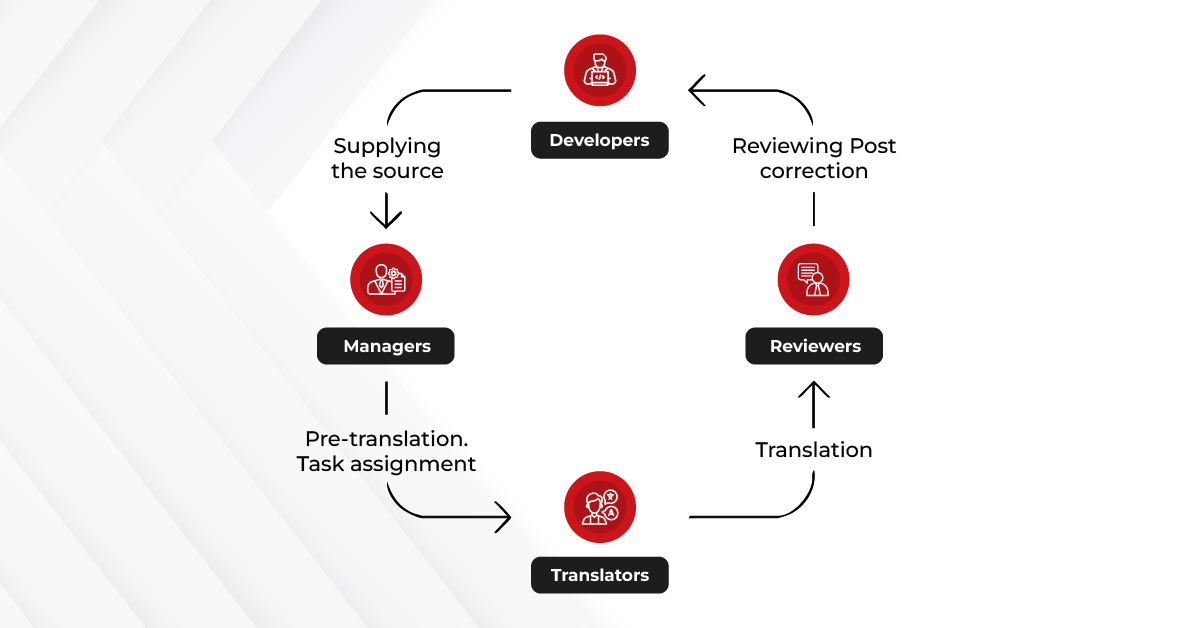
Even small localization programs benefit from a clear set of roles. Each role protects a specific part of the workflow and ensures that content moves forward without confusion.
Below is the minimal structure that most successful localization teams follow.
Requestor / Content Owner
The requestor represents the team that originally created the content. This role often belongs to a product manager, marketing lead, documentation owner, or content strategist.
Their responsibility involves defining the scope of the localization request and providing the information needed for translators to succeed. That includes:
- identifying target markets and languages
- clarifying deadlines and release priorities
- sharing context about the content’s purpose
- approving the final localized output
Localization or Project Manager
The localization manager—or project manager in vendor-led environments—acts as the operational coordinator of the workflow.
This role connects every stakeholder involved in the localization process. The manager ensures that files move between stages on time, terminology remains consistent, and review cycles stay aligned with product releases.
Responsibilities typically include:
- preparing localization workflows and timelines
- coordinating translators, reviewers, and QA specialists
- managing translation memory and terminology databases
- tracking progress across languages and releases
Linguists (Translators)
Experienced translators adapt content to local culture, tone, and context while maintaining brand consistency. They rely on translation memories, terminology databases, and style guides to align their work with previously approved content.
Strong linguists, therefore, act as both language and culture experts.
Reviewers
Reviewers confirm that translated content aligns with terminology standards, cultural expectations, and brand voice.
In-context review—where reviewers see the text within the actual interface or layout—helps catch issues that remain invisible in standalone translation files.
Localization QA Specialists
Quality assurance specialists focus on identifying issues before localized content reaches users.
Their work may involve:
- linguistic quality evaluation (LQA)
- formatting and placeholder validation
- UI text expansion checks
- date, currency, and number formatting validation
- right-to-left layout testing for languages such as Arabic or Hebrew
Engineering and Design Partners
Developers prepare localization files, integrate translations into applications, and ensure that variables and code structures remain intact. Designers provide visual context, character limits, and layout guidance that help translators understand how text appears inside the product.
Localization rarely fails because teams lack effort. Most breakdowns come from workflows that grew organically, new markets added over time, tools layered on top of each other, and processes that made sense years ago but struggle to keep pace with today’s release cycles.
That is where the right localization partner makes a difference.
At AsiaLocalize, we help organizations turn fragmented localization processes into scalable workflows. Our approach focuses on understanding how your content moves today—between product teams, marketing, developers, and regional reviewers—then designing a workflow that removes friction while protecting quality.
There is no one-size-fits-all model for localization. The right workflow depends on the type of content you produce, the number of markets you serve, and how quickly your teams release updates. Our role involves helping you build a system that fits the way your organization actually works.
Every project also runs through these standards and practices:
ISO 17100 · ISO 13485 · Native linguists · APAC expertise · Files shared only with assigned linguists
These foundations ensure that faster workflows never come at the expense of linguistic accuracy or operational reliability.
Remove manual bottlenecks from your localization workflow.
What Teams Ask Us About Localization Workflows
What is a localization workflow?
A localization workflow is the structured operational path that multilingual content follows from source preparation through translation, review, QA, and deployment into a product or platform.
How many steps are in a standard localization workflow?
A standard localization workflow includes 8 core steps: scoping, file preparation, context and briefing, translation with terminology control, bilingual and in-context review, QA, build and deployment, and post-release monitoring.
What is the difference between a localization workflow and a translation process?
A translation process focuses only on linguistic conversion, while a localization workflow covers the full operational path including stakeholder coordination, technology integration, QA, and deployment.
What tools support a localization workflow?
A Translation Management System (TMS) is the primary tool for managing localization workflows, centralizing files, translators, reviewers, terminology, and QA checks in one platform.
Explore our localization engineering services.