
Multilingual communication is the structured exchange of information across different languages, cultures, teams, and markets. For global companies, it goes beyond translation. It includes terminology control, localization, interpretation, accessibility, cultural adaptation, and governance so every message keeps its meaning across documents, platforms, meetings, and customer touchpoints.
Poor communication costs U.S. businesses up to $1.2 trillion a year in lost productivity. That number is often cited in leadership decks as a management issue, misalignment, unclear goals, and inefficient meetings. But in global organizations, the root cause runs deeper. It is fragmented multilingual communication layered onto already complex operations.
When teams span regions, multiple languages, and time zones, clarity becomes infrastructure. A product requirement written in English is interpreted in German, localized in Arabic, reviewed in Japanese, and implemented by engineers in another market entirely. Each handoff introduces risk. Context gets compressed. Tone shifts. Terminology drifts.
The cost is rarely dramatic. It shows up as rework. As duplicate reviews. As “quick fixes” after launch. As UI strings that break design. As legal disclaimers that need rewriting. As customer support teams clarifying what marketing meant. Individually, these feel manageable. Collectively, they compound into stalled cycles and diluted accountability.
In this article, we will break down why global communication fails even inside well-run organizations, and what it truly costs across teams, timelines, and markets. More importantly, we will explore how to prevent those fractures before they ripple across your entire operation.
The Real Meaning of Multilingual Communication
When global organizations talk about multilingual communication, the conversation often collapses into a single word: translation. Files go out. Text comes back. Boxes checked.
That narrow framing explains why so many global initiatives stall.
Multilingual communication is a system that shapes how strategy travels across markets, how product intent survives localization, how compliance language holds up under regulatory scrutiny, and how internal team members collaborate across linguistic diversity without friction.
It includes translation, of course, but also terminology governance, tone calibration, cultural adaptation, regulatory alignment, accessibility considerations, and channel-specific optimization. It accounts for how a message performs inside a mobile interface versus a legal contract. It considers how a brand voice shifts across high-context and low-context cultures. It protects meaning across product releases, marketing campaigns, investor reports, support documentation, and internal policy updates.
It also extends beyond external markets. Global companies operate in multilingual ecosystems internally: cross-border engineering teams, regional sales leadership, and distributed customer success units. When internal communication lacks linguistic structure, teams compensate through repetition, clarification, and informal translation. Productivity quietly erodes.
Multilingual Communication vs. Translation vs. Localization
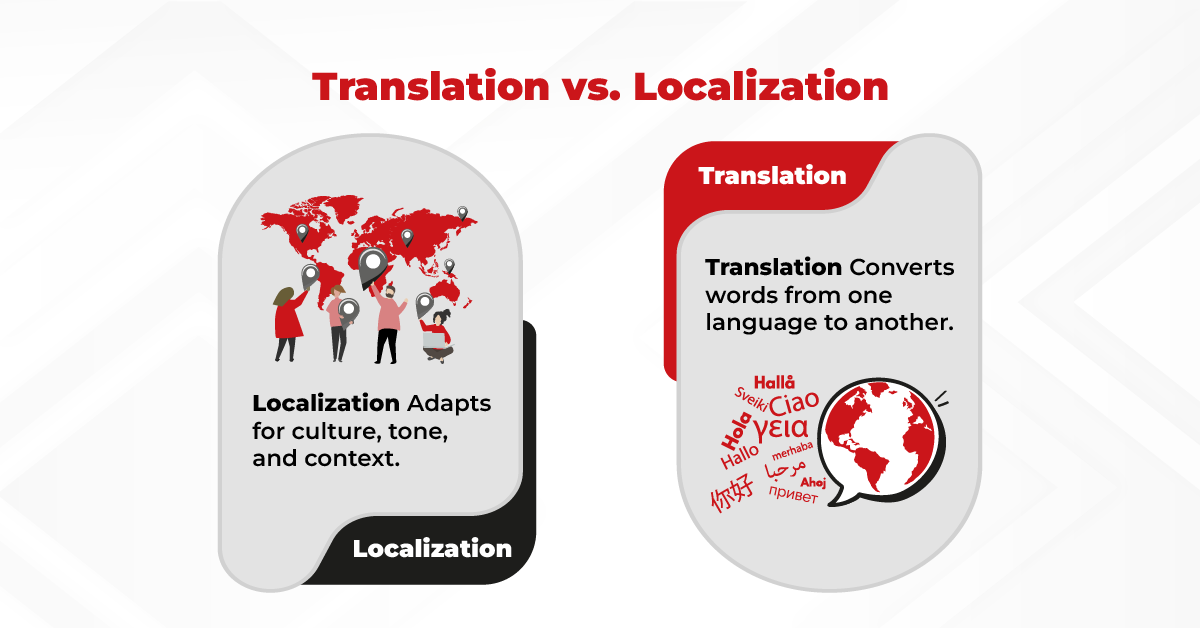
Translation focuses on linguistic accuracy. It converts written content from one language to another while preserving meaning. Contracts, product manuals, compliance documentation, investor reports, these demand precision. Translation protects intent at the sentence level.
Localization moves further. It adapts content for cultural, regulatory, and market relevance. Currency formats, UX layouts, imagery choices, idioms, tone of voice, and even color symbolism fall under its scope. Localization aligns content with how a specific audience reads, buys, and engages. In product environments, this includes engineering considerations such as string length, right-to-left support, plural rules, date formats, and character encoding.
Interpretation handles real-time spoken exchange. Executive briefings, live negotiations, training sessions, and press conferences. Unlike translation, interpretation operates without revision cycles. It requires cognitive agility and domain expertise under pressure.
Multilingual communication sits above all three. As framed in broader communication theory, including the way Wikipedia describes communication across language boundaries, it represents the structured exchange of meaning beyond a single linguistic system. In practical corporate terms, multilingual communication integrates translation, localization, and interpretation into one coordinated strategy.
Build a multilingual infrastructure with structured Professional Translation Services designed for growth.
How to Build a Multilingual Communication Strategy
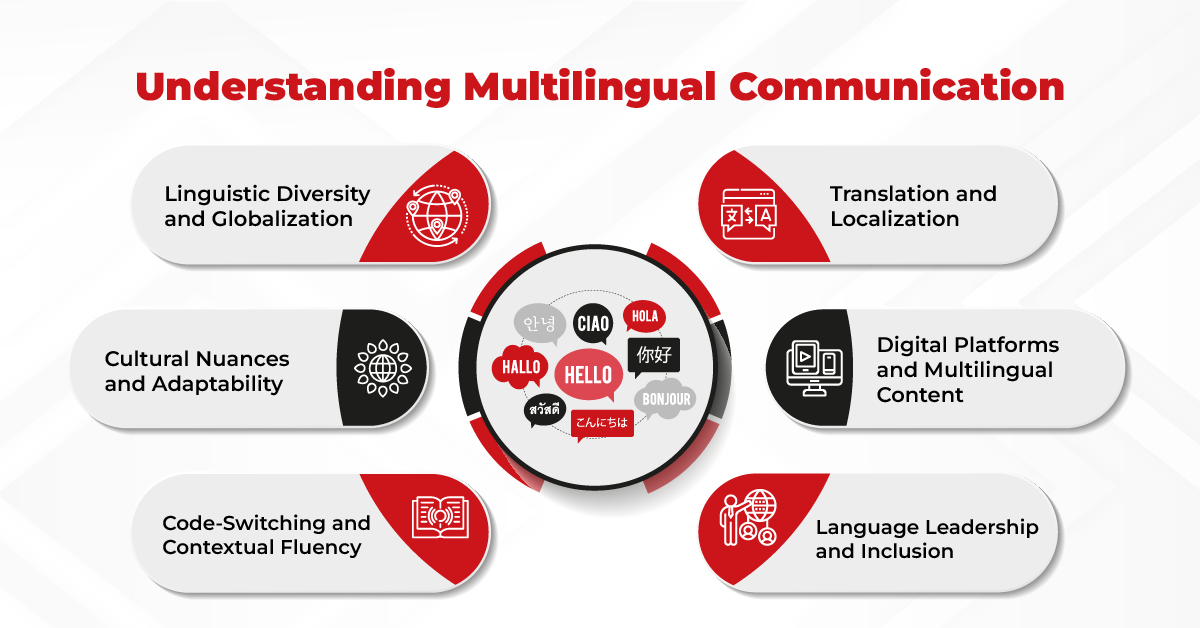
Global communication fails for predictable reasons. Teams expand faster than systems. Content multiplies across platforms. Markets diversify before governance catches up. Language becomes reactive instead of strategic.
Below is a six-part framework that organizations can apply immediately.
1) Audience & Language Mapping
Before a single word gets translated, clarity begins with mapping.
Which markets generate revenue today? Which regions sit in your expansion pipeline? What languages dominate customer support tickets? What languages do employees use internally?
Audience mapping includes:
- Preferred language by region and segment
- Legal or regulatory language requirements
- Internal workforce language distribution
- Priority growth markets
2) Channel Strategy
Language interacts with medium. Slack messages demand different clarity than board reports. Help centers require structured consistency. Live meetings require real-time interpretation support.
An effective channel strategy defines:
- Which content must be multilingual
- Which channels demand localization versus translation
- Where live interpreting or captioning is required
- How internal communications flow across time zones
Email updates, knowledge bases, onboarding portals, product notifications, and executive town halls each require tailored linguistic planning. The cost of treating all channels equally surfaces later, in confusion and duplicated effort.
3) Content System
A content system formalizes:
- Terminology glossaries aligned with brand and compliance
- Translation memory integration for consistency
- Template libraries for recurring communications
- Review loops between subject matter experts and linguists
This layer transforms language work from reactive tasks into repeatable processes. When terminology governance remains centralized, product messaging stays coherent across releases and regions.
4) Live Communication Layer
Written systems handle much of the load. Live environments carry higher stakes.
Executive briefings, investor calls, compliance training sessions, and global product launches, these moments require:
- Professional interpreting
- Live captions for accessibility
- Prepared multilingual materials
- Clear speaker protocols
5) Quality & Governance
This layer defines:
- Who owns terminology approval
- Who signs off on localized assets
- How version control operates
- Escalation paths for linguistic disputes
- Alignment with standards such as ISO 17100 for translation workflows
6) Measurement
Effective KPIs extend beyond word counts and turnaround times. Consider:
- Customer engagement metrics by language
- Conversion rates across localized markets
- Support ticket resolution time in multilingual environments
- Internal survey data on communication clarity
- Rework frequency tied to language misalignment
Overcoming Language Barriers at Work Without Slowing Teams Down
Language barriers at work rarely announce themselves. They surface quietly in longer review cycles, in repeated clarifications, in Slack threads that stretch across time zones without resolution. Productivity dips. Teams compensate with more meetings. Launch timelines slip by days, then weeks.
Below are practical moves that global organizations use to protect clarity while maintaining momentum.
1) Write for Clarity First
Short sentences travel better across languages. Consistent terminology reduces reinterpretation. Structured formatting improves comprehension for both human readers and translation workflows.
Practical adjustments:
- Limit sentence length.
- Use defined terms consistently.
- Avoid culturally specific idioms in core documentation.
- Separate technical requirements from narrative context.
2) Create a Single Source of Truth
When product specs live in one system, marketing copy in another, and support documentation in a third, translation teams spend time reconciling inconsistencies instead of delivering quality output.
A single source of truth means:
- Centralized documentation platforms
- Version-controlled master content
- Shared terminology glossaries
- Structured review ownership
3) Reduce “English-Only Drift” While Preserving Speed
In fast-moving companies, English often becomes the default internal shortcut. Teams draft quickly in one language and postpone adaptation. Over time, English-only documentation expands while localized versions lag behind.
That drift creates internal exclusion and external disconnect.
Reducing English-only drift does not require duplicating effort. It requires process alignment:
- Identify which documents require simultaneous multilingual release.
- Integrate translation into product and marketing timelines early.
- Use standardized templates to reduce adaptation time.
- Assign language owners for high-impact regions.
Multilingual Content for APAC, CJK, Thai, Khmer, and RTL Markets
Multilingual content in APAC and RTL markets changes the rules of design, layout, typography, and user experience. Strategy alone does not carry the launch. Precision in implementation does.
Below is where complexity intensifies.
CJK Constraints: Space, Structure, and UI Behavior
Chinese, Japanese, and Korean (CJK) scripts operate under different spatial and typographic logic than Latin-based languages.
- UI Length Variability: Simplified Chinese may compress meaning into fewer characters, while Japanese strings can expand depending on politeness level or contextual phrasing. Korean frequently alters spacing patterns based on grammatical particles. Interface layouts built around fixed-width assumptions often break under these variations.
- Truncation Risk: Buttons, navigation tabs, and mobile layouts that function in English may truncate CJK strings unexpectedly. Without in-context testing, these errors surface post-launch.
- Font Fallback and Rendering: CJK languages rely on complex glyph libraries. Inadequate font fallback leads to inconsistent character rendering across devices and operating systems. Product teams must confirm Unicode coverage and platform-level font compatibility before deployment.
Thai and Khmer: Line-Break Logic and Layout Sensitivity
Unlike English, Thai does not rely on spaces between words. Line-breaking algorithms must interpret syllable boundaries correctly. Poor segmentation creates awkward or misleading breaks. Khmer presents similar segmentation challenges and requires careful font selection for legibility.
What appears as a small formatting oversight can disrupt readability across entire help centers or onboarding flows.
These languages also influence:
- Auto-layout logic in responsive design
- PDF formatting behavior
- Text expansion inside tables and captions
Arabic RTL and BiDi Complexity
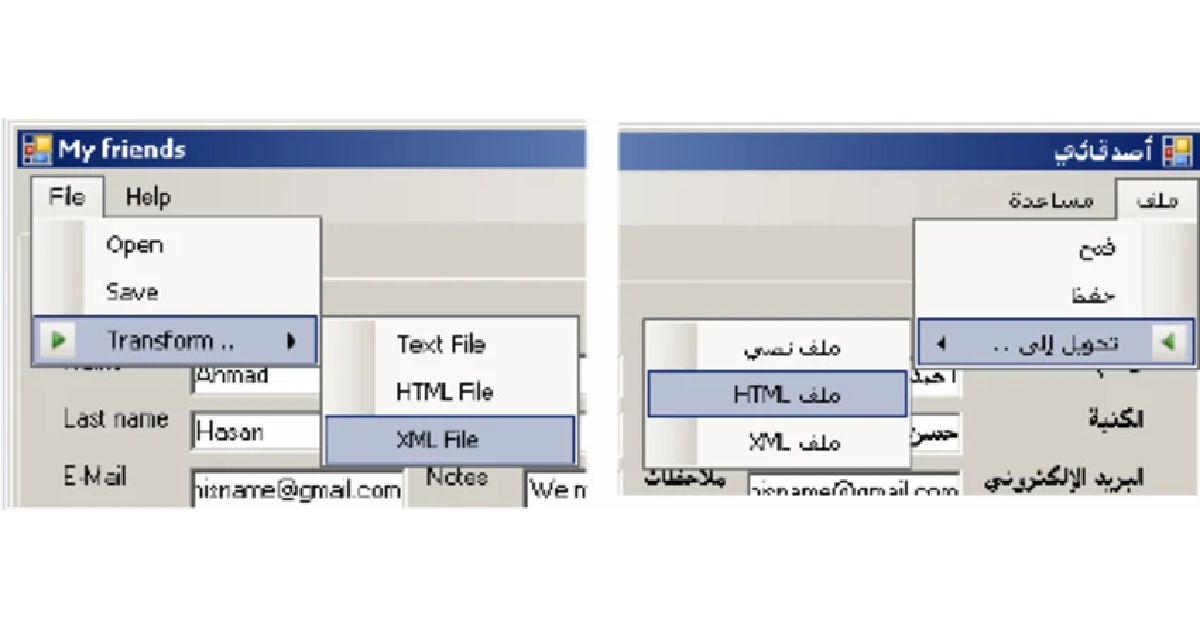
Right-to-left mirroring affects:
- Navigation hierarchy
- Icon directionality
- Progress indicators
- Scroll behavior
- Pagination order
Bidirectional (BiDi) text introduces additional complexity when mixing Arabic with numbers or English product names. Without proper handling, text can reorder incorrectly in UI fields, PDFs, or exported reports.
RTL environments also require mirrored layouts at the CSS and component level.
Arabic typography further demands attention to ligatures, diacritics, and contextual character shaping. Font selection becomes both aesthetic and functional.
Navigate CJK, Thai, and Arabic complexity with expert-driven Localization Services.
Teams expand into new markets, dealing with diverse audiences. Product managers push faster release cycles. Marketing launches regional campaigns. Leadership announces global strategy. Yet without structured multilingual communication, the message splinters somewhere between headquarters and the end user.
At AsiaLocalize, we approach multilingual communication as infrastructure. That means we evaluate your markets, content volume, technical stack, compliance exposure, and your release velocity before recommending a solution.
- Entering regulated sectors? We align workflows with ISO 17100-compliant processes and structured review layers.
- Scaling across APAC? We factor in CJK string behavior, Thai segmentation, and typographic engineering from day one.
- Launching in RTL markets? We account for mirroring, BiDi risk, and DTP implications across digital and print.
- Managing ongoing releases? We implement terminology governance and translation memory systems that reduce rework and protect brand voice over time.
When Global Teams Need Professional Translation and Localization Support
Planning new regions? Review the Languages We Translate to map your next move.