Updated November 1, 2026
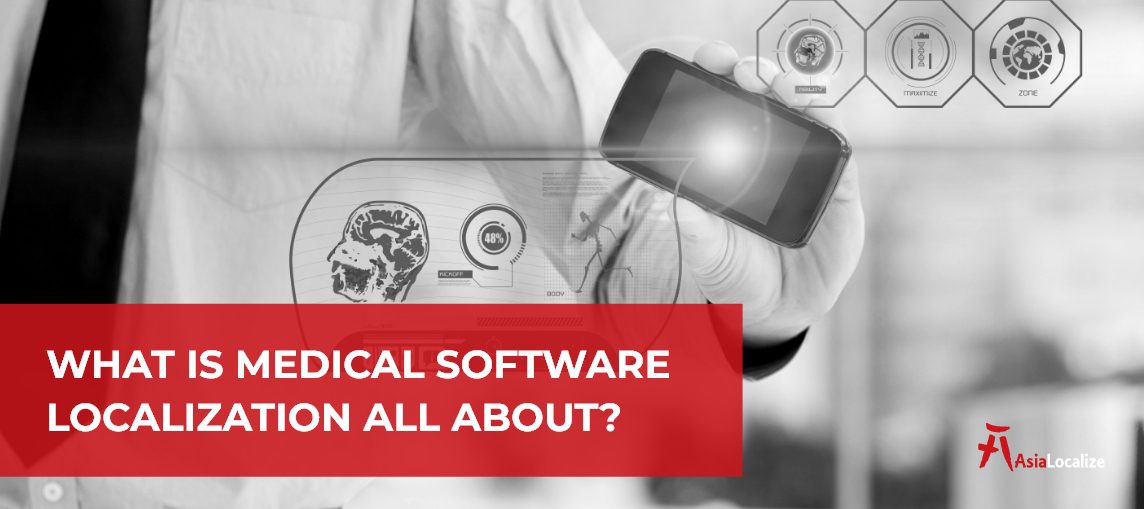
Medical software localization is the risk-controlled process of adapting software used by patients, clinicians, laboratory teams, and medical-device operators for a specific language, market, and use environment. It covers more than translated interface text: terminology, alarms, error messages, units, date and number formats, help content, accessibility labels, images, voice output, instructions for use, and regulated product information must work together in every release.
The practical goal is simple: an intended user should be able to understand the localized interface and use the software safely and effectively without ambiguity introduced by language, layout, or cultural conventions. Achieving that goal requires internationalization, specialist medical translation, in-context testing, human-factors review, and documented release control—not a one-time translation step.

What Is Medical Software Localization?
Medical software localization adapts a digital health product for the language, regulations, clinical practices, and user expectations of a target market. The product may be software as a medical device (SaMD), software embedded in a medical device, an in vitro diagnostic interface, a clinician dashboard, a patient app, a laboratory information module, or another health-related software function.
The exact regulatory classification and evidence requirements depend on the product, intended use, risk, users, and destination market. Localization teams therefore need an approved scope from regulatory, quality, clinical, engineering, and market-access stakeholders before language work begins.
What content is included?
- Navigation, menus, buttons, field labels, setup flows, and dashboards
- Warnings, contraindications, alarms, error messages, and recovery instructions
- Patient and clinician instructions, onboarding, training, and contextual help
- Units, dates, times, decimals, currencies, calendars, and measurement conventions
- Accessibility text, screen-reader labels, captions, audio, and voice interactions
- Images, symbols, screenshots, reports, PDFs, emails, and notifications generated by the product
- App-store content, release notes, privacy notices, and support material when they form part of the localized experience

Translation, Localization, and Internationalization: What Is the Difference?
| Discipline | What it does | Medical software example |
|---|---|---|
| Translation | Transfers meaning from one language to another. | Translating an alarm, help article, or clinician instruction accurately. |
| Localization | Adapts language and the complete user experience to a market. | Changing terminology, units, formats, layouts, screenshots, and regulatory text for Japan or Germany. |
| Internationalization | Engineers the product so it can support multiple locales without redesign. | Externalizing strings, supporting Unicode and right-to-left layouts, and separating units from values. |
Internationalization should happen before or alongside localization. If interface strings are embedded in code, containers have fixed widths, or the software assumes one date format, translators cannot solve the resulting defects. Early engineering work reduces rework and makes future language releases faster.
Why Medical Software Localization Matters
Patient safety and usability
In medical software, a mistranslated instruction, truncated dosage value, reversed date, or unclear alarm can become a use-related risk. The FDA’s August 2026 human-factors guidance treats the user interface broadly, including displays, controls, packaging, labels, and instructions. It recommends designing and evaluating interfaces so intended users can use devices safely and effectively in their real use environments.
Localization should therefore be connected to the product’s risk analysis and usability engineering process. High-risk strings—such as alarms, contraindications, critical values, and action instructions—need stricter review, testing, and traceability than low-risk marketing copy.
Market access and regulatory language requirements
Language requirements vary by jurisdiction and sometimes by product type, user group, and channel. In the European Union, manufacturers must examine the Medical Device Regulation (MDR), In Vitro Diagnostic Medical Device Regulation (IVDR), and the national requirements of each destination country. The European Commission’s overview of language requirements includes country-specific tables for labels, instructions for use, graphical user interfaces, and apps. It should be checked for the current revision during market planning.


In the United States, the applicable pathway depends on whether the function is regulated as a medical device and its level of risk. FDA resources on device software functions, premarket software documentation, labeling, human factors, and cybersecurity can all affect the product plan. Regulatory teams should confirm the applicable requirements; this guide is not legal or regulatory advice.
A consistent global product
Users may move between the interface, an instruction for use, a printed label, training material, and customer support during one task. If each channel uses different terminology, the user must interpret whether two terms describe the same feature or action. A controlled terminology base and coordinated release process keep these touchpoints aligned and help overcome language barriers in healthcare.
The Biggest Medical Software Localization Risks
- Terminology ambiguity: a familiar consumer word may be unsafe or inaccurate in a clinical context. Approved product, clinical, and regulatory terminology must be applied consistently.
- Text expansion and truncation: translated text can be substantially longer than English. Buttons, tables, alarms, wearable screens, and mobile layouts need room to expand.
- Variables and placeholders: numbers, patient names, device states, and dynamic values can appear in different grammatical positions. Translators need context and protected placeholders.
- Locale-sensitive data: decimal separators, thousands separators, dates, time zones, units, and paper sizes must be unambiguous and correctly transformed—or intentionally left unchanged.
- Bidirectional and complex scripts: Arabic and Hebrew interfaces require right-to-left behavior, mirrored layouts where appropriate, and testing of mixed text, numbers, and Latin product names.
- Version drift: UI strings, help, labeling, and instructions can fall out of sync when software releases move faster than controlled documentation.
- Accessibility defects: translated screen-reader labels, focus order, captions, contrast, and voice instructions must remain understandable and operable.
- Privacy and security: screenshots, logs, and translation files may contain personal or protected health information. Data access, retention, hosting, and vendor controls require review.

A Risk-Based Medical Software Localization Workflow
1. Define markets, users, and regulated scope
Document the product classification, intended purpose, target countries, required languages, intended users, use environments, accessibility needs, and release platforms. Separate regulated content from optional content, then assign risk levels and reviewers.
2. Make the software localization-ready
Externalize every user-facing string, use Unicode, support plural rules and grammatical gender, avoid concatenated sentences, and keep units separate from numerical values. Add layout flexibility and support for right-to-left scripts. Pseudolocalization can expose hard-coded strings, clipped text, unsupported characters, and expansion problems before translation begins.
3. Prepare context and terminology
Create an approved glossary, style guide, do-not-translate list, product screenshots, string descriptions, character limits, and rules for abbreviations, units, and capitalization. Identify high-risk messages and link them to their source requirements and risk controls.
4. Translate with qualified specialists
Use linguists with relevant medical, device, software, and target-market expertise. Translation memory improves consistency, while a terminology base constrains critical terms. A second qualified reviewer should check accuracy and clinical meaning for content where errors could affect safety or performance.
5. Integrate localization into development
Connect the repository, translation management system, build pipeline, and issue tracker so changed strings are detected early. Continuous localization can shorten the lag between source and localized releases, but automated movement of content must not bypass quality or regulatory approvals.
6. Test in the real interface
Reviewers need the localized build, not isolated strings alone. Microsoft’s localization-testing guidance distinguishes linguistic, visual, and functional validation and recommends checking locale formats, consistency, and content in context. For medical software, the test plan should also be tied to risk controls and representative clinical tasks.
7. Validate with representative users when required
A linguistically correct interface can still confuse its intended users. Human-factors and usability activities should consider users’ language proficiency, clinical knowledge, physical abilities, environment, and time pressure. Critical tasks and foreseeable use errors deserve particular attention.
8. Approve, release, and retain evidence
Use controlled approvals and record who translated, reviewed, tested, and approved each language version. Retain source and target versions, terminology, issues, test evidence, software build identifiers, and release dates. Change control should trigger an impact assessment whenever the source interface, intended use, risk controls, or regulations change.
What Should Medical Software Localization Testing Cover?
| Test layer | Key checks | Typical evidence |
|---|---|---|
| Linguistic | Accuracy, terminology, grammar, tone, completeness, readability, and consistency. | In-context review record and resolved linguistic issues. |
| Visual | Truncation, overlap, line breaks, fonts, icons, bidirectional layout, and responsive screens. | Annotated screenshots and defect log. |
| Functional | Locale switching, input, search, sorting, exports, notifications, links, and fallback behavior. | Test cases mapped to build and locale. |
| Locale | Dates, times, decimals, units, calendars, names, addresses, and time zones. | Locale-specific expected-versus-actual results. |
| Safety and usability | Critical tasks, alarms, warnings, error recovery, comprehension, and foreseeable misuse. | Risk-linked human-factors or usability findings. |
| Accessibility | Keyboard use, focus order, screen readers, labels, captions, zoom, and voice output. | Accessibility test results for each supported locale. |
| Regression | Previously approved content and workflows after code or content changes. | Automated and manual regression results. |

Can AI or Machine Translation Be Used?
AI and machine translation can support terminology extraction, first-pass translation, quality checks, and low-risk content workflows. They should not be treated as autonomous approval authorities. The acceptable approach depends on content risk, language pair, data sensitivity, regulatory obligations, and the strength of human review.
A defensible governance model defines which content may use AI, where data is processed, whether prompts or files are retained, how output is validated, and who gives final approval. Critical instructions, alarms, contraindications, and safety-related interface text normally require qualified human review and documented verification. Organizations should also prevent confidential or patient data from entering unapproved systems.
How to Choose a Medical Software Localization Partner
- Relevant expertise: experience with your device type, software stack, languages, and destination markets.
- Quality system: documented processes, reviewer qualification, corrective actions, and change control. AsiaLocalize supports life sciences translation with ISO 17100-certified workflows and medical-device quality processes.
- Engineering capacity: support for resource files, APIs, repositories, builds, pseudolocalization, and right-to-left testing.
- In-context testing: linguistic QA on real devices, browsers, screen sizes, and operating systems.
- Security controls: access management, encryption, retention rules, incident handling, and approved hosting locations.
- Traceability: clear links between source changes, target strings, reviewers, defects, approvals, and software builds.
- Scalable delivery: terminology and translation assets that can support future languages and continuous releases.
Medical Software Localization Cost and Timeline Drivers
Cost is not determined by word count alone. Major drivers include the number of languages and platforms, software readiness, content risk, terminology maturity, review requirements, test-device access, number of builds, integrations, screenshots, audio or video, and frequency of source changes. A short but safety-critical interface may require more effort than a long low-risk help center.
The most reliable estimate follows a technical and linguistic assessment. A pilot locale can reveal string-quality, layout, workflow, and testing risks before a full rollout. Freezing high-risk source content early and using incremental releases also reduces avoidable rework.
Medical Software Localization FAQs
Is medical software localization legally required?
It may be required depending on the product, jurisdiction, intended users, and how the software and accompanying information are supplied. Requirements can differ for the interface, labels, instructions, apps, and professional versus patient users. Confirm the current rules with qualified regulatory and legal teams for every target market.
When should localization begin?
Internationalization and terminology planning should begin during product design. Translation can run incrementally as strings stabilize, while formal in-context testing must use representative localized builds. Waiting until the end often exposes architectural problems when they are most expensive to fix.
Does a translated user interface replace localized instructions for use?
Not automatically. The UI, instructions, labeling, training, and other product information can have separate requirements and must remain consistent. The approved content set should be defined by the manufacturer’s regulatory and quality teams.
What is linguistic validation for medical software?
Linguistic validation evaluates whether target users understand the localized content as intended. Its depth depends on risk and use. It can include specialist review, cognitive debriefing, comprehension testing, or usability work with representative users; translation review alone does not prove usability.
How are software updates kept synchronized across languages?
A continuous-localization workflow detects changed strings, reuses approved translations, routes new content to reviewers, tests it in the build, and ties language approvals to release control. Each update still needs risk-based impact assessment and regression testing.
Build a Safer Global Medical Software Experience
Successful medical software localization connects language quality with engineering, human factors, regulatory strategy, and lifecycle control. AsiaLocalize combines medical translation expertise, qualified linguists, terminology management, software localization engineering, and in-context QA to help organizations launch consistent user experiences across Asia and global markets.
Share your target markets, software platforms, intended users, content scope, and release plan with our team. We can assess localization readiness, identify risks, and design a workflow that fits your product lifecycle.