
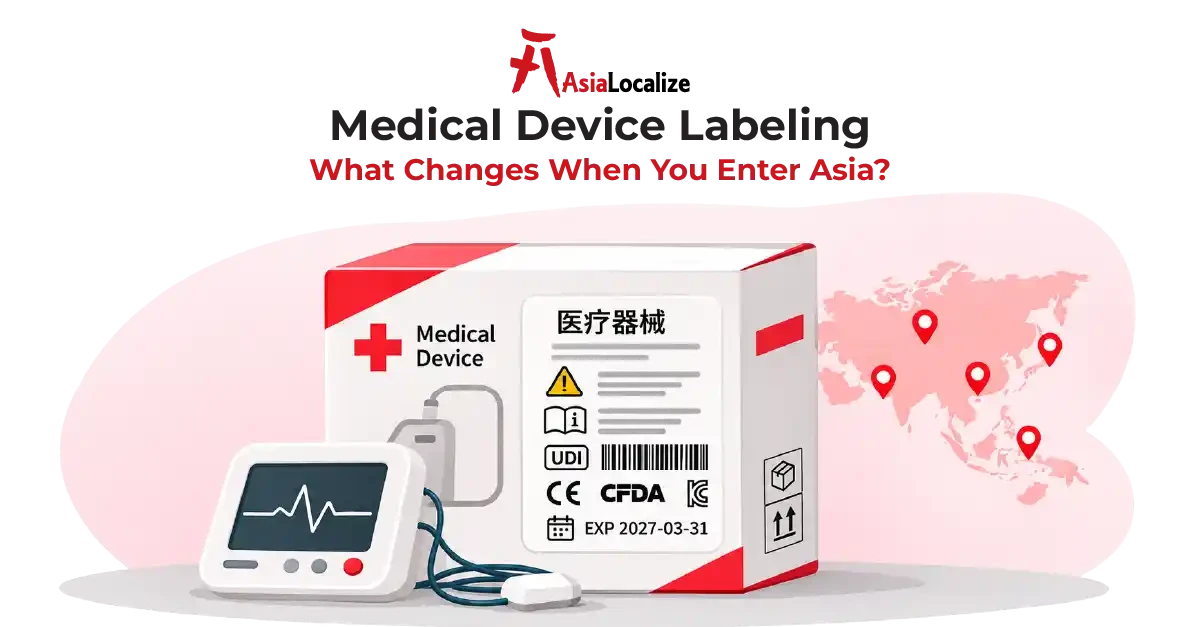
A device cleared for the US market can still need new labeling before an Asian launch. China, for example, requires Chinese instructions and labels, with the Chinese version taking precedence. These details matter in every market: a 2025 FDA-listed recall covered 914 US devices after an instruction sheet listed an incubation time of 20 minutes instead of 60.
For Medical Device Labeling, translation belongs in the same controlled process as the source content.
This guide explains what counts as labeling, FDA and EU MDR requirements, ISO 15223-1 symbols, and language and local content rules across Asian markets. We’ll also show how to manage translation and version control, review warnings and final layouts, and spot the errors that cause avoidable rework.
What Counts as Medical Device Labeling?
A translation quote based only on carton copy can overlook the material that explains how to use the device safely.
Under FD&C Act Section 201(m), labeling covers information on a device or its packaging and material accompanying it. IMDRF N52, Edition 2 (2024), similarly includes labels, IFUs, and patient information in printed or electronic formats.
The inventory for medical labeling should therefore include, where applicable:
- Physical device labels and immediate/outer packaging.
- Printed instructions for use (IFUs) and electronic IFUs (eIFUs), where permitted.
- On-screen operating instructions, alarms, warnings, and error messages.
- Patient leaflets, implant cards, and other patient information provided.
For an infusion pump, that means collecting the screen’s alarm messages alongside the manual and carton text. Review them together so the terminology and instructions agree. Screen text also needs review in the interface, where character limits and line breaks can affect readability.
The IFU remains labeling when supplied as a separate document. Electronic delivery also leaves its applicable content and language requirements in place.
FDA Medical Device Labeling: Part 801, UDI and QMSR
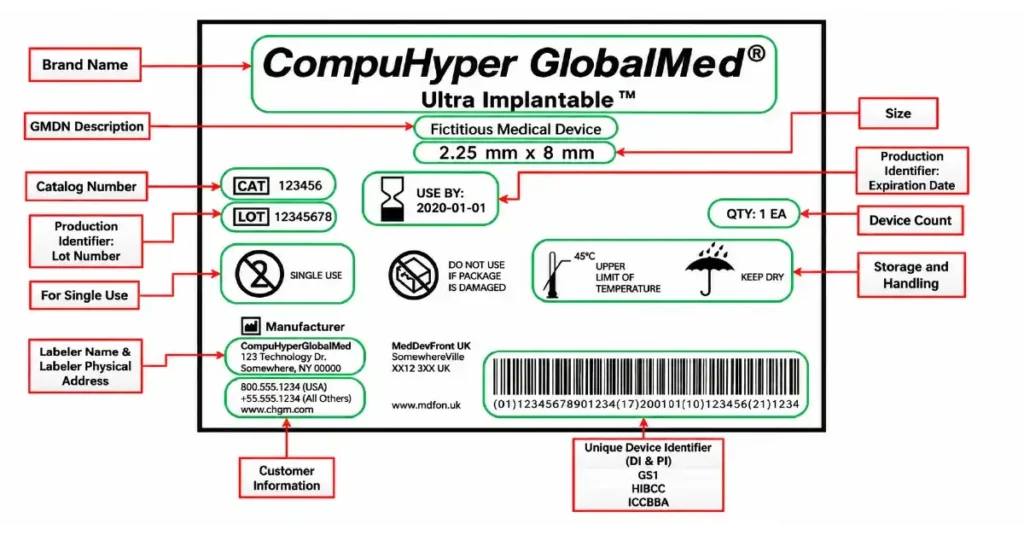
FDA labeling requirements for medical devices cover both the information supplied and the controls used to release it. The core 21 CFR Part 801 labeling provisions address:
- Business details (801.1): Identify the manufacturer, packer, or distributor and their place of business.
- Directions (801.5): Provide adequate directions for safe intended use; prescription devices may qualify for the exemption under 801.109.
- Presentation (801.15): Keep mandatory information prominent and legible.
- UDI (Subpart B): Unless exempt, labels and device packages need a unique device identifier in readable text and machine-readable form. Include both in your UDI label review.
English is generally required, with a predominant-language exception for products distributed solely in Puerto Rico or qualifying US territories. Section 801.15(c)(2) specifies, in part: “all words, statements, and other information required … shall appear thereon in the foreign language.” Adding Chinese text to a US-marketed label therefore triggers Chinese versions of every mandatory label statement. Plan space for the complete translation before artwork approval.
Our analysis of openFDA data identified explicitly labeling-related root causes in 51 of 945 recall events initiated in 2025 (5.4%), using data updated October 29, 2026 and counting each event once.
Since February 2, 2026, Part 820’s QMSR has incorporated ISO 13485:2016. Section 820.45 requires documented labeling procedures, accuracy checks, recorded release, and measures preventing mix-ups. Translations and revised artwork should follow those controls.
Read FDA medical device labeling guidance alongside these regulations. For Asian launches, use the US label as a controlled source master. Preserve approved safety meanings and terminology, then review each destination’s language, local representative details, and identifier rules. Record and approve those adaptations before releasing the translated artwork for production.
EU MDR Labeling Requirements: Why the Country Matters
A device sold in Austria and Denmark may need different language versions, even when its design and intended use stay the same.
What must the label include?
The Medical Device Regulation (EU) 2017/745 sets label and instructions for use (IFU) requirements in Annex I, Chapter III, Section 23. An MDR label identifies the device and manufacturer and includes applicable warnings and tracking details, such as batch or serial numbers. The CE mark indicates conformity with EU requirements. For manufacturers outside the EU, the EC REP label provides the authorised representative’s name and address and appointed regulatory contact based in the EU.
An IVD label, for products that test samples outside the body, follows the separate In Vitro Diagnostic Medical Devices Regulation (EU) 2017/746, Annex I, Section 20.
Which language is required?
Under Article 10(11), each member state determines the official EU language(s) required where the device reaches the user. EU medical device labeling language requirements also depend on the intended user.
| Country | Professional use only | Use by the public |
|---|---|---|
| Austria | German or English | German. |
| Denmark | Generally Danish | Danish. |
Check the European Commission’s country tables and national regulator before commissioning translations.
Can instructions be digital?
Electronic instructions, or eIFUs, may replace paper for professional-use devices under Regulation 2021/2226, expanded in 2025. This requires safeguards, including a risk assessment and paper copies on request. If use by the public is foreseeable, paper instructions for those users generally remain necessary.
Plan language and format requirements together before finalising artwork.
ISO 15223-1 Symbols: Less Text, Clearer Labels
On a small device label, repeating “Don’t reuse” in several languages quickly uses valuable space. Standard symbols can replace that repeated wording, leaving more room for readable safety information and fewer phrases to translate.
ISO 15223-1:2021 sets out internationally standardised symbols for information supplied with medical devices. Common examples cover:
- Identification: manufacturer, authorised representative (EC REP) and MD (medical device).
- Tracking: LOT (batch number), use-by date and UDI (unique device identifier).
- Safe use: don’t reuse and consult instructions for use (IFU).
Actual dates, numbers, and company details still accompany the relevant symbol. The 2025 amendment updates the earlier EC REP design.
When a glossary is required
Under 21 CFR 801.15, FDA permits symbols from recognised standards without English text beside them, provided they meet its conditions for use. Include a symbols glossary explaining each symbol, its name, meaning, and standard/reference details. A prominent notice on or inside the package must show where to find it.
Where translation still matters
Medical device labelling standards work alongside national language rules. China, for example, requires Chinese label and instruction text, with symbols meeting applicable national standards. Budget for remaining warnings, instructions, and any glossary explanations required in the destination language.
Under ISO 13485:2016 labeling requirements, symbols, translated glossaries, and artwork belong within the same approval and change controls. Review them together and record changes before release.
Medical Device Labeling in Asia: What Each Market Expects
An English label may work for a hospital device in one Asian market, while a home-use version needs another language before it can be sold. Medical device labeling regulations depend on the destination, device, and intended user.
Use the table below to compare medical device labelling requirements for labels and instructions for use (IFUs).
| Market | Regulator | Label language expectation | Note |
|---|---|---|---|
| China | National Medical Products Administration (NMPA) | Chinese (Simplified). | Under Order No. 6, content must match registration or filing information; Chinese takes precedence. |
| Japan | Health Ministry (MHLW) / PMDA | Japanese. | Electronic package inserts introduced in August 2021 cover many professional-use products; paper requirements generally remain for consumer products. |
| South Korea | Ministry of Food and Drug Safety (MFDS) | Korean, with limited exceptions. | Imported devices require the importer’s name and address, plus the overseas manufacturer and country. |
| Malaysia | Medical Device Authority (MDA) | Bahasa Malaysia for home-use devices; English for others. | Additional languages may be included; check the intended audience. |
| Thailand | Thai FDA | Thai for home use; Thai or English for professional use. | Current notification effective June 20, 2026; check device-specific provisions. |
| Vietnam | Ministry of Health | Vietnamese labels and IFUs. | Compliant supplementary labels may accompany imports; retain the original label. |
| Indonesia | Ministry of Health | Bahasa Indonesia for key safety and use information. | Registration documents include label artwork and Indonesian instructions. |
Labeling regulatory requirements for medical devices cover more than language. Your country checklist should also capture local contact details, registration numbers, and whether users receive paper or electronic instructions. Confirm the product’s classification and any exemptions before commissioning translations.
A distributor can coordinate local translation, but the manufacturer should retain approval of the content. Supply an approved source, have a qualified medical translator prepare the local version, and review the final artwork. Record every change so packaging, instructions, and registration documents remain consistent. Even adding an importer’s address should trigger a recorded artwork revision with a clear approval trail.
Supporting documents may have separate certification rules. If an application asks for proof of translation accuracy, check whether a Certificate of Translation Accuracy meets the required format and whether each file needs its own statement.
A Label Translation Workflow That Keeps Every Language Aligned
Medical device translation services should sit inside your existing label approval process, with each language version linked to its approved source and release record.
- Approve the source. Before medical device documentation translation begins, freeze the wording, assign a revision number, and identify every affected file.
- Agree on terminology. Use terminology management to build an approved glossary covering terms such as “single use,” “sterile,” and device components in each language.
- Translate and revise. Choose linguists with medical-device expertise. A second qualified linguist checks the translation against the source, following ISO 17100, the standard for translation services.
- Review local requirements. Have an in-country regulatory reviewer check claims, warnings, and mandatory local information against the destination’s requirements.
- Back-translate selected statements. Have a separate linguist translate high-risk warnings, contraindications (when the device must not be used), and dosage or use instructions back into the source language. Compare meanings and resolve differences. Use this additional check selectively, according to patient risk.
- Check the finished artwork. For medical device packaging translation, inspect Chinese, Japanese, Korean, and Thai font rendering, text overflowing fixed label areas, and date and unit formats. Have a linguist check the final production file.
- Inspect and record release. Complete labeling inspection, record approval, and retain the source, translations, artwork, and review records within ISO 13485/QMSR document and change controls.
Labeling Errors to Catch Before Release
A warning can be translated correctly and still disappear off the edge of a printed label.
Our analysis of openFDA data found 51 labeling-related recall events initiated in 2025 (data updated October 31, 2026). FDA’s FY2025 device dataset recorded 54 citations on system-generated Form 483s for labels lacking required UDIs. These figures cover labeling broadly; Form 483 records inspection observations.
Audit medical equipment labels for:
- Mixed revisions: local-language warnings left on an old version.
- Glossary gaps: required symbol explanations left untranslated.
- Ambiguous dates: 05/06 can mean May 6 or June 5. FDA generally requires YYYY-MM-DD under 21 CFR 801.18.
- Artwork defects: missing Chinese, Japanese, or Korean characters, misplaced Thai vowel or tone marks, or text overflow.
- Unit errors: misplaced decimal points or inaccurate conversions.
- UDI faults: absent identifiers, unreadable codes, or mismatched printed and encoded identifiers.
- Registration mismatches: translated claims, contacts, or warnings differ from submitted information.
Review a printed sample at actual size against the approved translation, and verify both UDI forms against applicable UDI labeling requirements. Assess each export version against its local rules, even when the US label has a clean inspection history.
Medical Device Labeling: Six Checks Before You Submit
- Inventory the content: Include labels, packaging, printed and electronic instructions, patient materials, and software text.
- Confirm market rules: Check medical device labelling requirements by country and intended user, including each EU member state’s language rules.
- Verify required details: Check local contacts, registration numbers, UDIs, symbols and glossary translations.
- Check translations: Match approved source revisions and terminology; back-translate high-risk statements.
- Inspect artwork: Check characters, overflow, readability, dates, units, and scannable codes.
- Complete the records: Document reviews, approvals, and labeling inspections; archive the final files.
Prepare Your Labels for the Next Market
Medical device labeling leaves plenty to coordinate: local languages, consistent warnings, readable artwork, and controlled revisions. With a decade of translation and localization experience, AsiaLocalize helps you manage that work through medical device translation services covering labels, instructions, and supporting documents. Our linguists bring medical expertise, supported by approved terminology and checks on the final layout.