Marketing transcreation adapts a campaign’s intent, emotion, brand voice, and cultural cues so the message feels created for each target market—not merely translated into its language. It is the difference between being understood and being persuasive.
For global brands, literal translation can preserve meaning while losing the idea that made the original campaign memorable. A joke may fall flat, a slogan may sound unnatural, or a visual reference may carry the wrong association. Marketing transcreation solves that gap by rebuilding the message around the response it needs to create.
The commercial case for language-aware experiences is clear. In a 2020 survey of 8,709 consumers in 29 countries, CSA Research found that 76% preferred product information in their own language and 40% would not buy from websites in other languages. Language is the entry point; cultural relevance is what turns access into connection.
What Is Marketing Transcreation?
Marketing transcreation is the creative adaptation of campaign content for another language and culture while protecting the core message, brand identity, and intended audience response. The term combines “translation” and “creation.”
According to Microsoft’s globalization guidance, transcreation makes extensive changes when needed to preserve intent and cultural resonance. That may include rewriting copy, replacing idioms, changing imagery, adapting humor, or proposing a different call to action. It is especially useful for slogans, headlines, advertisements, videos, brochures, and campaign concepts.
A skilled transcreation team does not ask only, “What do these words mean?” It asks, “What should this audience understand, feel, remember, and do?” The answer guides every creative choice.
Marketing Transcreation vs. Translation
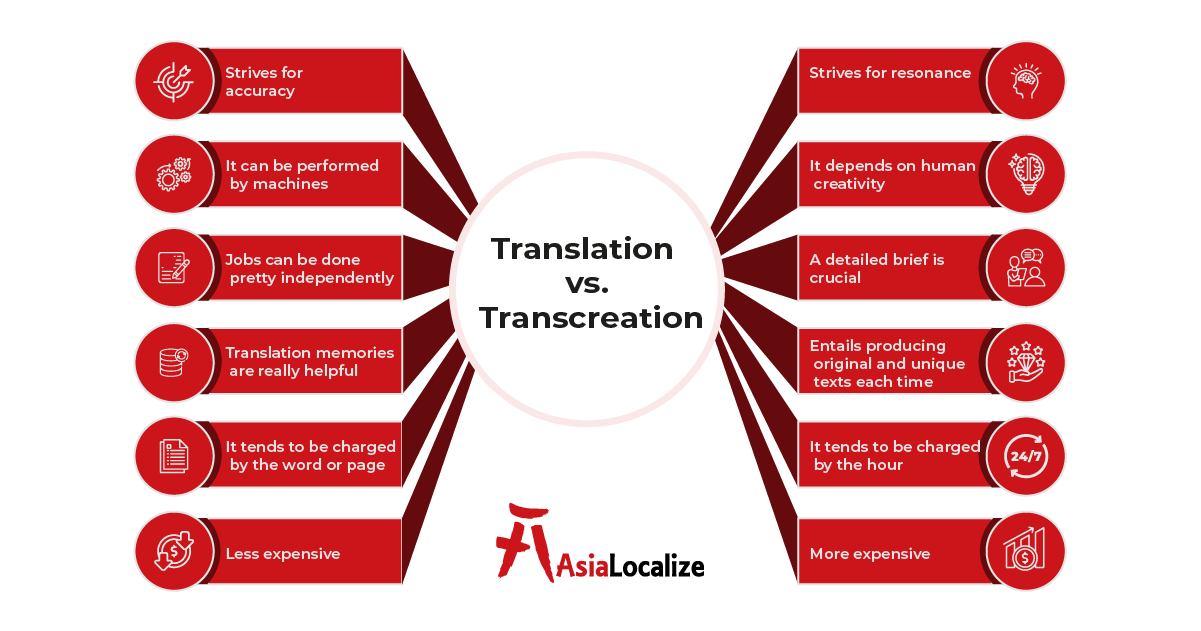
Translation and transcreation are complementary services, but they solve different problems. Translation prioritizes accurate transfer of meaning. Marketing transcreation prioritizes an equivalent effect in the target market while remaining faithful to the campaign strategy.
| Decision area | Translation | Marketing transcreation |
|---|---|---|
| Primary goal | Preserve meaning accurately | Recreate intent and audience response |
| Creative freedom | Limited | High, within brand guardrails |
| Best for | Informational and regulated content | Campaigns, slogans, ads, video, and social media |
| Typical input | Source text and terminology | Creative brief, audience insight, brand voice, and source assets |
| Review standard | Accuracy, terminology, and readability | Accuracy, cultural fit, emotional impact, and performance |
For example, product specifications usually need translation. A launch slogan, paid-social concept, or emotionally charged video script may need transcreation. Many international programs use both: accurate translation for functional content and creative adaptation for high-impact moments.
Why Marketing Transcreation Creates Global Impact
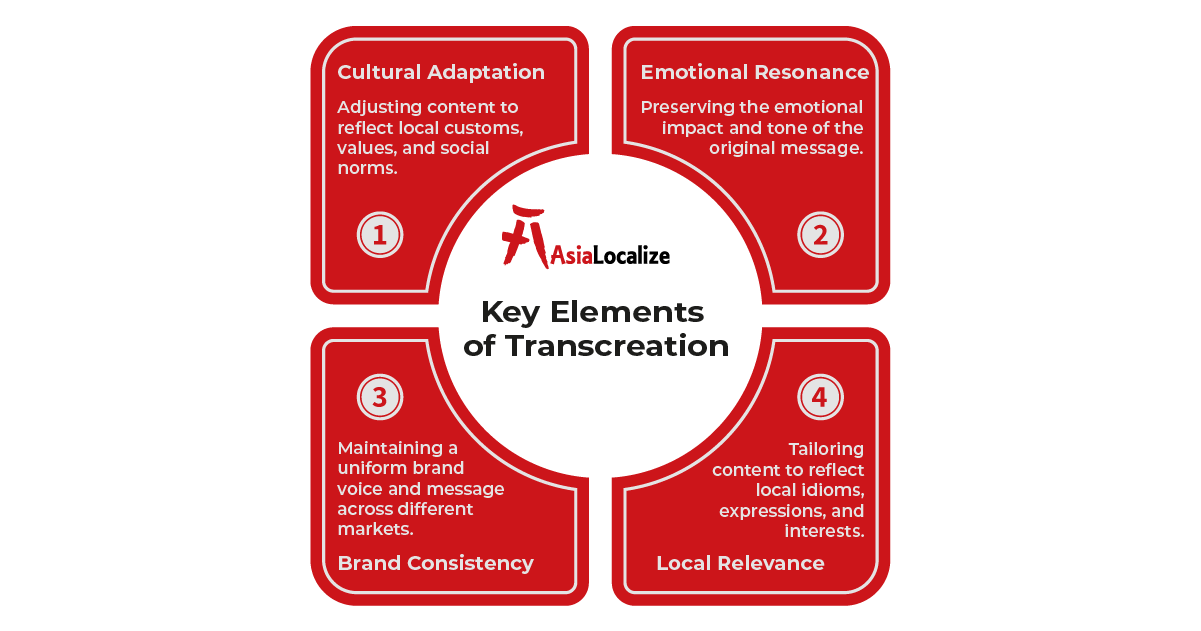
Global reach is a distribution result. Real impact is an audience result. Marketing transcreation helps close the distance between them in four ways:
- Cultural relevance: Local references, taboos, humor, symbolism, and expectations shape how a message is received.
- Emotional equivalence: The wording may change, but the intended feeling—trust, urgency, aspiration, or belonging—remains.
- Brand consistency: Voice and positioning stay recognizable even when the expression changes.
- Local clarity: Calls to action and value propositions sound natural instead of imported.
This is particularly important for advertising translation, where every word competes for attention, and for localized marketing, where campaigns must work across channels and customer journeys.
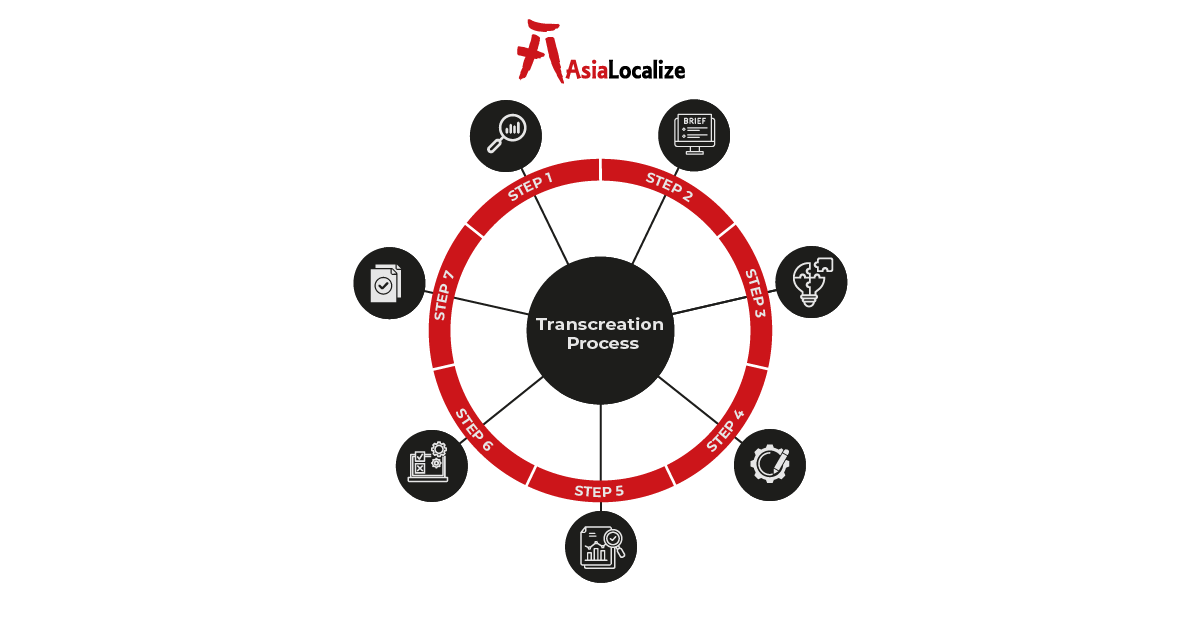
The 6-Step Marketing Transcreation Process
A professional marketing transcreation process is structured, collaborative, and testable. These six steps keep creative freedom aligned with business goals.
1. Research the target market
Review audience needs, cultural context, competitors, channel behavior, local regulations, and language preferences. Research should identify both opportunities and risks before copy is written.
2. Build a precise creative brief
Define the campaign objective, audience, core message, brand voice, mandatory elements, prohibited claims, call to action, channels, character limits, and desired response. A strong brief gives linguists the context that word-for-word source files cannot provide.
3. Create multiple local concepts
Native-language copywriters develop transcreated options rather than one rigid rendering. Each option should include a rationale explaining the linguistic and cultural choices, plus a back translation when stakeholders need visibility.
4. Review for brand, language, and culture
Local reviewers and brand stakeholders evaluate accuracy, tone, cultural suitability, consistency, legal constraints, and alignment with the brief. Review criteria should be agreed before feedback begins.
5. Adapt the complete asset
Copy rarely works alone. Layout, imagery, typography, voice-over, subtitles, timing, landing pages, and calls to action may also need adjustment. For digital campaigns, connect the work with website localization services so the experience remains consistent after the click.
6. Test, launch, and learn
Use local stakeholder review, audience testing, or controlled A/B tests where appropriate. After launch, compare results by market and feed the learning into future briefs, glossaries, and brand guidance.
When Should You Use Marketing Transcreation?
Use marketing transcreation when the content is highly visible, emotionally persuasive, culturally sensitive, or central to brand differentiation. Strong candidates include:
- Campaign concepts, taglines, slogans, and headlines
- Paid search, display, video, and social media campaigns
- Product launches and market-entry campaigns
- Landing pages, hero copy, and conversion-focused calls to action
- Brand films, scripts, voice-over, and subtitles
- Influencer briefs, experiential campaigns, and selected video game content
Standard translation is usually more efficient for factual, repetitive, or tightly controlled materials such as technical documentation, knowledge-base articles, contracts, policies, and data sheets. The right approach depends on the content’s purpose and risk—not its length.
Four Elements of Effective Marketing Transcreation
High-quality transcreated content balances four connected requirements: cultural adaptation, emotional resonance, brand consistency, and local relevance. Overemphasizing one can weaken the others. A clever local line that abandons the brand is not successful transcreation; neither is an accurate line that feels unnatural.
The best safeguard is a multilingual brand system: approved terminology, tone-of-voice guidance, visual rules, previous decisions, and a clear escalation path. Broader localization services can then keep those decisions consistent across products, websites, support content, and campaigns.
How to Measure Marketing Transcreation Success
Measure the outcome against the campaign objective and the target market baseline. Do not judge a transcreated line only by how closely it resembles the source.
- Brand measures: message recall, awareness, consideration, sentiment, and brand-lift studies
- Engagement measures: click-through rate, video completion, saves, shares, and qualified traffic
- Conversion measures: lead quality, conversion rate, cost per acquisition, revenue, or another campaign action
- Quality measures: local review findings, terminology consistency, rework rate, and cultural-risk incidents
- Learning measures: winning concepts by market, reusable claims, and updates captured for future campaigns
Compare like with like. Channel, media spend, audience mix, seasonality, and landing-page quality can all affect results. When volume allows, test creative variants within the same market instead of assuming one line will perform equally everywhere.
Frequently Asked Questions
What is marketing transcreation in plain terms?
It is the process of recreating marketing content for a new language and culture so it produces the intended response while protecting the core message and brand voice.
When is marketing transcreation better than translation?
It is better when persuasion, emotion, humor, wordplay, cultural symbolism, or brand personality matters as much as literal meaning. Translation remains the right choice for content that mainly needs precise information transfer.
What does a good transcreation brief include?
Include the objective, audience, target markets, core message, desired emotion and action, brand voice, mandatory and prohibited elements, channel specifications, legal constraints, references, and success metrics.
How do you measure transcreation success in a target market?
Choose metrics tied to the campaign goal, then compare performance with a relevant local baseline or controlled creative variant. Combine business results with brand, engagement, and linguistic-quality measures.
Can transcreated content be reused across web, social media, and video?
Yes, when the core concept is adapted to each channel’s format, length, user behavior, and production constraints. Reuse the strategic idea and approved messaging—not necessarily the identical wording.
Make Every Market Feel Like the First Market
A campaign should not feel international because it traveled far. It should feel local because it understands the audience. AsiaLocalize combines market insight, native creative talent, linguistic quality, and structured review to help brands carry one strategy across many cultures.
Want your campaign to feel native in every market? Share your source campaign, brand brief, and target markets with our transcreation services team. We will help you define the right workflow and develop culturally grounded options for review.