Expanding your software into new markets sounds exciting until real users get their hands on it.
Because what looks “ready” internally can feel completely unfamiliar to someone in a new target locale. A checkout flow that doesn’t match local expectations. Dates that read the wrong way around. Currency that forces users to stop and think. Even small details inside your in-app content can quietly signal, this product wasn’t made for me, and that moment of hesitation is often where conversions drop.
Research from CSA Research shows that 76% of consumers prefer to buy in their own language, and 40% won’t buy at all if it’s not available. But language alone isn’t the full story. People navigate software, trust it, and decide within seconds whether it “fits” them.
That’s where a solid software localization process starts to shape how the product is perceived. It’s what helps you move from a product that technically works in a new market to one that actually resonates in it.
In this blog, we’ll walk through how a structured approach to localization turns global expansion from a risky rollout into a scalable, repeatable growth strategy.
What Is the Software Localization Process?
The software localization process makes a product feel like it was built with a specific market in mind, from the way it speaks to users, to how it behaves, down to the smallest details in the interface.
So what does the software localization process really involve?
Think of it as adapting your product across four layers at once:
- UI translation: Translating buttons, menus, and messages, but with context, so nothing feels robotic or out of place
- Cultural adaptation: Adjusting tone, visuals, and messaging so they land naturally in each market
- Functional localization: Making sure things like currencies, date formats, and input fields behave the way users expect
- Experience alignment: Ensuring the product flows the way local users intuitively navigate digital products
Make your website speak as if it belongs there.
Explore our website localization services.
Localization vs. Internationalization: Why Technical Readiness Shapes Everything

Most localization issues start in the code.
A product might look clean, fast, and stable in one market. The moment you prepare it for another language, small cracks begin to show—text breaks layouts, currencies behave unpredictably, and UI elements stop adapting the way they should. At that point, localization becomes rework, and the importance of internationalization comes into play from the outset.
What is internationalization, in simple terms?
Internationalization is the process of preparing your software so it can support multiple languages and markets without needing structural changes later.
That includes:
- Separating translatable content into resource files
- Enabling clean string extraction workflows
- Designing UI layouts that expand and adapt across languages
- Supporting regional settings like date formats, currencies, and number systems
Why localization gets harder without it
When internationalization is missing, even simple updates become complicated.
For example, if developers leave text embedded directly in the code instead of placing it in resource files, every time you need to update a word—or add a new language—engineers have to go back into the codebase. That slows everything down and increases the risk of breaking something unrelated.
Or consider UI design. Without flexibility, longer languages like German stretch beyond buttons, while right-to-left languages like Arabic require layout mirroring. Fixing these issues late means redesigning screens that were already considered “done.”
Find the localization tools that actually fit your workflow.
What good internationalization actually enables
When the technical groundwork is done right, everything downstream becomes easier:
- Translators work with clean, structured content through proper string extraction.
- Designers don’t need to rework layouts for every language.
- Engineers avoid repeated code changes for each release.
- Teams can roll out updates across multiple markets in parallel.
Where localization fits in
- Internationalization prepares the product.
- Localization adapts it for each market.
Localization vs Internationalization: Understand the difference before it costs you later.
A Step-by-Step Software Localization Workflow
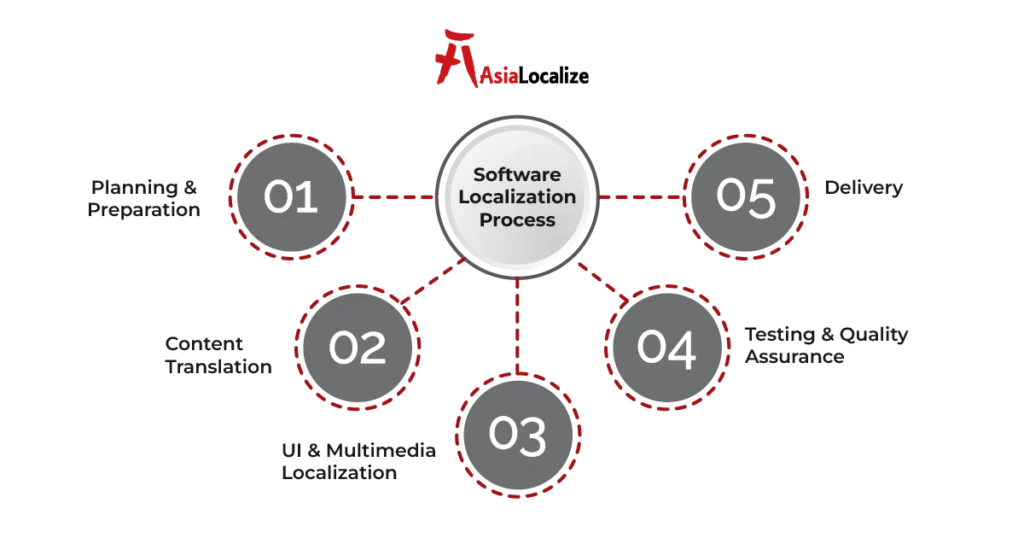
A solid localization strategy looks great on paper. What makes it work in reality is the workflow behind it.
What follows is a practical, end-to-end workflow that leading teams use to move from a single-language product to a fully localized, market-ready experience.
Localize your app the way users expect it through our app localization services.
1. Define the Localization Strategy and Target Locale
A strong localization strategy focuses on business impact. That means choosing markets based on growth potential, user demand, and product fit.
Each target locale should be clearly defined. Spanish for Spain and Spanish for Mexico serve different audiences. The same applies to English across the US, UK, and APAC markets.
At this stage, teams align on:
- Priority markets and rollout phases
- Which product areas need localization first (core flows vs. secondary content)
- Ownership across product, engineering, and localization project management
- Timelines, KPIs, and expected outcomes
Make localization feel like part of your product.
Explore our localization services.
2. Prepare the Product Through Internationalization
This is where technical readiness pays off. That starts with internationalization:
- Moving all user-facing text into resource files
- Enabling clean string extraction for translation workflows
- Designing UI components that handle text expansion gracefully
- Supporting right-to-left languages and complex scripts where needed
- Adapting regional settings such as dates, currencies, and number formats
3. Build Language Assets Before Translation Starts
Translation quality depends heavily on preparation.
Before any content is translated, teams set the foundation:
- A clear style guide that defines tone, voice, and writing conventions
- Strong terminology management to keep key terms consistent across all in-app content
- A translation memory to reuse approved translations and reduce cost over time
- Context materials like screenshots or notes that show where each string appears
- The right CAT tools to manage workflows, consistency, and collaboration
4. Translate and Adapt the UI and In-App Content
This is where the product starts to take shape in each market.
UI translation covers visible interface elements—buttons, menus, labels, notifications—but the real value comes from going beyond literal translation.
Teams adapt:
- Onboarding flows
- Help content and system messages
- Product microcopy and interaction cues
Through cultural adaptation, content is refined to match local expectations, communication styles, and user behavior. Tone stays aligned with the brand, while still feeling natural to each audience.
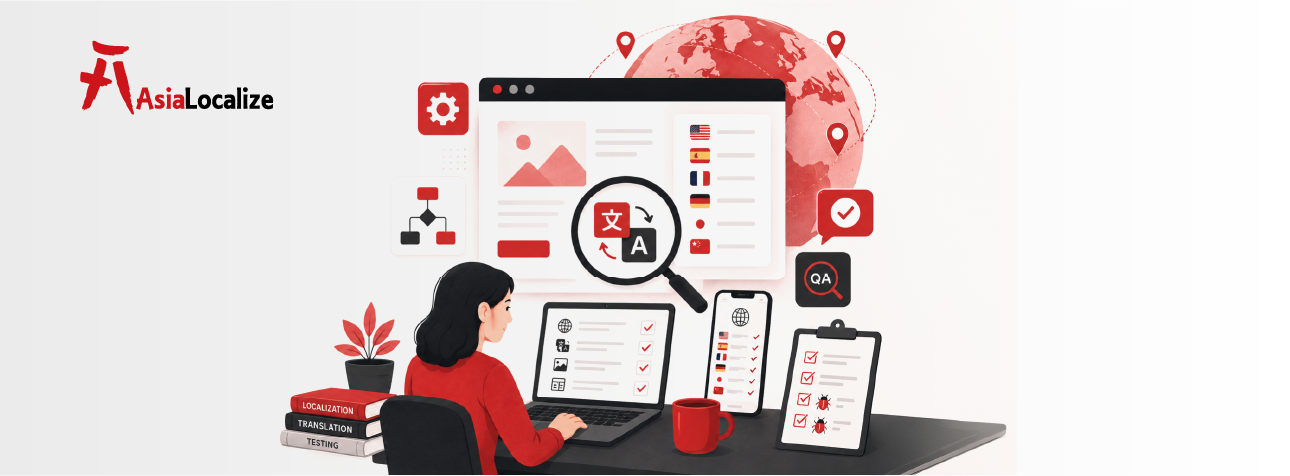
5. Run Localization Testing Before Release
A translation that looks perfect in a spreadsheet can fail inside the product. That’s why localization testing is integral.
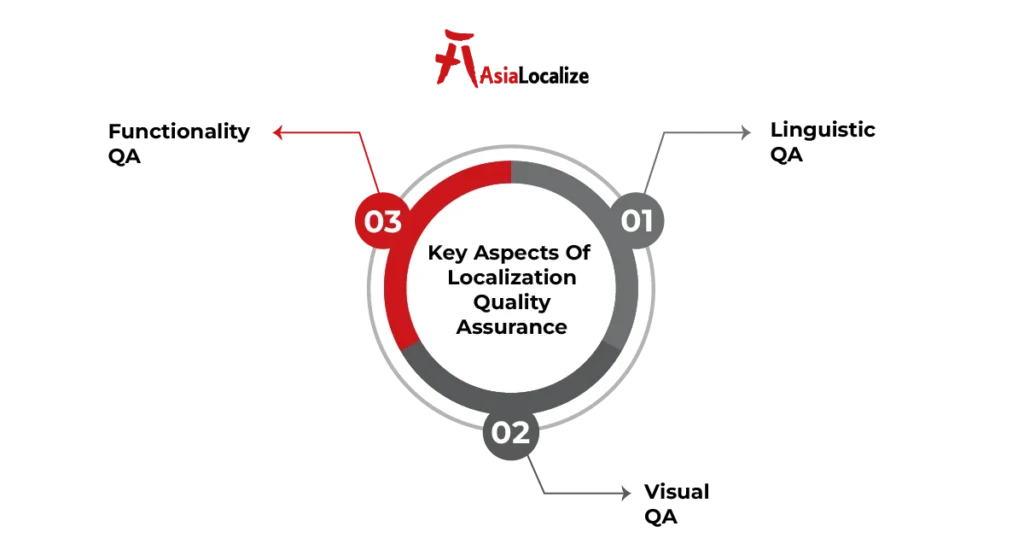
It combines:
- Linguistic QA to review language quality and clarity
- Functional testing to ensure features behave correctly across languages
- In-context review to catch layout issues, truncation, broken links, and navigation gaps
6. Coordinate Release Management and Multilingual Deployment
Strong release management keeps everything aligned:
- Planning launches across multiple languages
- Managing multilingual deployment without delays between markets
- Syncing updates across product, engineering, and localization teams
- Using version control to track changes and maintain consistency
When this step is handled well, every language version moves forward together. No lag, no fragmentation, just a unified product experience across markets.
When a localization workflow is set up right, things just work. Updates go out without breaking layouts. New languages don’t slow the team down. Your in-app content sounds consistent across markets, and releases stay aligned instead of drifting apart. There’s a natural flow to it.
That’s the difference a solid process makes. It takes localization from something reactive—fixing issues as they appear—to something structured that supports how your product grows.
The challenge is that localization rarely stays simple for long. What starts as adding one new target locale quickly turns into managing multiple languages, syncing updates across teams, and making sure every version of your product feels just as polished as the original. Without the right setup, that complexity builds up fast.
That’s why we shape the approach around you. We look at how your product is built, how your team works, and where things tend to slow down. Sometimes it’s about setting up the right foundations so localization runs alongside development. Sometimes it’s about improving consistency through better terminology and smarter use of translation memory. And sometimes, it’s simply about making sure everything comes together cleanly before release.
Because at the end of the day, localization should make your life easier. And when it’s done right, it becomes one of the quiet drivers behind your product’s growth.
Translate your software without losing its logic.
Check out our software translation services.