Types of translation describe the different methods, workflows, subject specializations, and content formats used to carry meaning from one language into another. The right choice depends on the purpose of the content, its risk level, the target audience, and whether cultural or regulatory adaptation is required.
A legal contract, mobile app, advertising slogan, clinical document, and training video should not follow the same translation process. This guide explains 20 major types of translation, when each is appropriate, and how businesses can combine human expertise with language technology without sacrificing quality.
Language directly affects purchasing decisions. In CSA Research’s 2020 survey of 8,709 consumers in 29 countries, 76% preferred products with information in their own language. Choosing the correct translation service is therefore not just a linguistic decision; it is part of customer experience, compliance, and international growth.
Types of Translation at a Glance
| Content or goal | Best-fit translation type | Recommended workflow |
|---|---|---|
| Contracts and court documents | Legal or certified translation | Specialist translator plus independent review |
| Patient-facing and pharmaceutical content | Medical translation | Subject expert plus terminology and regulatory QA |
| Manuals and engineering documents | Technical translation | Technical linguist, glossary, and functional review |
| High-volume internal material | Machine translation with post-editing | Approved MT engine plus human post-editor |
| Campaigns, slogans, and brand copy | Marketing translation or transcreation | Native creative linguist plus in-market review |
| Websites, software, and apps | Localization | Linguistic, functional, and visual QA |
| Video and e-learning | Audiovisual translation | Transcription, translation, timing, and media QA |
Types of Translation by Workflow and Method
1. Professional Human Translation
A qualified linguist translates the content and makes informed decisions about meaning, tone, terminology, and context. Human translation is the safest choice for high-risk, highly visible, or culturally sensitive material, including contracts, clinical content, investor communications, and brand campaigns.
2. Machine Translation
Machine translation uses an automated system to produce a target-language version. It can be useful for understanding large volumes of low-risk content, internal communications, or material with a short lifespan. Raw machine output should not be used for safety-critical, regulated, legal, or public-facing content without appropriate human review.
3. Machine Translation Post-Editing (MTPE)
With MTPE, a professional linguist corrects machine-generated output. Light post-editing aims for understandable content, while full post-editing targets publishable quality, terminology consistency, and natural style. MTPE can improve speed and cost efficiency when the source is suitable, the engine performs well for the language pair, and expectations are defined before production.
4. Literal Translation
Literal translation stays close to the wording and structure of the source. It may be appropriate for controlled language, certain technical labels, or initial analysis, but it can sound unnatural and may fail when idioms, cultural references, or different grammatical structures are involved.
5. Semantic and Communicative Translation
Semantic translation prioritizes the precise contextual meaning of the source, while communicative translation prioritizes clarity and effect for the target reader. Professional projects commonly balance both: preserve essential meaning, then express it naturally for the audience and purpose.
6. Transcreation
Transcreation recreates the emotional and persuasive effect of creative content instead of following the original wording closely. It is ideal for slogans, advertising, campaign concepts, product launches, and brand storytelling. Effective transcreation services usually include a creative brief, alternative options, and explanations of cultural choices.
Official and Industry-Specific Types of Translation
7. Certified Translation
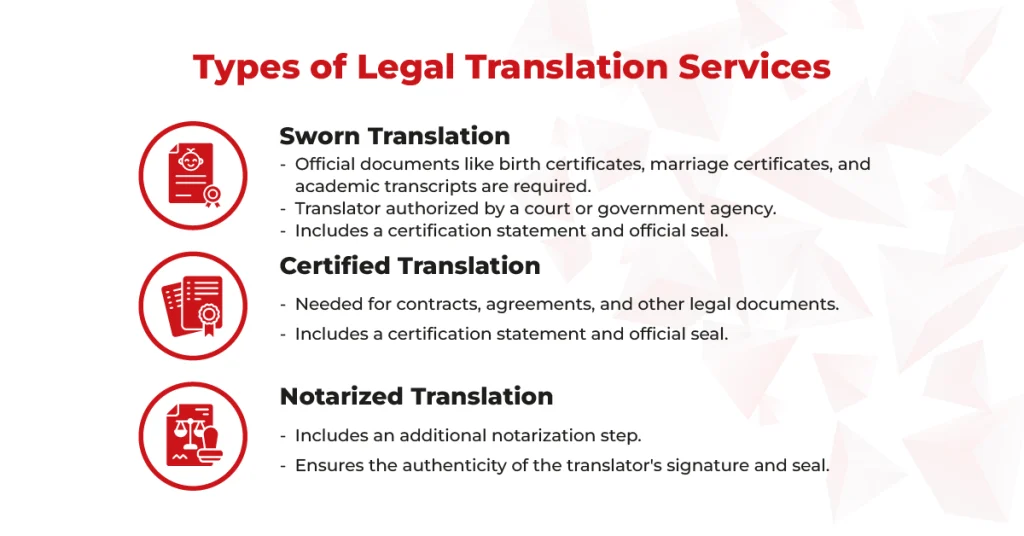
A certified translation is accompanied by a statement confirming that the translation is complete and accurate. It is often requested for immigration, education, legal, government, and corporate submissions. Requirements vary by receiving authority, so the destination, purpose, and required format must be checked before work begins. Our document translation services support certified and business-critical documents.
8. Sworn and Notarized Translation
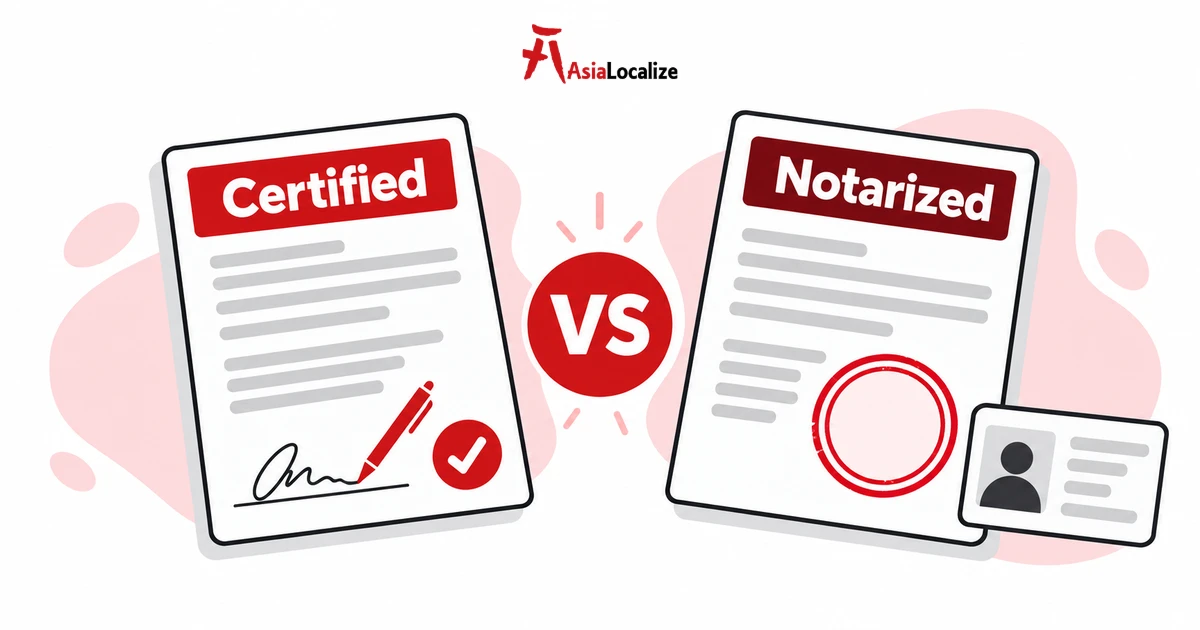
A sworn translation is completed or endorsed by a translator authorized under a particular country’s legal system. A notarized translation generally involves a notary witnessing a signature or declaration; the notary does not normally verify the linguistic quality. These terms are not interchangeable, and requirements differ across jurisdictions. Always follow the instructions of the receiving institution.
9. Legal Translation
Legal translation covers contracts, court documents, corporate filings, patents, policies, and regulatory material. It requires command of legal terminology and the relevant legal contexts, along with confidentiality and strict version control. For cross-border matters, legal translation services should use subject specialists and an independent review process.
10. Medical and Life Sciences Translation
Medical translation includes clinical trial materials, patient information, medical records, device documentation, labels, and pharmaceutical content. Accuracy can affect patient safety and regulatory acceptance, so projects need qualified linguists, controlled terminology, privacy-aware handling, and documented review. Learn more about AsiaLocalize’s medical translation services.
11. Technical Translation
Technical translation is used for manuals, specifications, standard operating procedures, safety data, engineering documentation, and product support. The translator must understand the subject and maintain terminology across related files. Diagrams, measurements, warnings, and user-interface references also need careful QA. AsiaLocalize provides technical translation services for complex products and systems.
12. Financial Translation
Financial translation covers annual reports, audit material, banking documents, investor communications, tax content, insurance documents, and regulatory disclosures. It requires consistent accounting terminology, accurate figures, awareness of reporting conventions, and rigorous review of tables, dates, currencies, and footnotes.
13. Scientific and Patent Translation
Scientific translation serves research papers, laboratory documentation, technical reports, patents, and intellectual property submissions. Subject expertise is essential because a small terminology error can change a claim or scientific interpretation. Patent work also requires consistency between claims, drawings, abstracts, and prior terminology.
Creative, Digital, and Product Translation Types
14. Marketing Translation
Marketing translation adapts brochures, email campaigns, product pages, social content, and sales material. It preserves the offer and brand voice while adjusting idioms, calls to action, cultural references, and search terms. When the creative concept itself must change, transcreation is usually more appropriate.
15. Literary Translation
Literary translation brings novels, poetry, essays, scripts, and other creative works to new readers. The translator must reproduce voice, rhythm, imagery, characterization, and cultural meaning. Several valid renderings may exist, so editorial judgment is central to the process.
16. Website Localization
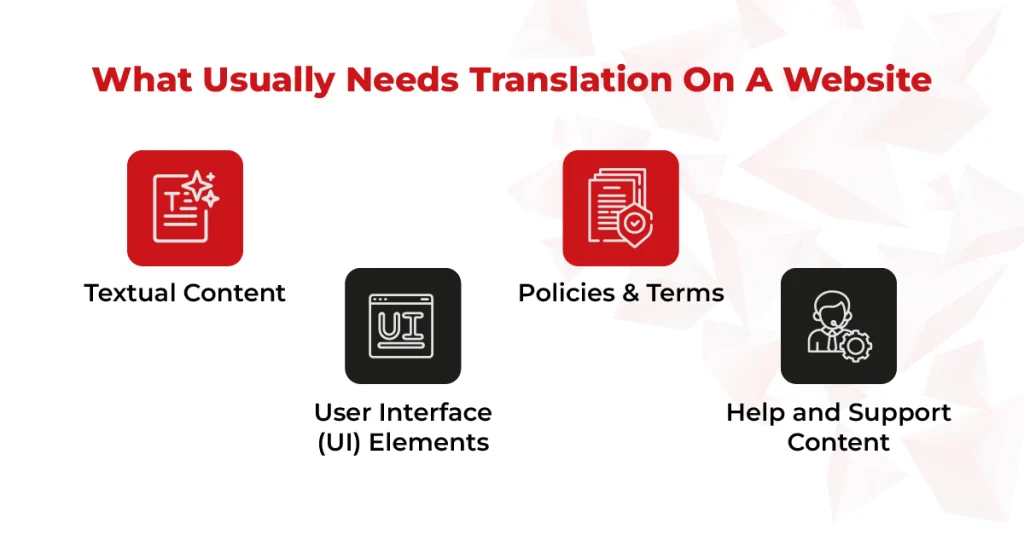
Website localization adapts more than page copy. It can include navigation, images, forms, currencies, date and address formats, privacy notices, SEO elements, and the complete user journey. International SEO also requires localized search intent rather than mechanically translating keywords. Explore our website localization services.
17. Software and App Localization
Software localization adapts user-interface strings, help content, notifications, screenshots, and app-store material. The process must account for character limits, variables, plural rules, bidirectional scripts, and text expansion. Linguistic testing in the actual product is essential because a correct translation can still fail when displayed in context. See AsiaLocalize’s app localization services.
18. E-commerce Translation
E-commerce translation includes product titles, descriptions, filters, size information, checkout flows, delivery messages, reviews, and customer support. High-volume catalog content may suit an MTPE workflow, while high-value landing pages and campaign copy normally need human marketing expertise. Local payment, measurement, and compliance expectations must also be considered.
19. Audiovisual Translation
Audiovisual translation includes subtitles, captions, dubbing, voice-over, transcription, and on-screen text. The linguist works within timing, reading-speed, lip-sync, and screen-space constraints. E-learning and accessibility projects may also require closed captions, audio description, and synchronized quizzes.
20. Game Localization
Game localization covers dialogue, menus, tutorials, character names, store listings, and community content. Translators need narrative context and must handle variables, branching dialogue, humor, ratings requirements, and platform terminology. In-context testing helps identify truncation, gender errors, broken variables, and cultural problems before release.
Translation, Localization, Transcreation, and Interpreting
- Translation transfers written meaning from a source language to a target language.
- Localization adapts a product or experience for a specific market, including linguistic, cultural, functional, and technical elements.
- Transcreation recreates persuasive or emotional impact for a new culture.
- Interpreting transfers spoken or signed communication in real time or consecutively; it is a related language service, not a type of written translation.
A global launch may require all four. For example, a company could translate contracts, localize its app, transcreate its campaign, and use interpreters during partner meetings.
How to Choose the Right Type of Translation
- Define the purpose. Decide whether the content must inform, persuade, instruct, comply, or serve as official evidence.
- Assess the consequences of error. Legal, medical, safety, financial, and brand-critical content needs more specialized review than low-risk internal material.
- Identify the audience and market. Country, language variant, literacy level, culture, platform, and accessibility needs all affect the solution.
- Check formal requirements. Ask the receiving authority whether certification, sworn status, notarization, formatting, or a particular delivery method is required.
- Match technology to risk. Human translation suits high-stakes and creative work; MTPE can suit repetitive, high-volume content when the language pair and source material are appropriate.
- Plan quality assurance. Agree on terminology, review stages, reference material, in-context testing, and final approval before production starts.
What a Reliable Translation Workflow Includes
The right types of translation still need a disciplined process. A professional workflow should include project scoping, source-file review, linguist selection, terminology management, translation or post-editing, independent revision when risk requires it, automated QA checks, formatting review, and final delivery control.
For Asian markets, the plan should also account for language variants, writing systems, honorifics, local regulation, address and name order, font support, line breaking, text expansion, and bidirectional layout where relevant. In-country review is especially valuable when local brand preferences or regulatory interpretation may differ.
Frequently Asked Questions
What are the main types of translation?
The main types can be grouped by workflow, method, industry, and format. Common examples include human translation, machine translation, MTPE, certified, legal, medical, technical, financial, marketing, literary, audiovisual, website, software, and e-commerce translation.
Which type of translation is most accurate?
No single type is always the most accurate. Accuracy depends on the content and purpose. High-risk documents generally require a qualified subject-matter translator and independent review, while an appropriately designed MTPE workflow may be effective for suitable high-volume material.
What is the difference between certified and sworn translation?
A certified translation normally includes a signed accuracy statement. A sworn translation is produced or endorsed by a translator officially authorized under a specific legal system. The exact requirements depend on the country and receiving institution.
Is localization a type of translation?
Localization includes translation but has a wider scope. It adapts cultural references, formats, design, functionality, search behavior, and the user experience for a particular locale.
Can AI replace professional translators?
AI and machine translation can accelerate suitable workflows, but they do not remove the need for expert judgment in regulated, confidential, creative, or high-impact content. The appropriate level of human involvement should be determined by risk, audience, quality expectations, and language-pair performance.
How do I choose a translation provider?
Look for relevant subject and language-pair expertise, a documented QA process, secure file handling, clear certification capabilities, terminology management, transparent project ownership, and the ability to test localized content in context.
Build the Right Translation Strategy
Choosing among the many types of translation is easier when the decision begins with content purpose, business risk, audience, and market requirements. A blended program may use specialist human translation for critical content, MTPE for scale, localization for digital products, and transcreation for campaigns.
AsiaLocalize combines native-language specialists, subject expertise, technology, and structured quality assurance for multilingual projects across Asia and worldwide. Explore our professional translation services or request a tailored recommendation for your content, languages, timeline, and target markets.