

Most companies chasing global growth get stuck at the extremes. They either roll out identical experiences everywhere—hoping scale alone will win—or drown in endless rounds of “local tweaks” that fragment the brand.
Both paths fail for the same reason: they miss the middle ground.
That middle ground is glocalization, a strategy that blends global consistency with local nuance, where every market feels seen without needing to reinvent the wheel.
Actually, brands that localize see up to 1.5x to 2x increase in revenue per user. We’ve seen it firsthand—across SaaS rollouts, retail expansions, and digital launches where a single source of truth meets market-level precision.
This guide breaks it all down into what actually matters:
Definition → Differences → When to Use It → How to Implement → KPIs → Pitfalls.
By the end, you’ll see why the smartest global brands no longer ask “Should we localize?”
They ask, “How do we glocalize—well, and fast?”
Glocalization, Defined: Where Scale Meets Local Sense

Gloc is what happens when a global strategy grows roots in local soil.
It’s the process of keeping a scalable global core—your product logic, brand voice, and operating model—while shaping the outer layers to mirror each market’s language, culture, and behavior.
In practice, glocalization means you don’t copy-paste campaigns or redesign them from scratch—you engineer adaptability. Your core stays unified, your edges flex.
Glocalization vs. Globalization vs. Localization: The Strategy Spectrum Explained
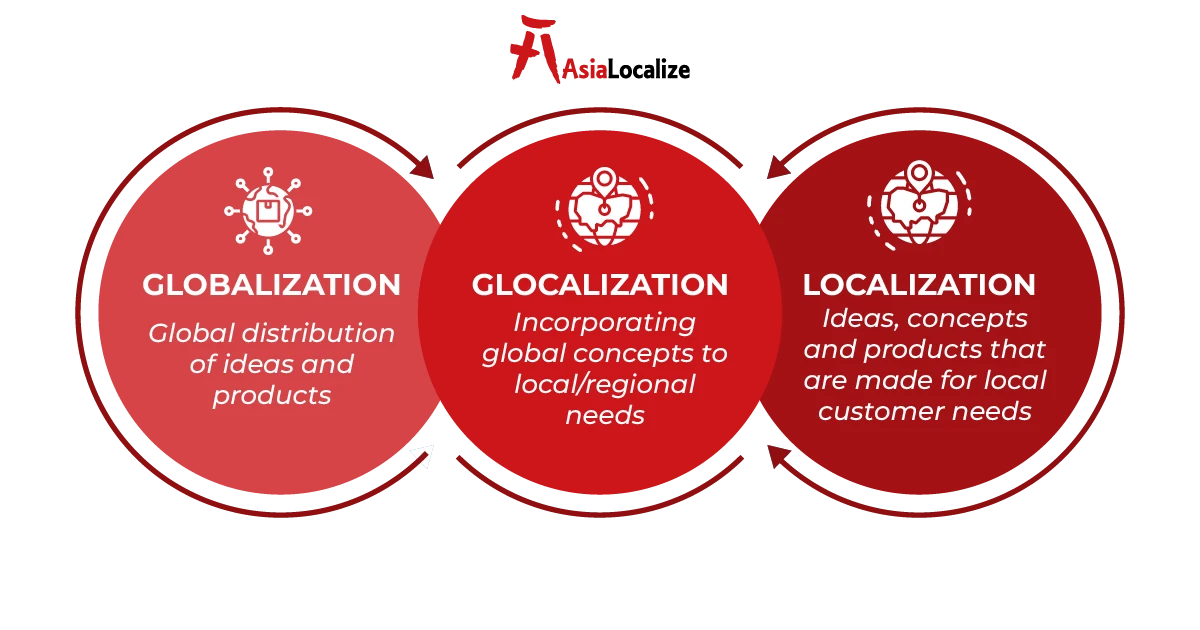
For years, global teams treated globalization and localization as two ends of a single rope—pull too hard on one, and the other unravels. But the truth is subtler: success lies in how well you hold the tension between them.
Globalization is about sameness: standardized offerings, unified processes, and economies of scale. It drives consistency and control—but often at the cost of emotional resonance. Think efficiency over empathy.
Localization, on the other hand, dives deep into adaptation—tuning every message, interface, and campaign to match cultural nuance. It connects, but it doesn’t always scale. Without structure, teams end up duplicating effort and losing brand coherence.
Believe is the sweet spot in between—a governed adaptability model. You keep a strong global backbone (your product, strategy, and brand DNA), then localize the high-impact layers: customer experience, content, and compliance.
| Strategy | Speed | Cost | Risk | When to Use |
| Globalization | Fast | Low | High cultural risk | Early expansion or homogenous markets |
| Localization | Moderate | High | Medium | Brand-building in mature markets |
| Glocalization | Optimized | Balanced | Low | Long-term, scalable global growth |
Search engines speak every language. Does your brand? Learn how to boost visibility worldwide in our Multilingual SEO Guide for Global Rankings.
When Glocalization Becomes a Must in Your Strategy!

Glocalization is for brands that have outgrown surface-level translation and are ready to build real resonance.
You know you’ve reached that point when uniform messaging starts to fall flat, conversions dip in certain markets, or local teams quietly rebuild assets from scratch because “the global version doesn’t land.”
That’s when a glocalization strategy shifts from nice-to-have to non-negotiable.
1. Your customers don’t behave the same way everywhere
If your audience spans markets with different languages, cultural habits, and purchase behaviors, you’re already facing fragmentation. According to CSA Research, 76% of global consumers prefer buying in their native language, and 40% simply won’t buy if they don’t understand the content. Glocalization ensures you meet that diversity with precision—without breaking your brand’s spine.
2. You operate in regulated or high-stakes industries
Finance, healthcare, government, or legal—these sectors live and die by compliance. A global template won’t cover region-specific data laws, accessibility standards, or consumer rights. Controlled localization (WCAG, GDPR, HIPAA, PDPA, etc.) keeps your operations trusted, fast, and compliant.
3. You sense strong cultural signals that affect conversion
Colors, imagery, tone, and even humor trigger different emotional responses by culture. The right nuance can multiply engagement; the wrong one can cost reputation. Glocalization helps you align both what you say and how it feels—so your message lands as if it were written there.
4. You’re managing high growth or large revenue markets
If a single region holds 10%+ of your projected global revenue, it deserves more than a translated version of your homepage. At that scale, precision matters. Studies show that brands investing in localized experiences see up to 1.5×–2× higher revenue per user, driven by stronger trust, relevance, and repeat engagement. Investing in local precision pays for itself in retention and lifetime value.
You’ve built a great store—now let the world find it. Explore International SEO for eCommerce: hreflang & URL Structure and turn every local search into a global sale.
How to Implement Glocalization
Glocalization thrives when a brand moves with intention and ease across markets.
It grows from the everyday rhythm of teams—how they decide, adapt, and translate a shared vision into local meaning. The most resilient companies keep that vision steady while letting each market express it in its own language and tone.
What follows is a framework that helps global operations stay coherent yet alive, blending structure with intuition so every market feels both guided and free.
1) Define the Global Core
Before anything can flex, something has to hold firm. The global core is that anchor—it’s what keeps every market aligned even as messaging, visuals, and experiences adapt.
Start by crystallizing the elements that must remain universal:
Product specifications, brand voice, pricing logic, base content templates, and a clear center of excellence to govern them.
In practice, that means your global identity becomes a living system, not a fixed rulebook. The strongest brands maintain unified termbases, centralized translation memories, and brand style guides that ensure every local variation still “sounds like us.”
2) Map Local Adaptation Layers
With the global core defined, this is where glocalization takes form—where your strategy meets real people. Each market brings its own rhythms, humor, and habits. Mapping local adaptation layers means giving every region the space to sound and feel like itself while staying aligned with your shared identity.
Marketing & Customer Experience
This is the emotional front line. Transcreation replaces literal translation to preserve intent and tone. Visuals shift to fit cultural context, keyword research becomes local, and promotions follow regional calendars. According to CSA Research, brands that deliver experiences in the audience’s own language see70% higher engagement and 40% greater conversion intent.
Product & Technology
A globally scalable product starts with a flexible architecture. Internationalization (i18n), clean resource files, ICU message formats, and right-to-left typography are what make adaptation seamless instead of costly. Smart use of feature flags and locale-specific releases allows real-time optimization—so each market grows from the same foundation, but at its own pace.
Compliance & Accessibility
Every geography brings its own guardrails: data residency, accessibility (WCAG), labeling, and consent/cookies. Embedding compliance early protects credibility before users even click “accept.”
3) Build the Operating Model
A glocalization strategy only works when it runs on a clear, dependable system—one that keeps every market aligned and every release consistent.
- Establish your language assets
Create a centralized termbase and build a translation memory (TM) to store approved phrasing. Managed through CAT tools and a unified TMS, these assets can cut turnaround time and cost by over 30%, while ensuring every version sounds authentic to you.
- Set the creative and linguistic rules
Develop style guides and brand playbooks that outline preferred tone, formatting, and design principles. These keep local adaptations expressive but cohesive—every linguist or marketer knows the same boundaries and freedoms.
- Integrate human insight
Assign true in-market reviewers who bring emotional accuracy and cultural sense-checks to final content. Their feedback refines nuance, not just grammar, anchoring your global consistency in real local experience.
- Close the quality loop
Run regular Linguistic QA (LQA) cycles to monitor accuracy, readability, and resonance. Continuous feedback transforms quality from a checkpoint into a habit.
- Define a rollout rhythm
Plan a predictable release cadence that syncs global launch goals with local timelines. Each market knows its window to adapt, test, and approve—keeping the whole operation agile yet steady.
4) Ship, Measure, and Evolve
Once your system is in motion, the real growth begins. Each release, campaign, or feature becomes a live signal of how your brand resonates in different markets.
- Launch with purpose
Start every rollout as an experiment, not a broadcast. Use A/B testing and structured trials across markets to see what drives engagement and conversion. Deloitte Digital found that local data-led, proving that intuition works best when backed by evidence.
- Read the market pulse
Build localized dashboards that go beyond numbers. Track adoption, conversion, retention, and sentiment—how users feel your message as much as how they act on it.
- Keep the conversation open
Encourage a steady exchange between in-market teams and global leads. The local side brings lived context—how customers actually think and respond—while the global side keeps direction and coherence. Together, they turn feedback into foresight, catching cultural shifts long before the metrics do.
- Turn feedback into rhythm
Transform what you learn into a process. Every insight—no matter how small—feeds back into your playbooks, design choices, and content pipeline. Over time, this rhythm builds brands that don’t just adapt to markets—they grow with them.
Glocalization succeeds when structure and sensitivity move in sync—when a brand holds its center yet adapts with ease to every market it touches. It’s the difference between being seen everywhere and being understood everywhere.
At AsiaLocalize, this balance is what we’ve built our craft around. For over a decade, we’ve helped global teams shape frameworks that travel well—term by term, market by market. We design systems that make each adaptation feel original.
Learn how to pair glocalization with strong multilingual visibility in our post on Website Localization Best Practices for SEO.