Languages spoken in India reflect one of the world’s most diverse linguistic landscapes. With an estimated 1.46 billion people in 2025 (UN World Population Prospects 2024) and hundreds of mother tongues, India is not a single-language market; it is a collection of regional, cultural, and digital audiences.
For businesses entering India, this diversity matters. Choosing the right language for the right region can shape how audiences understand your message, trust your brand, and respond to your products or services.
Did you know there is a 36% chance that two randomly selected Indians will share a language they both understand, according to an analysis of the 2011 Census?
The 22 Constitutionally Recognized Languages in India. and to connect meaningfully with your target audience, it’s essential to select the right language(s) and establish a localization strategy that resonates with specific regions and communities.
This guide is here to help you make informed choices about Indian languages and give you the tools to craft a successful entry plan.
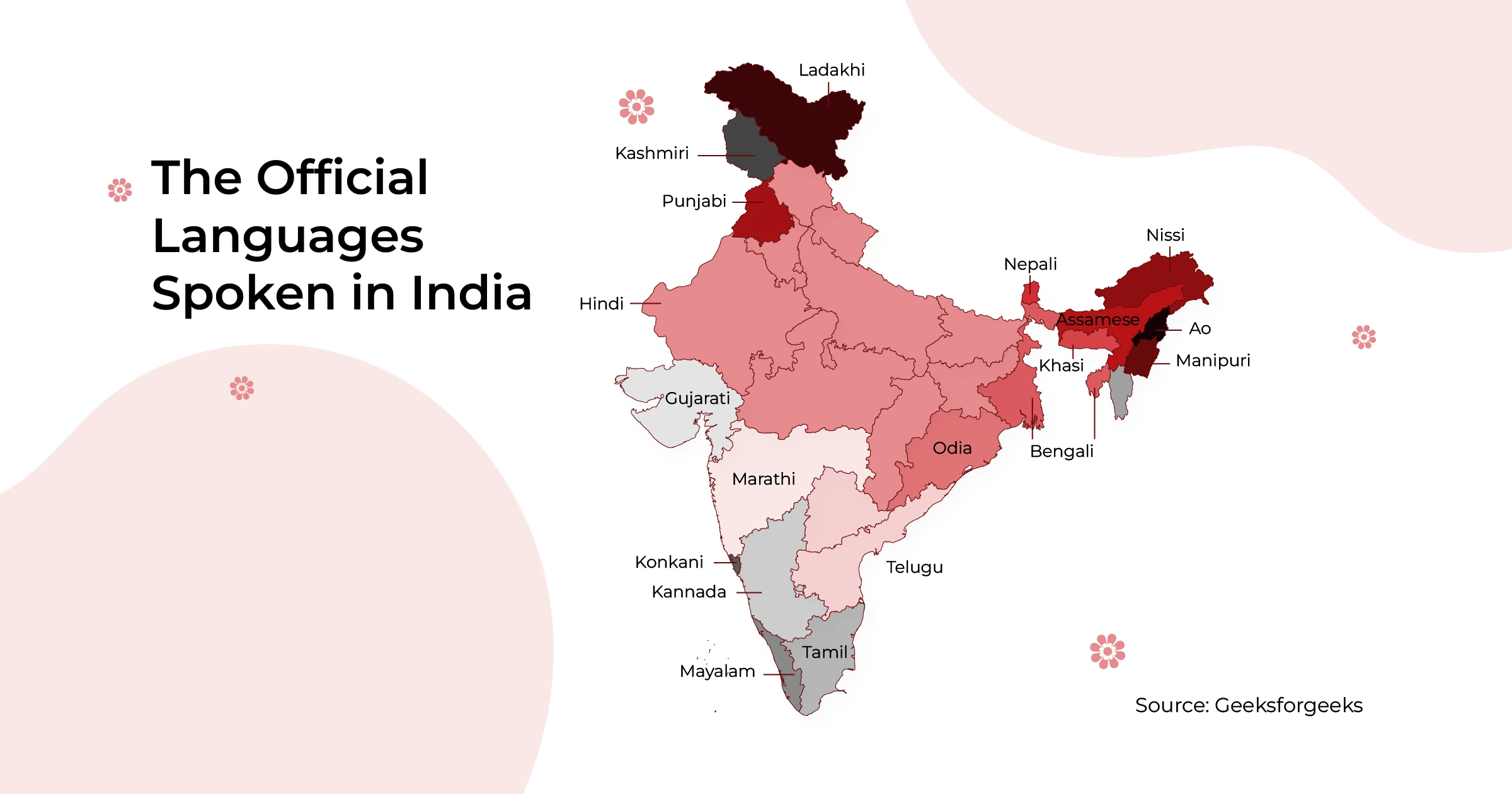
What Languages Are Spoken in India?
Quick answer: India has no single national language. Hindi and English are the official languages of the central government, and the Constitution’s Eighth Schedule recognises 22 scheduled languages. The 2011 Census identified 121 main languages and 270 mother tongues with at least 10,000 speakers each.
| Measure | Figure | Source |
|---|---|---|
| Main languages identified | 121 | Census of India, 2011 |
| Mother tongues with 10,000+ speakers | 270 | Census of India, 2011 |
| Constitutionally recognised (scheduled) languages | 22 | Eighth Schedule, Constitution of India |
| Population reporting a mother tongue grouped under Hindi | 43.63% | Census of India, 2011 (C-16) |
| People reporting English as mother tongue, second or third language | 128.5 million (10.6%) | Census of India, 2011 (C-17) |
The Official Languages Spoken in India
Hindi
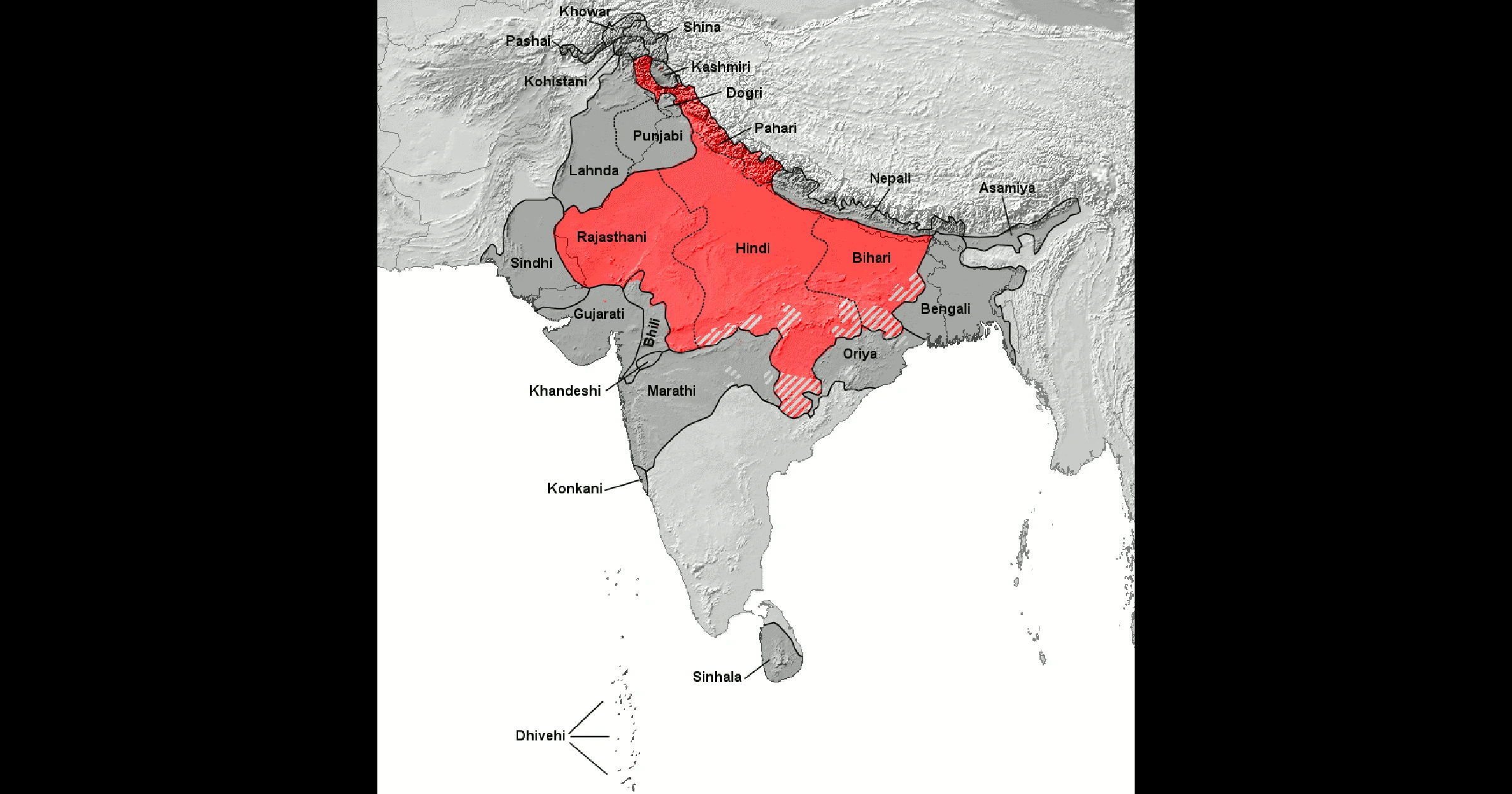
Hindi is the most spoken language in India and one of the two official languages of the central government. According to the 2011 Census, 43.63% of the population reported a mother tongue grouped under the Hindi language (which includes Hindi itself and related mother tongues such as Bhojpuri and Rajasthani), mainly in North and Central India, including states such as Uttar Pradesh, Bihar, Rajasthan, Madhya Pradesh, and the National Capital Territory of Delhi.
Hindi belongs to the Indo-Aryan language family, the largest language family in India. It’s characterized by its melodic sense, which means that intonation is an essential part of speaking it.
Hindi is listed as the official language of nine states, which is also known as the Hindi Belt, including:
- Himachal Pradesh
- Delhi
- Haryana
- Uttar Pradesh
- Madhya Pradesh
- Bihar
- Uttaranchal
- Jharkhand
- Rajasthan
- Chattisgarh
English
English has remained one of India’s official languages since the British Raj. While it is not spoken in daily life by most Indians, it is common among urban and upper‑income groups. In the 2011 Census, about 128.5 million people (10.6% of the population) reported English as their mother tongue, second language or third language, almost all of them as a second or third language.
However, Indian English is a fascinating blend of Hindi and English, known as Hinglish. It’s not the standard English you might be familiar with, but it’s a unique and vibrant form of communication that adds a distinctive flavor to the Indian business landscape.
The 22 Constitutionally Recognized Languages in India.
The Indian Constitution recognizes 22 scheduled languages, giving them formal recognition across national language policy and public administration contexts.
Indo-Aryan and Dravidian Languages
In India, languages belong to two major language families: Indo-Aryan and Dravidian language family.
The Indo-Aryan family, which includes Hindi and many other languages spoken in northern and central India, is the largest language family in the country. On the other hand, the Dravidian language family is prominent in southern India, encompassing languages like Telugu, Tamil, Kannada, and Malayalam.
Key Regional Languages
Understanding the critical regional languages in India is crucial for businesses targeting specific states. Each language carries its own cultural significance and serves as a primary communication medium for the local population.
India’s regional languages each open a distinct market. Alongside Hindi, businesses often need Bengali translation, Telugu translation services, Marathi translation, Punjabi translation services, Kannada translation, Malayalam translation services, and Odia (Oriya) translation to reach audiences in their first language.
- Bengali: Spoken in West Bengal and Tripura.
- Marathi: Spoken in Maharashtra.
- Tamil: Spoken in Tamil Nadu.
- Telugu: Spoken in Andhra Pradesh and Telangana.
- Gujarati: Spoken in Gujarat.
- Kannada: Spoken in Karnataka.
- Malayalam: Spoken in Kerala.
- Punjabi: Spoken in Punjab.
India’s Wealth of Languages
The 2011 Census of India identified 270 mother tongues spoken by at least 10,000 people nationwide, grouped under 121 main languages. These include both Scheduled and Non‑Scheduled languages.
- Language Families: The native languages of India are categorized into several language families, including Indo-Aryan, Dravidian, Austro-Asiatic, Tai-Kadai, and Sino-Tibetan.
- Tribal Languages: India is also home to numerous tribal languages, such as Abujmaria, Garo, Aaria and Tsangla, and Saurashtra. Many of the existing tribal languages are considered endangered, as they face the threat of extinction due to factors such as urbanization, migration, and the dominance of more widely spoken languages.
According to research conducted by the People’s Linguistic Survey of India, Majhi is only spoken by four people now.
Choosing the Right Languages To Enter the Indian Market
Consumer behavior in India can shift dramatically from one region to another, making it crucial to define your target audience and understand their demographics and preferences in detail.
India is one of the world’s fastest-growing e-commerce markets, so e-commerce localization is often the first priority for market entry.
For example, while Hindi is widely spoken in northern states, southern regions are home to languages such as Tamil, Telugu, and Kannada. This diversity means a single-language approach will likely miss important regional, cultural, and behavioral differences, underscoring the need for a tailored strategy that respects India’s cultural and linguistic variety.
One important factor to consider is the “digital opportunity” each language presents. This refers to the potential of a language for digital engagement and commerce, including metrics like the number of internet users who speak it, social media activity, online content creation, and the growth of e-commerce within those language communities.
Turning India’s Language Diversity Into a Localization Strategy
Understanding India’s language landscape is only the first step. For businesses entering the Indian market, the real challenge is deciding which languages matter most for each audience, region, product, and digital channel.
As a global IT and software delivery hub, India also generates strong demand for software & IT translation.
For example, Hindi translation services can support campaigns targeting large parts of North and Central India, while Tamil, Telugu, Bengali, Marathi, Gujarati, Kannada, Malayalam, and Punjabi may be more relevant for specific regional markets.
This is where multilingual localization services become important. Instead of translating one message into one language and hoping it works everywhere, businesses need a localized approach that adapts tone, terminology, visuals, calls to action, and customer support content for each audience.
For digital expansion, website localization services can also help adapt page structure, forms, search behavior, product descriptions, and multilingual SEO elements so the experience feels natural to Indian users across different states and language communities.
AsiaLocalize Your Partner for Language Success in India
For over a decade, we’ve been working with thousands of reputable businesses to tap into the Indian market, building strategies and Hindi translation services customized only for their business goals.
With the help of our native translators and the most up-to-date technologies, we build culturally relevant messages that attract and engage your audience.
FAQs About Languages and Localization in India
How many languages are spoken in India?
India is home to hundreds of mother tongues and 121 main languages identified in the 2011 Census. The country also recognizes 22 scheduled languages under the Constitution.
What is the most spoken language in India?
Hindi is the most spoken language in India, especially across North and Central India. However, many other languages are dominant in specific regions.
Why does localization matter for businesses entering India?
Localization helps businesses adapt content to India’s regional languages, cultural expectations, search behavior, and digital habits instead of relying on a single national message.
Do businesses need Hindi translation services only for India?
Not always. Hindi is important, but businesses may also need Tamil, Telugu, Bengali, Marathi, Gujarati, Kannada, Malayalam, Punjabi, or other regional languages depending on their target audience.

The Census of India figures cited above are set out alongside the other 10 Asian markets we track in our full Business Languages of Asia data reference, where every published figure is attributed to its named primary source.