
While consistency can open more potential for your business overseas, inconsistency can just as quickly drag it down. Research shows that consistent brand presentation can increase revenue by up to 23%. However, companies that fail to maintain consistency spend fortunes on correcting translation errors and duplicated work.
If a product manual refers to a feature as ‘smart control,’ another page calls it ‘intelligent mode,’ and the marketing brochure introduces yet another term, the result will undoubtedly undermine your entire market expansion.
Why put your entire expansion strategy at risk when terminology management offers a clear way to prevent these problems in the first place?
At its core, terminology management means creating a single source of truth for the words and phrases your company uses, so whether it’s a product feature or a legal disclaimer, it always shows up the same way across every market. Without it, teams slip into using conflicting terms, translations lose accuracy, and your brand voice consistency becomes diluted.
In this blog, we’ll unpack what terminology management really means and why it matters for companies aiming to grow globally. We’ll look at how consistent terminology safeguards your brand voice, reduces costly translation errors, and creates a smoother experience for your customers across markets.
Understanding the Building Blocks of Terminology Management
At the center of terminology management is the termbase, your multilingual glossary of approved words and phrases. It’s where product names, feature labels, and technical terms are stored with clear definitions, so everyone from writers to translators is speaking the same language.
Building that termbase is a process that keeps your content aligned. It usually involves:
- Terminology extraction – identifying the words that matter most from manuals, product specs, and marketing copy.
- Active term recognition – alerting teams in real time when an approved term should be used, or when an off-brand one sneaks in.
- Approval workflow – giving linguists, subject experts, and brand owners the final say before terms become official.
To keep everything accurate and on-brand, companies also set clear rules through:
- Preferred terms lists – the exact words that should always be used.
- Forbidden terms lists – terms that risk confusion or dilute the brand, and therefore shouldn’t appear at all.
The Difference Between a Termbase and a Translation Memory
It’s easy to mix them up, but they serve very different roles:
- Termbase – focuses on individual words and phrases. It stores approved product names, technical terms, and brand expressions, making sure the right word is used every single time.
- Translation Memory (TM) – stores full sentences or segments. It recalls how content was translated before and suggests the same or similar phrasing again, ensuring speed and consistency across larger texts.
Together, they complement each other: the termbase safeguards accuracy at the word level, while the translation memory maintains flow across entire documents. Both usually live inside a translation management system (TMS), which ties everything together. Read our full TMS guide to see how.
Why Businesses Should Invest in Terminology Management
Putting effort into managing your terminology pays off in concrete ways. Here’s how it benefits your bottom line and your brand:
- Consistency across all content: A localization style guide paired with a termbase creates a unified voice. Companies that localize content see 65% of online shoppers prefer content in their own language. Failing to maintain a consistent tone or terminology risks diluting your message and confusing customers.
- Enhanced accuracy through technical terminology standardization: Using one approved term for one concept prevents costly mistakes. In technical content, even small errors, like acronym disambiguation, can snowball into major issues.
- Time & cost savings by reducing rework: Using termbases, glossaries, TMs (translation memories), and computer-assisted translation tools from the start cuts duplicated effort. Integrating a glossary and TM trimmed translation turnaround time from six days down to one, without sacrificing quality, and helped increase active users by 73%.
This is where localization shows its real value. By aligning terminology management with Localization Services for Consistent Terminology, businesses streamline operations, improve linguistic quality assurance, and deliver a smoother customer experience worldwide.
How It Works in Practice
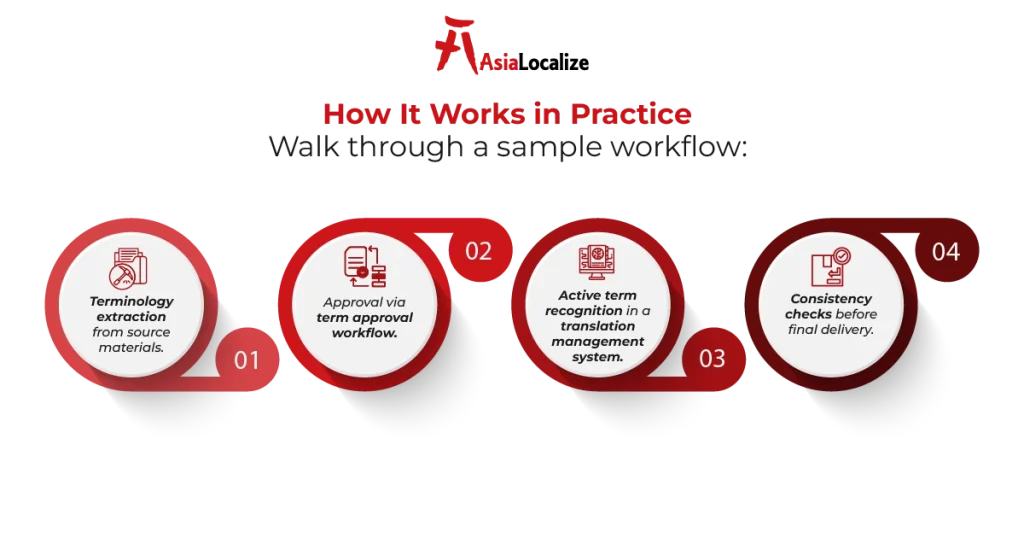
Terminology management follows a clear, practical workflow that keeps every piece of content aligned:
- Terminology extraction – pulling out the key terms from source materials such as product manuals, technical sheets, or marketing assets.
- Approval workflow – reviewing these terms with linguists, subject-matter experts, and brand stakeholders to confirm which ones should become the standard.
- Active term recognition – once approved, these terms are integrated into the translation management system so translators are automatically prompted to use the right wording.
- Consistency checks – before delivery, content is checked against the approved lists to make sure no forbidden terms slip through, and every phrase is aligned with the brand voice.
Getting Started with Terminology Management
Before terminology management can deliver real results, it needs a clear starting point. The following steps can turn terminology management from an idea into a working strategy for your business:
1. Audit your content
Start by reviewing what you already have. Look for:
- Product names that appear in different forms.
- Technical terms are translated in multiple ways.
- Marketing taglines that lose impact across languages.
These inconsistencies are the first signs that terminology management can add value.
2. Choose the right tools
The next step is to put structure in place. Using computer-assisted translation (CAT) tools together with a translation management system (TMS) allows you to:
- Enforce approved terminology.
- Flag forbidden terms in real time.
- Keep global teams aligned, no matter the volume of content.
3. Track your progress
Terminology management is measurable. Two key metrics show how well it’s working:
- Terminology coverage – the percentage of approved terms in use.
- Term adherence rate – how consistently teams apply the rules.
Improvements in these areas translate directly into stronger brand voice, fewer errors, and lower costs.
Terminology management is no longer optional for businesses that want to scale globally. The good news is, you don’t have to figure it out alone.
With some of the most advanced terminology management systems in Asia, we give you the structure and expertise to keep your brand voice sharp, your technical content consistent, and your translations cost-effective. From linguistic quality assurance to consistency checks, we help you put the right words in the right place, every time, in every market.
| Learn More About Our Technical Translation Services! |