Medical terminology is never just a matter of word choice. In healthcare, life sciences, and pharmaceuticals, the language used in a translated document can influence everything from patient comprehension and clinical-trial documentation to regulatory consistency, medical device usability, and pharmacovigilance reporting.
That’s why medical translation terminology demands far more than bilingual fluency or an AI-generated draft. It requires subject-matter expertise, contextual judgment, and rigorous terminology management grounded in approved references and industry standards.
The stakes are high whenever medical information guides care or regulatory decisions. The U.S. Agency for Healthcare Research and Quality estimates that 795,000 Americans die or become permanently disabled each year because of disease misdiagnosis. This figure is not a measure of translation errors—diagnostic failures have many causes—but it illustrates why every part of clinical communication must be handled carefully. In multilingual documentation, terminology decisions should therefore be traceable to authoritative, document-specific references.
In this guide, we’ll explore why medical terminology remains one of the most demanding aspects of specialized translation, where human expertise remains indispensable, and how professional terminology management helps healthcare organizations, pharmaceutical companies, CROs, and medical device manufacturers maintain consistency across multilingual content.
Why Medical Translation Terminology Goes Beyond Medical Vocabulary
Medical translation goes far beyond finding the equivalent of a medical term in another language. Every document has a specific purpose, audience, and regulatory context, which means the same medical concept may need to be expressed differently depending on where it appears.
Medical translation terminology includes the specialized terms, abbreviations, classifications, product names, and patient-facing language used across healthcare, pharmaceuticals, clinical trials, medical devices, and life sciences. It spans everything from physician notes and discharge summaries to informed consent forms, pharmacovigilance reports, package leaflets, patient education materials, and instructions for use (IFUs).
The challenge is that there is rarely one universally “correct” translation. A term that is perfectly appropriate in a clinical trial protocol may be too technical for a patient information leaflet. In contrast, wording designed for patients may not meet the precision expected in regulatory documentation. The goal is always to preserve the medical meaning while choosing terminology that fits the document’s purpose and audience.
This balance between clinical precision and patient readability is what makes medical translation a specialized discipline. Beyond medical expertise, translators need to understand the document type, applicable terminology standards, and market-specific requirements to ensure every term is both accurate and appropriate.
As multilingual medical content continues to grow, maintaining consistent terminology across documents, products, and languages has become just as important as translating the content itself. That’s why professional medical translation relies on structured terminology management, a topic we’ll explore later in this guide.
Why Medical Terminology Is One of Translation’s Biggest Challenges
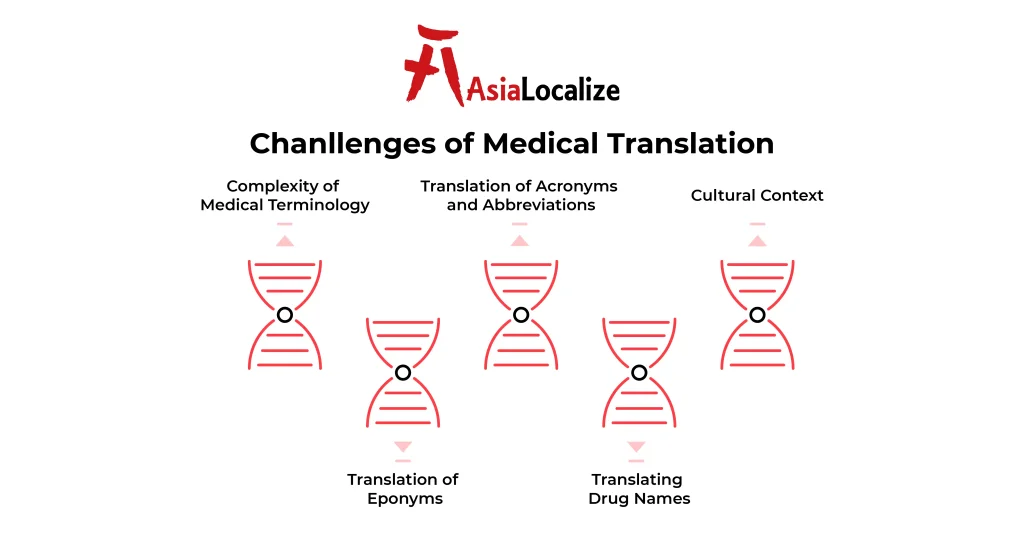
Medical terminology follows patterns, but it rarely follows simple translation rules. Terms often share Greek or Latin roots across languages, giving the impression that they’re interchangeable. In practice, however, similar-looking terms can carry different meanings, usage conventions, or levels of familiarity depending on the language, healthcare system, and intended audience.
The following are some of the most common challenges professional medical translators navigate every day.
Greek and Latin Roots Can Be Misleading
Medical terminology is built largely on Greek and Latin prefixes, suffixes, and word roots. While many of these terms look familiar across languages, their accepted usage often differs. A literal translation may sound scientifically correct but fail to match the terminology healthcare professionals or patients actually use in the target market.
Acronyms and Abbreviations Depend on Context
Abbreviations save space but introduce ambiguity. Acronyms such as MS, MI, RA, or ADR can have multiple meanings depending on the specialty, document type, or clinical context. Expanding an abbreviation based on assumption rather than context can alter the meaning of an entire sentence, making context verification an essential part of the translation process.
Drug Names and Dosage Instructions Leave No Room for Interpretation
Drug names, dosage units, routes of administration, treatment frequency, and decimal formatting must remain accurate throughout the translation. Even small inconsistencies can create confusion, particularly when content is updated, localized for multiple markets, or reviewed by different stakeholders.
Safety Terminology Must Follow Industry Standards
Safety documentation relies on standardized terminology to support consistent reporting and regulatory review. In pharmacovigilance projects, translators frequently work with MedDRA (Medical Dictionary for Regulatory Activities), the ICH-maintained terminology used for the registration, documentation, and safety monitoring of medical products. Each concept has a language-independent numeric code, which supports consistent exchange of coded safety information across markets.
Patients Need Clarity
Educational materials, informed consent forms, and package leaflets require plain, accessible wording without changing the intended medical meaning. FDA patient-labeling guidance recommends defining technical terms and using consistent wording, while EMA product-information templates emphasize language patients are likely to understand. The challenge is to simplify the language without oversimplifying the science or changing indications, warnings, precautions, or risks.
Medical Terminology Changes Across Markets
Medical terminology is not universal. Preferred terms can vary by country, regulator, healthcare system, and language variant. A project brief should define both language and market—for example, the required Chinese script and target jurisdiction—because regulator-preferred terminology and labeling conventions may differ. A translation prepared for one market may therefore require terminology changes before it is suitable for another.
How Medical Translation Terminology Changes Across Document Types
The examples below illustrate how medical translation terminology priorities change by document type. For deeper guidance, see our resources on clinical trial translation and medical device translation.
| Content Type | Terminology Risks | What Professional Translation Controls |
| Medical records and discharge summaries | Abbreviations, diagnoses, procedures, medications, allergies, dates, measurement units, and handwritten shorthand can easily be misunderstood without sufficient context. | Maintain consistent terminology, preserve medical meaning, verify ambiguous abbreviations where possible, and avoid making assumptions about unclear source text. |
| Prescriptions and dosage instructions | Drug names, dosage units, routes of administration, treatment frequency, contraindications, and decimal formatting require absolute precision. | Preserve approved terminology, maintain every unit and numerical value exactly, and flag ambiguous wording for review rather than guessing. |
| Clinical trial documents | Endpoints, eligibility criteria, adverse events, protocol terminology, and informed consent language must remain consistent across multiple documents and study phases. | Follow approved termbases, align terminology with the study protocol, and adapt patient-facing language where informed consent requires greater clarity. |
| Pharmaceutical labeling and Patient Information Leaflets (PILs) | Indications, warnings, adverse reactions, storage instructions, and dosage guidance must meet both regulatory and patient communication requirements. | Apply approved terminology consistently while ensuring language remains clear and accessible for the intended audience. |
| Medical device Instructions for Use (IFUs) | Device components, software interface text, safety warnings, symbols, and procedural instructions must remain synchronized across related materials. | Keep terminology consistent across IFUs, labels, packaging, software UI, and supporting documentation to reduce confusion during product use. |
| Patient education materials | Symptoms, prevention guidance, treatment instructions, and risk information can become overly technical if translated too literally. | Use plain language, respect cultural and linguistic expectations, and preserve the original medical meaning without introducing unnecessary complexity. |
The Most Common Medical Terminology Translation Risks and How to Avoid Them
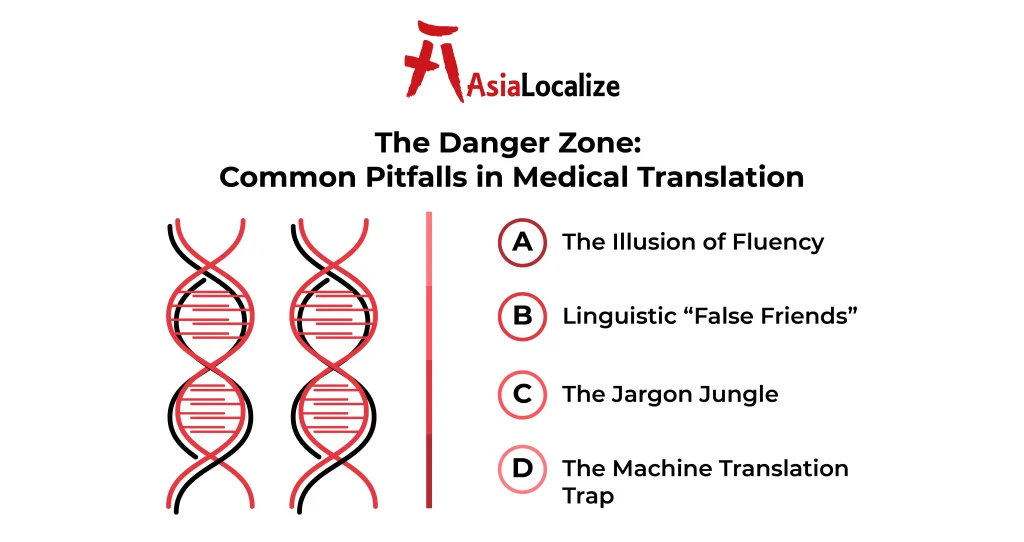
Here are some of the most common terminology risks professional medical translation teams work to prevent.
Using a Medically Correct Term That Isn’t the Approved One
A translation may be scientifically accurate yet still conflict with the terminology approved for a product, study, or target market. Pharmaceutical companies, medical device manufacturers, and clinical research organizations often maintain approved glossaries to ensure every document uses the same terminology throughout the product lifecycle.
Translating Look-Alike Medical Terms Too Literally
Many medical terms share Greek and Latin roots, making them appear almost identical across languages. That similarity can be misleading. A literal translation may alter the intended meaning, narrow or broaden the scope of a concept, or produce wording that healthcare professionals rarely use in the target language. Context should always guide terminology choices.
Using Different Terms for the Same Concept
A disease, medical device component, procedure, or medication shouldn’t appear under multiple names within the same project. Even when every translation is technically correct, inconsistent terminology creates confusion for reviewers, healthcare professionals, and patients while increasing the effort required to maintain multilingual documentation over time.
Expanding Acronyms Without Enough Context
Medical abbreviations often have multiple meanings. For example, MS may refer to multiple sclerosis, mitral stenosis, or morphine sulfate, depending on the document. Expanding an acronym without confirming its context can change the meaning of an entire sentence. Professional translators verify ambiguous abbreviations rather than relying on assumptions.
Carrying Forward Outdated Terminology
Medical documents evolve continuously through revisions, protocol amendments, product updates, and regulatory changes. If terminology updates are applied inconsistently, older terms can remain in translated content long after they’ve been replaced in the source. Maintaining centralized terminology resources helps ensure that updates are reflected consistently across all languages.
Writing for Patients Like You’re Writing for Clinicians
Patient education materials, informed consent forms, and package leaflets should remain medically accurate while using language that readers can understand. Overly technical wording may reduce comprehension, even when every term is scientifically correct.
Trusting Fluent AI Output Without Human Validation
Modern AI and machine translation systems generate remarkably natural-sounding text, but fluency should never be mistaken for accuracy. Medical terminology depends on context, approved references, document type, and intended audience, factors that automated systems cannot consistently validate on their own. Human medical linguists remain essential for reviewing terminology, resolving ambiguity, and ensuring consistency across multilingual content.
A Proven Workflow for Managing Medical Translation Terminology
While every project has its own requirements, the workflow typically follows six key steps.
1. Start by Assessing Content Risk
The first step is understanding the purpose of the content. A patient information leaflet, a clinical trial protocol, and a marketing brochure all require different levels of precision, review, and regulatory alignment. Classifying content by risk, whether patient-facing, regulatory, clinical, technical, internal, or marketing, helps determine the terminology standards and level of linguistic oversight the project requires.
2. Build the Right Terminology Resources
Before translation begins, professional teams gather the resources that will guide terminology decisions. These may include approved glossaries, termbases, style guides, product names, previous translations, and market-specific terminology. Starting with the right linguistic assets reduces inconsistencies and creates a single source of truth for everyone involved in the project.
3. Align with Approved References
Medical translation rarely relies on dictionaries alone. The reference hierarchy should be agreed before translation begins: approved source labeling and the client termbase usually govern product-specific wording, while authoritative resources support regulated concepts. Examples include ICH MedDRA for regulatory safety terminology, the EDQM Standard Terms database for pharmaceutical forms and routes of administration, and EMA QRD templates for EU product information. Country-specific requirements and current approved materials should always be verified for the target market.
4. Assign the Right Medical Linguists
Medical content requires more than language proficiency. Translators need familiarity with the relevant therapeutic area, document type, and industry terminology to make informed decisions when context becomes complex. Matching projects with linguists who understand the subject matter leads to more accurate and consistent outcomes.
5. Review Beyond Grammar
Professional reviewers verify terminology consistency, medication names, abbreviations, numerical values, units of measurement, formatting, and audience appropriateness. Every review helps confirm that the translated content communicates the intended meaning clearly while remaining aligned with project requirements.
6. Capture Knowledge for Future Projects
Every completed project creates valuable terminology decisions that shouldn’t be lost. Approved reviewer feedback is incorporated into termbases and translation memories, allowing future updates and related documents to benefit from the same approved terminology. Over time, this continuous feedback loop speeds up localization and reduces repetitive review effort.
Authoritative Medical Terminology Resources
No single database covers every medical translation terminology decision. Professional teams select references according to the content, product, regulator, and target market.
- ICH MedDRA: regulatory terminology for medical-product registration, documentation, and safety monitoring.
- EDQM Standard Terms: standardized pharmaceutical forms, routes and methods of administration, containers, devices, and certain patient-friendly terms.
- EMA QRD templates: required structure and standardized wording for centrally authorized EU medicine information.
- Client-approved termbase and source labeling: the controlling references for product names, study terminology, and organization-specific usage.
Because controlled vocabularies and regulatory templates are maintained over time, teams should record the source, language, market, version, approval status, and review date for every critical term.
Keep Your Medical Terminology Consistent Across Every Language
When terminology is managed consistently, organizations reduce review cycles, improve multilingual quality, and create documentation that remains aligned across markets.
At AsiaLocalize, our medical translation specialists combine linguistic expertise with structured terminology management, industry-approved references, and rigorous quality assurance to help healthcare and life sciences organizations translate with confidence.
Need a trusted partner for your next medical translation project?
Explore our Medical Translation Services.
Frequently Asked Questions About Medical Translation Terminology
What is medical translation terminology?
Medical translation terminology is the controlled set of clinical, pharmaceutical, regulatory, device, and patient-facing terms used to preserve meaning across languages. The correct term depends on the document type, audience, target market, and approved reference sources.
Why is terminology management important in medical translation?
Terminology management keeps product names, safety terms, abbreviations, procedures, units, and warnings consistent across documents and languages. It also makes terminology decisions traceable, reduces repetitive review, and helps teams apply approved wording during updates.
Which terminology resources do medical translators use?
Professional teams prioritize client-approved source labeling and termbases, then use document- and market-specific references such as ICH MedDRA, EDQM Standard Terms, and EMA QRD templates. The applicable regulator and current approved materials should always be checked for the target market.
Can AI translate medical terminology accurately?
AI can support drafting and terminology lookup, but fluent output does not guarantee medical, contextual, or regulatory accuracy. A qualified medical linguist should validate ambiguous terms, numerical information, warnings, approved terminology, and patient-facing language before use.