
Last updated: October 2026. Platform figures change every quarter, so each one below carries its source and date.
Social media localization is adapting a brand’s social channels for each market: choosing the platforms local audiences actually use, rewriting copy and hashtags in the right tone, adjusting visuals, dates and posting times, and answering comments in the local language. In Asia, that often means WeChat, LINE, KakaoTalk or Zalo rather than only Instagram and Facebook.
A brand translates its global posts into Japanese, Korean and Simplified Chinese, schedules them on Instagram and Facebook, and waits. Engagement stays flat. In mainland China, the posts can’t be seen at all, and in Japan, Korea and Vietnam much of the audience is busy on a different app.
Social media localization fixes this by adapting the platform, the message, the visuals and the timing for each market, not just the words. This guide maps the platforms that matter across Asia, what to change in a post, and how to run and measure localized social media.
Social media localization: key takeaways
- Platforms differ by market: LINE leads in Japan, KakaoTalk in Korea and Zalo in Vietnam, while Facebook, Instagram, X, YouTube and WhatsApp are blocked in mainland China.
- Localize more than words: tone, hashtags, character limits, colors and numbers, visuals, dates, the local calendar and posting times.
- Use a six-step workflow with pre-approved tone rules so reactive posts can still go out within hours.
- Measure each market on its own terms and test localized posts against translated-only versions.
What Is Social Media Localization (and What Isn’t It)?
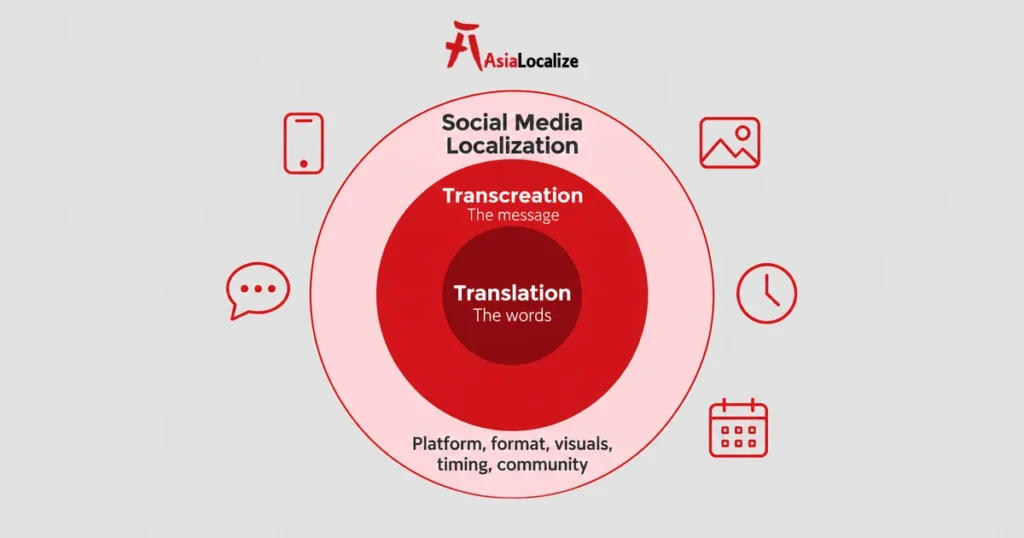
Social media localization is the work of making a brand’s social presence feel native in each market. It covers which platforms you use, what you post, how it looks, when it goes out and how you answer comments. Translation and transcreation are tools inside that process, not substitutes for it.
| What changes | Best used for | |
|---|---|---|
| Social media translation | The language of the post. The message, format and platform stay the same. | Factual updates, product details, customer service replies |
| Transcreation | The message itself, rebuilt to land with the same effect in another culture | Slogans, wordplay, campaign hashtags, headlines |
| Social media localization | Platform choice, format, copy, visuals, timing and community management | Any market where you want an active, growing audience |
Ask a vendor for “translation” when you need a Japanese LINE account that reads as local, and the scope and budget are wrong from day one. Clear terms let marketing leads brief and budget correctly.
“Can’t we auto-translate posts?” Machine translation copes well with literal captions, such as opening hours. It is far less reliable with humor, slang, honorifics and platform conventions, which are what make a post feel local. Many teams use it for a first draft, then have a native linguist adapt it.
Which Social Media Platforms Matter in Each Asian Market?
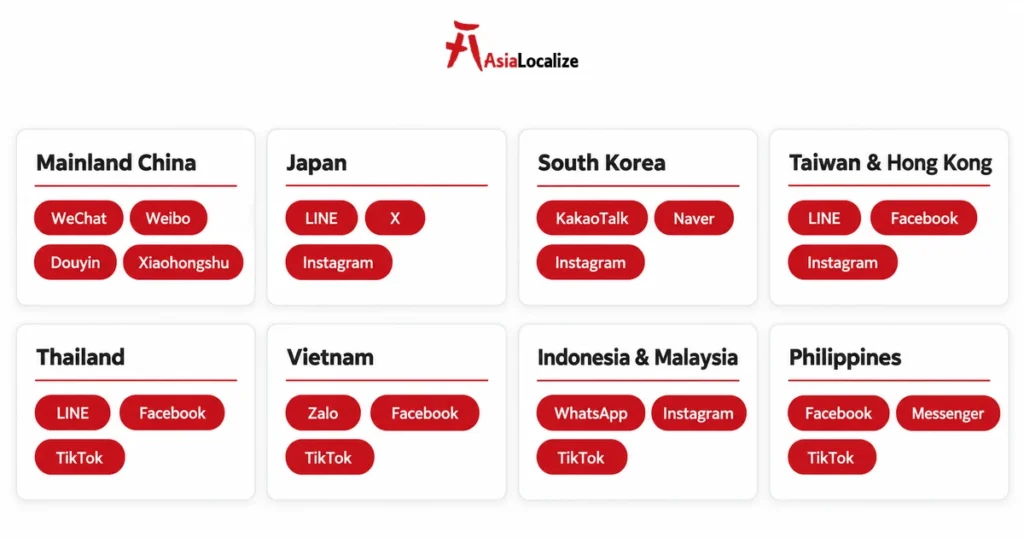
There is no single Asian social media landscape. Each market mixes global apps, local networks and messaging platforms, and in several the messaging app is where brands do most of their work.
| Market | Platforms to plan for | Localization watch-outs |
|---|---|---|
| Mainland China | WeChat, Weibo, Douyin, Xiaohongshu (RED), Bilibili | Separate local accounts; Simplified Chinese; the Advertising Law bans terms such as “national level” and “highest level” |
| Japan | LINE, X, Instagram, YouTube, TikTok | Polite register (keigo) for brand voice; seasonal moments such as Golden Week and Obon |
| South Korea | KakaoTalk (Kakao channels), Naver Blog and Café, Instagram, YouTube | Check Naver for your category; honorific levels; fast-moving slang |
| Taiwan and Hong Kong | LINE (Taiwan), Facebook, Instagram, Threads; WhatsApp (Hong Kong) | Traditional Chinese, with different vocabulary in each; never reuse mainland copy |
| Thailand | LINE, Facebook, TikTok, YouTube | Thai script has no spaces between words, so line breaks and hashtags need care |
| Vietnam | Zalo, Facebook, TikTok, YouTube | Diacritics must be exact; Zalo Official Accounts work much like LINE Official Accounts |
| Indonesia and Malaysia | WhatsApp, Instagram, TikTok, Facebook, YouTube | Bahasa Indonesia and Bahasa Melayu are not interchangeable; Ramadan and Hari Raya calendars |
| Philippines | Facebook, Messenger, TikTok, YouTube | English, Filipino and Taglish mixes; a more informal tone |
Mainland China is the clearest case. Freedom House’s full Freedom on the Net 2024 report on China lists Facebook, Instagram, Twitter (now X), YouTube, WhatsApp and LINE among the platforms blocked there. Its abridged 2025 edition says thousands of domains remain blocked by the Great Firewall. You can’t localize a global account into China, so WeChat marketing and every other channel start from separate local accounts.
The audience is large. Tencent reported 1,439 million combined monthly active users (MAU) for Weixin and WeChat as of 30 June 2026, and Weibo reported 561 million MAU in June 2026.
Japanese social media looks different from a Western channel plan. In the Ministry of Internal Affairs and Communications’ FY2025 media-use survey, published in June 2026, 92.9% of respondents of all ages used LINE. Instagram was at 54.8%, X at 44.7% and Facebook at 27.0%. So the answer to “what is the most popular social media in Japan?” is LINE, with X carrying far more weight than Facebook.
Korean social media runs on its own ecosystem. Kakao reported an average of 49.6 million domestic KakaoTalk MAU in the second quarter of 2026. Before choosing channels, check whether your category is discussed on Naver Blog and Café as well as on Instagram and YouTube.
Southeast Asia and Taiwan also lean on messaging apps. LY Corporation reported 54 million LINE MAU in Thailand and 22 million in Taiwan as of 31 March 2026. In Vietnam, VNG reported 81.3 million Zalo MAU for the second quarter of 2026.
The practical rule: pick two or three platforms per market based on where your audience actually is, not the global channel list. That puts budget on the apps people open daily. For language-specific support, see our Japanese, Korean, Chinese, Thai, Vietnamese, Indonesian, Malay and Tagalog translation services.
Why Localize Social Media? The Business Case
Platforms rank posts partly on how people respond to them, and people respond to content that feels written for them. A translated global post often reads as an import next to local brands.
CSA Research’s Can’t Read, Won’t Buy – B2C survey, published in July 2020, covered 8,709 consumers in 29 countries. Of those, 76% preferred to buy products with information in their own language. Forty percent said they would not buy from websites in other languages.
CSA found that respondents from five Asia-Pacific countries “lead the charge for local language content”: Taiwan (94%), Korea (92%), China (92%), Japan (90%) and Indonesia (88%).
“Our audience reads English.” Some of it does, especially in B2B and in the Philippines, Singapore and Malaysia. Even there, English-only content narrows the market you can reach. These figures give marketing leads a defensible case for localized social media marketing.
What Should You Localize in Every Social Media Post? 8 Checks
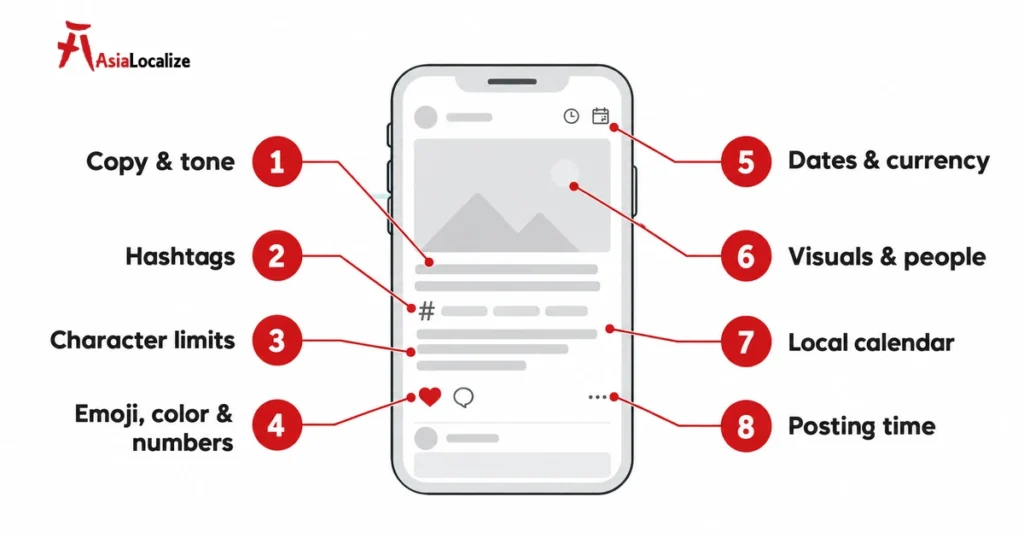
Localizing a post starts with the copy, but it doesn’t end there. Run every post through these eight checks.
- Copy and tone. Japanese and Korean have several politeness levels, so pick one register and keep it consistent. Filipino audiences expect a looser style, often Taglish. Set a tone rule per market.
- Hashtags. Research local hashtags; a translated English tag is often one nobody follows. Thai has no spaces between words, so check where a Thai hashtag starts and ends. Slogans, puns and hashtag campaigns rarely survive literal translation, which is where transcreation services rebuild the message for each market.
- Character limits and script length. Chinese, Japanese and Korean text is compact. But X counts each of these characters as two, capping a post at 140 characters for standard (non-Premium) accounts. Other languages, such as Vietnamese, can run longer than English. Check every image and button with the final copy in place.
- Emoji, color and numbers. Red signals luck and celebration in Chinese-speaking markets, while white is linked with mourning in parts of East Asia. The number four sounds like “death” in Chinese, Japanese and Korean, so avoid it in prices and promotions.
- Visuals and people. Models, settings, food and gestures should look like the market.
- Dates, currency and units. Japan, China and Korea write dates year first. Show prices in local currency with local number formatting.
- Calendar. Plan around Lunar New Year (Seollal in Korea, Tết in Vietnam), Ramadan and Hari Raya, Songkran in Thailand, Golden Week in Japan and Singles’ Day (11.11) in China. Avoid launches that clash with them.
- Posting time. The region spans several time zones, from Jakarta (UTC+7) through Kuala Lumpur (UTC+8) to Tokyo (UTC+9). Schedule each market for its own peak hours.
This list lets content teams get a post right the first time, before a cultural misstep goes live.
How Do WeChat, LINE, KakaoTalk and Xiaohongshu Work for Brands?
On several key Asian platforms, brand messages sit next to personal chats. Choosing the right account type and format before launch saves months of rework.
WeChat is less a feed than an operating system. Brands publish through an Official Account, and readers follow it much as they would subscribe to a newsletter. Weixin’s developer documentation now treats Official Accounts (formerly Subscription Accounts) and Service Accounts as separate account types, each with its own documentation. Mini Programs add app-like functions inside WeChat.
WeChat official account marketing usually combines long-form articles, a menu that routes followers onward, and prompt replies in Chinese. Publishing limits, verification and registration rules for foreign companies change, so confirm the current terms with Weixin before choosing an account type. China runs on its own platforms entirely; our guide to Chinese social media localization covers Baidu SEO and how WeChat, Weibo and Douyin fit together.
LINE
LY Corporation puts LINE at about 100 million monthly active users in Japan as of the end of March 2026. A LINE Official Account lets a business message users who add it as a friend. Content is messaging-first: short broadcasts, coupons and chat replies. Copy has to read as natural Japanese, Traditional Chinese or Thai inside a chat window, not as an ad.
KakaoTalk
Kakao channels work the same way among Korean social media apps. Users add a brand’s channel, and its messages land in the same chat list as friends and family. That closeness raises the bar for tone: honorific level, message length and frequency all need Korean judgment.
Xiaohongshu (RED)
Xiaohongshu is built around “notes”: photo or video posts with long, searchable captions. Many users treat it as a search engine for reviews and recommendations. Brands often work with KOLs (key opinion leaders) and KOCs (key opinion consumers, ordinary users whose reviews carry weight). Copy should sound like a peer’s honest review, not a press release.
How Do You Localize Short-Form Video?
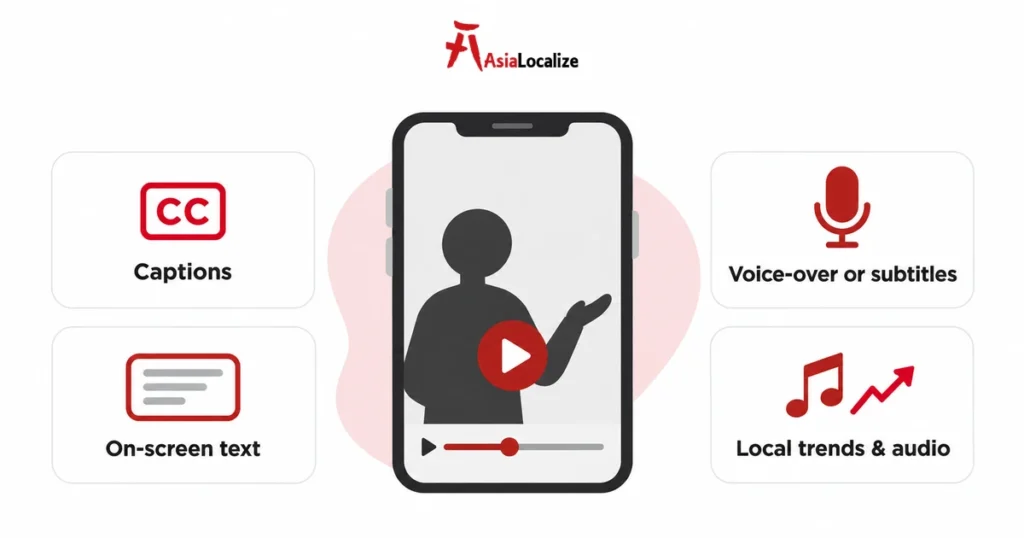
Short-form video on Douyin, TikTok, Instagram Reels and YouTube Shorts is a core format on many of the platforms above. Douyin and TikTok are separate apps with separate accounts, so a TikTok plan doesn’t carry into mainland China. Plan for viewers who may watch with the sound off, so captions and on-screen text can carry the message alone. Localizing a video means making four decisions.
- Burned-in or platform captions. Burned-in captions survive reposting but need an export per language. Platform captions are easier to edit.
- On-screen text. Titles, labels and graphics need translating and re-timing to the edit, not just the speech.
- Voice-over or subtitles. Subtitles are faster and cheaper. A local voice-over can feel more native for explainer and product videos.
- Local trends and audio. Trending sounds differ by market and come with licensing rules, so a video may need a local re-edit.
“We’ll just add subtitles.” Subtitles cover speech, not the on-screen text, trending audio or cultural references the edit depends on. That makes short-form video a multimedia localization job, not a caption add-on, and it lets video perform in each market instead of looking imported.
How Do You Run Social Media Localization at Speed? A 6-Step Workflow
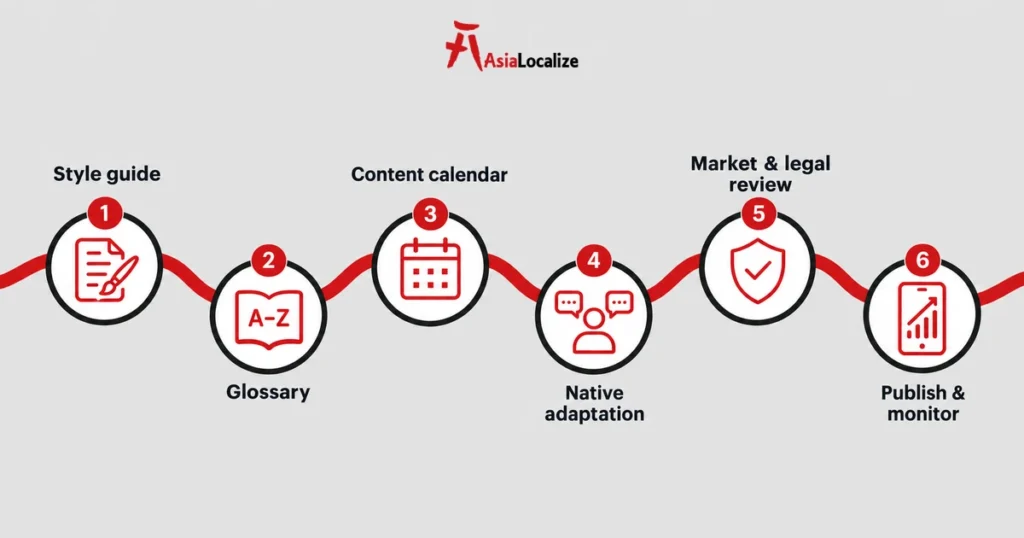
A multilingual social media strategy needs a process that is repeatable and quick. This six-step workflow shows who does what, and where review and legal checks sit.
- Style guide per market. Set the tone, honorific level, emoji use and words to avoid.
- Glossary. Approve brand and product terms in each language once, so every post uses them the same way. Our guide to terminology management explains how to build one.
- Content calendar. Map local holidays, shopping festivals and platform moments for each market.
- Native-speaker adaptation. Linguists adapt each post and flag anything that needs transcreation.
- In-market review, plus legal review where needed. Article 9 of China’s Advertising Law prohibits terms such as “national level” and “highest level” in ads, so check claims before publishing there.
- Publish and monitor. Answer comments in the local language, with clear rules for escalating complaints.
Evergreen posts can go through all six steps. Reactive posts, such as replies to a trend, can’t wait for a full cycle. Pre-approve tone rules, no-go topics and a named reviewer per market, so a reactive post can go out within hours. In-house or through a multilingual social media agency, this keeps every market on-brand without slowing the feed.
How Do You Measure Localized Social Media?
Measure each market on its own terms: engagement rate, follower growth, share and save rate, click-through and conversions. WeChat, LINE and Kakao each report through their own analytics with different definitions, so compare trends within a market, not raw numbers across markets.
To isolate the effect of localization, run fully localized posts against translated-only versions in the same market for a few weeks. The gap in engagement and click-through shows what localization is worth and where to put effort next.
Social Media Localization Checklist
- Choose two or three platforms per market based on current local data.
- Write a style guide and glossary for each market.
- Research local hashtags; don’t translate English ones.
- Adapt visuals, dates, currency and the posting calendar.
- Localize video captions, on-screen text and audio.
- Measure each market against translated-only posts.
Launch Social Content Across Asia
Tell us which markets and platforms you are planning for. Our multilingual digital marketing services include cross-market social media, and our transcreation and multimedia localization teams adapt campaigns and video for each market. AsiaLocalize is ISO 17100 certified, has completed 8,000+ projects and 10 million words, and works in 120+ languages. Explore our localization services or request a quote.
Frequently Asked Questions
What is social media localization?
Social media localization is adapting your social content for a specific market and platform: the language, but also the visuals, video, hashtags, posting times, formats and the platforms you use. It goes beyond translating posts word for word, so the content reads as if it were made for that audience.
What is the most popular social media in Japan?
LINE. In the Ministry of Internal Affairs and Communications’ FY2025 media-use survey, 92.9% of respondents used LINE, ahead of Instagram (54.8%), X (44.7%) and Facebook (27.0%).
Which social media platforms are blocked in China?
Freedom House’s Freedom on the Net 2024 report lists Facebook, Instagram, Twitter (now X), YouTube, WhatsApp and LINE among the platforms blocked in mainland China. Brands reach Chinese audiences through separate local accounts on WeChat, Weibo, Douyin, Xiaohongshu and Bilibili.
What is the difference between social media translation and transcreation?
Social media translation changes the language of a post while the message, format and platform stay the same. Transcreation rebuilds the message itself so it lands with the same effect in another culture, which suits slogans, wordplay, campaign hashtags and headlines.
Should we localize every post?
Not always. Campaign and evergreen posts usually justify full localization. Routine updates can often be translated and reviewed, and some English content can stay as is for English-reading audiences.
Can one Chinese version serve mainland China, Taiwan and Hong Kong?
No. Mainland China uses Simplified Chinese, while Taiwan and Hong Kong use Traditional Chinese, and everyday vocabulary differs between all three. Adapt each version separately.
Can machine translation handle social media posts?
Only partly. Machine translation copes with literal captions such as opening hours, but it is far less reliable with humor, slang, honorifics and platform conventions. Many teams use it for a first draft, then have a native linguist adapt the post.
Does social media localization help people find our posts?
It can. Many users search inside social apps in their own language, so localized captions, keywords and hashtags (the social side of multilingual SEO) give posts a better chance of appearing in those results.