
Scientific translation is the specialized transfer of research and technical knowledge between languages while preserving terminology, methods, numerical data, references, and the author’s intended level of certainty. It enables scientific findings to travel across borders without changing the evidence or conclusions behind them.
According to UNESCO, global scientific publication output increased by 21% between 2015 and 2019, while international research collaboration continued to rise, with nearly one in four scientific publications involving co-authors from multiple countries.
This is where scientific translation takes on a role that extends far beyond language. Translating a scientific document means preserving the integrity of the research itself. Every statistical claim, measurement unit, methodology, confidence level, equation, and carefully qualified conclusion must survive the transition intact. A single misplaced term can alter the interpretation of a study, raise regulatory concerns, delay publication, or undermine years of research.
The rise of AI has undoubtedly changed the translation landscape. Large language models and machine translation engines can process enormous volumes of content in seconds, making multilingual communication faster and more accessible than ever before.
Yet scientific content remains one of the clearest examples of where speed alone can’t guarantee accuracy. Scientific writing is built on precision, consistency, and context, qualities that still demand human judgment when the stakes involve publication, intellectual property, compliance, patient safety, or scientific credibility.
In this guide, we’ll explore what scientific translation really entails, how it differs from technical, medical, and academic translation, where AI fits into today’s workflows, and the quality practices that ensure scientific meaning is preserved from the first sentence to the final citation.
What Is Scientific Translation?
Every scientific discovery is built on evidence, yet that evidence only creates value when other researchers, regulators, healthcare professionals, and organizations can understand it.
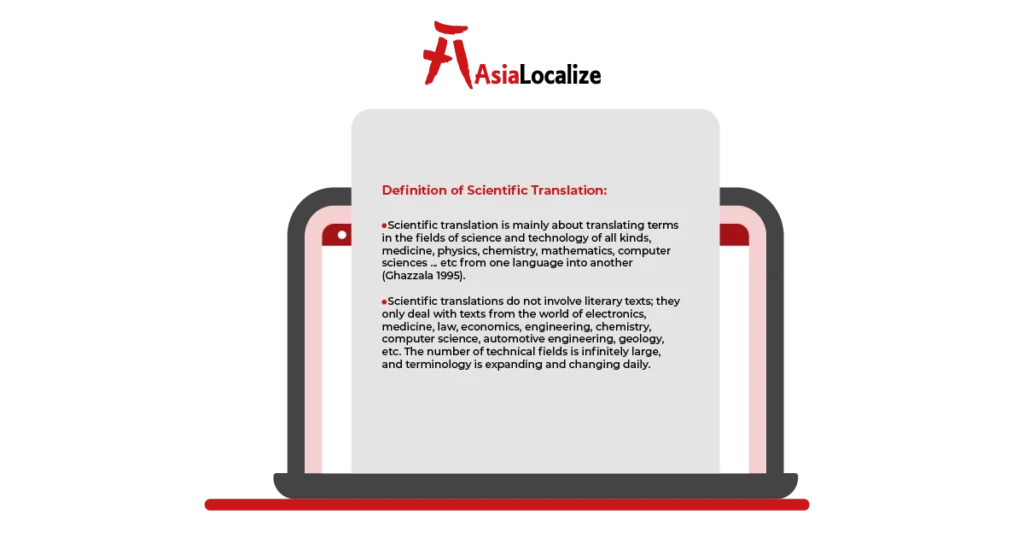
Rather than converting words from one language into another, scientific translation transfers scientific knowledge while preserving the integrity of the original work. It safeguards terminology, experimental methods, statistical findings, measurement units, equations, references, and the carefully calibrated level of certainty behind every conclusion.
The objective extends far beyond producing fluent text; it is to ensure that readers in another language interpret the science exactly as the original authors intended.
Scientific translation supports virtually every discipline where precision matters. While scientific papers often come to mind first, the field encompasses a much broader range of content, including:
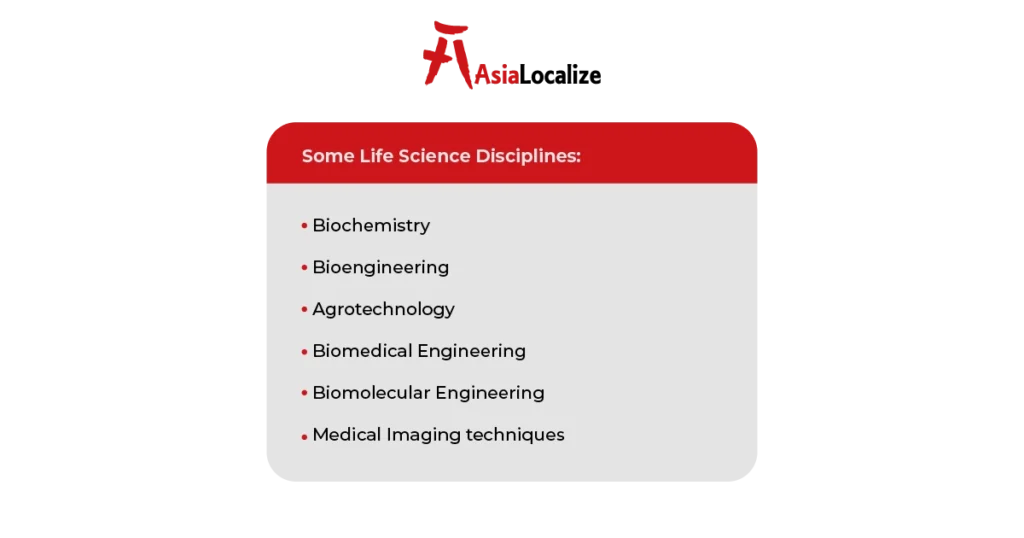
- Medicine and healthcare, from clinical research to epidemiological studies.
- Pharmaceuticals, including drug development, validation reports, and regulatory documentation.
- Biotechnology, covering genomic research, molecular biology, and laboratory innovation.
- Biology and life sciences, where accurate species names, biological processes, and laboratory terminology are essential.
- Chemistry and materials science, requiring exact representation of formulas, reactions, and experimental procedures.
- Physics, where equations, symbols, and standardized terminology must remain intact.
- Engineering, particularly research-driven innovation that combines scientific principles with technical applications.
- Environmental science, including climate research, sustainability reports, and ecological assessments.
- Academic research, such as journal manuscripts, conference papers, grant proposals, and institutional publications.
Across each of these fields, scientific language follows conventions that leave very little room for interpretation. A phrase that appears interchangeable in everyday English may carry a precise methodological or statistical meaning in a research paper. Even small adjustments in wording can unintentionally strengthen—or weaken—the evidence being presented.
Ultimately, successful scientific translation preserves scientific intent. When terminology remains consistent, data retains its original meaning, and conclusions reflect the evidence accurately, research can be reviewed, replicated, published, and trusted, regardless of the language in which it is read.
Why Scientific Translation Demands a Different Standard
Scientific translation demands a level of accuracy that goes far beyond producing natural-sounding text. Every translated document must preserve the scientific meaning behind the original research, from technical terminology and statistical findings to methodology, units of measurement, and carefully qualified conclusions.
Unlike general translation, scientific translation leaves little room for interpretation. Even subtle wording changes can alter how research is understood. Common challenges include:
- Specialized terminology: Scientific terms often have standardized meanings that differ from their everyday use. Choosing the wrong equivalent can change the interpretation of an entire study.
- Statistical language: Words such as significant, associated, correlated, and observed convey precise scientific conclusions. For example, translating significant as important instead of statistically significant overstates the research findings.
- Measurement units and numerical data: Dosage units, concentrations, decimal separators, equations, and reference ranges must remain accurate. Even a small numerical error can have serious consequences, particularly in pharmaceutical and life sciences content.
- Methods and biomarkers: Laboratory techniques, testing protocols, biomarkers, and scientific procedures require recognized terminology rather than literal translation to ensure researchers can correctly interpret and reproduce the work.
- Acronyms and abbreviations: Some abbreviations, such as DNA or PCR, remain universal, while others require localization or expansion depending on the target audience and industry standards.
- The level of certainty: Scientific authors deliberately distinguish between observations, correlations, and proven conclusions. Words like may, suggest, and likely carry important meaning that should never be strengthened or weakened during translation.
The impact extends well beyond language quality. Inaccurate scientific translation can delay journal publication, trigger additional questions during regulatory review, create inconsistencies across international research teams, or introduce unnecessary risk into product documentation. In healthcare and life sciences, communication errors can ultimately affect patient safety.
A review published in the Journal of General Internal Medicine found that language barriers contribute to communication failures that can negatively influence the quality and safety of care, highlighting the importance of accurate multilingual scientific communication.
For that reason, scientific translation follows a fundamentally different standard from general translation.
Scientific, Technical, Medical, or Academic Translation: What’s the Difference?
Specialized translation is often treated as a single category, but in practice, every discipline follows its own priorities. Scientific, technical, medical, and academic translation all demand subject-matter expertise and meticulous attention to detail, yet the translator’s approach changes depending on the document’s purpose, target audience, and intended use.
| Translation Type | Typical Content | Primary Quality Focus |
| Scientific Translation | Research papers, laboratory reports, journal articles, study documentation, scientific communications | Preserving scientific evidence, research methodology, terminology, statistical meaning, and the author’s conclusions |
| Technical Translation | User manuals, engineering specifications, product datasheets, patents, operating instructions | Ensuring technical accuracy, usability, product functionality, and consistency across documentation |
| Medical Translation | Clinical trial documents, medical records, patient information leaflets, healthcare materials, regulatory submissions | Protecting clinical accuracy, patient safety, medical terminology, and regulatory compliance |
| Academic Translation | Theses, dissertations, conference papers, university documents, scholarly articles | Maintaining academic style, logical argumentation, citation standards, formatting, and publication readiness |
Although the categories share common ground, the translator’s workflow shifts considerably from one project to another.
- Scientific translation prioritizes research integrity. Every term, statistical claim, methodology, and conclusion must accurately reflect the original study so researchers can interpret and build upon the findings with confidence.
- Technical translation focuses on functionality. The objective is to ensure that users can safely assemble, operate, troubleshoot, or maintain products without ambiguity. Clarity often takes precedence over stylistic refinement.
- Medical translation carries additional clinical responsibility. Translators must preserve precise medical terminology while considering patient comprehension, healthcare regulations, and the potential consequences of inaccurate information.
- Academic translation supports scholarly communication. Beyond linguistic accuracy, it requires maintaining the author’s voice, academic register, logical flow, citation conventions, and discipline-specific writing style to meet institutional or journal expectations.
Common Scientific Documents and Their Translation Challenges
Scientific translation supports a wide range of documents across research, healthcare, engineering, and life sciences.
Here are some of the most common documents that require scientific translation:
Research Papers and Journal Articles
Research manuscripts require accurate translation of methodology, results, scientific terminology, citations, and publication style.
Scientific Reports and White Papers
These documents often combine technical research with business, regulatory, or policy insights.
Clinical Trial and Life Sciences Documents
Clinical protocols, informed consent forms, investigator brochures, and study materials require consistent terminology and careful attention to regulatory and ethical standards. Our overview of life sciences translation services explains how these high-risk materials are handled.
Laboratory Reports and Test Results
Lab documentation depends on precise units, abbreviations, reference ranges, and formatting.
Grant Proposals and Funding Applications
Grant applications combine scientific expertise with persuasive writing.
Scientific Presentations and Conference Materials
Abstracts, posters, presentation slides, and speaker notes should communicate complex ideas clearly while maintaining consistent terminology and fitting within layout constraints.
Patents and Technical-Scientific Documentation
These documents combine scientific, technical, and legal language. Accurate translation is essential to preserve patent claims, protect intellectual property, and avoid ambiguity during regulatory or legal review.
Although these document types vary in purpose and audience, they all require a translation approach that protects scientific meaning, maintains consistency, and reflects the conventions of the specific field.
What Defines a High-Quality Scientific Translation?
The following quality factors form the foundation of professional scientific translation.
| Quality Factor | Why It Matters |
| Terminology Management | Consistent terminology is essential in scientific communication. Professional translators rely on glossaries, termbases, client-approved terminology, and previously validated translations to ensure the same concept is translated consistently across every document and language. |
| Subject-Matter Expertise | Language skills alone aren’t enough. Scientific content should be translated or reviewed by linguists who understand the relevant discipline—whether biotechnology, chemistry, engineering, medicine, or environmental science—to interpret specialized concepts accurately. |
| Units, Numbers, and Scientific Data | Measurements, equations, symbols, decimal separators, concentrations, and reference ranges must remain accurate throughout the translation. Even minor inconsistencies can change how data is interpreted. |
| Scientific Claims and Levels of Certainty | Research relies on carefully qualified language. Expressions such as may, suggests, associated with, significant, and observed communicate different levels of evidence and should be preserved exactly as intended. |
| Acronyms and Abbreviations | Some abbreviations remain universal, while others require localization or expansion depending on the target audience. Each acronym should be evaluated within its scientific and regional context. |
| Formatting and References | Scientific documents often include tables, figures, captions, citations, appendices, equations, and journal-specific formatting requirements. Preserving these elements helps maintain readability, consistency, and publication readiness. |
| Bilingual Review and Quality Assurance | Every scientific translation benefits from an independent review process. Bilingual revision, automated QA checks, and client feedback help identify inconsistencies before delivery and strengthen future terminology resources. |
Can AI Handle Scientific Translation? Here’s Where It Helps and Where It Doesn’t.
For organizations managing large volumes of internal content, AI can significantly reduce turnaround times and improve accessibility across global teams.
However, scientific content presents challenges that extend beyond language, requiring translators to preserve research methodology, technical terminology, statistical meaning, and carefully qualified conclusions. That’s why the most effective approach is knowing when AI can help and when it doesn’t.
Recent research supports a balanced, risk-based approach. A 2026 ACL study of scientific-paper translation across 28 languages reported strong preservation of key details, yet one-third of participating authors identified overtranslation of technical terms. A 2024 comparative study likewise found complementary strengths between generative AI and human translators rather than a universal replacement for expert review.
AI and machine translation can deliver excellent results for:
- Internal research reviews and reference materials
- Large-volume documents where publication quality isn’t required
- First-pass translations for multilingual teams
- Content that will undergo professional post-editing before publication
However, scientific documents with legal, regulatory, commercial, or clinical implications still require expert human validation. AI can accelerate the process, but it shouldn’t be the final decision-maker when accuracy directly affects research outcomes or business decisions.
Common challenges include:
- Terminology inconsistencies, especially when a scientific term has multiple accepted meanings.
- Overtranslation, where standardized scientific terms are unnecessarily translated instead of using their established equivalents.
- Mistranslated acronyms and abbreviations that vary by discipline or region.
- Hallucinated content, where AI generates plausible—but incorrect—terminology or explanations.
- Changes in scientific certainty, replacing cautious language such as may or suggests with more definitive statements.
- Formatting issues, particularly in tables, equations, references, citations, and structured scientific data.
The table below provides a practical way to decide when AI alone may be sufficient—and when professional scientific translation remains the safer choice.
| Document Purpose | AI Translation | Human Review Recommended? |
| Internal reading or reference | ✅ Suitable | Optional |
| First-pass translation for internal teams | ✅ Suitable | Recommended |
| Publication-ready research papers | ⚠️ Draft only | ✅ Essential |
| Clinical trial documentation | ❌ Not recommended | ✅ Essential |
| Patient-facing scientific or medical content | ❌ Not recommended | ✅ Essential |
| Patent applications and IP documentation | ❌ Not recommended | ✅ Essential |
| Regulatory submissions and compliance documents | ❌ Not recommended | ✅ Essential |
| Business-critical scientific reports | ⚠️ Draft only | ✅ Essential |
Inside a Professional Scientific Translation Workflow
While workflows may vary depending on the document type and industry, professional scientific translation typically follows these essential steps.
1. Understand the Project Scope
Every successful project starts with context. Before translation begins, the team reviews the document type, scientific discipline, target language, intended audience, regulatory requirements, deadline, and overall risk level.
2. Build the Terminology Foundation
Translators gather client-approved glossaries, terminology databases, style guides, previous translations, journal requirements, and any reference materials that help ensure consistent language throughout the project.
3. Assign the Right Subject-Matter Expert
Scientific knowledge matters just as much as language proficiency. A biotechnology paper benefits from a linguist familiar with life sciences, while an engineering report requires someone who understands the terminology and conventions of that field. Matching expertise to the content helps preserve both accuracy and context.
4. Choose the Best Translation Approach
Not every project follows the same workflow. Depending on the document’s purpose, risk level, and timeline, the project may be translated entirely by a human specialist or begin with machine translation followed by professional post-editing (MTPE).
5. Perform an Independent Bilingual Review
Translation is only one part of the quality process. A second linguist compares the translated document against the source text to verify scientific meaning, terminology, consistency, and completeness. This independent review helps identify issues that a single translator may naturally overlook.
6. Complete Quality Assurance and Formatting Checks
Before delivery, every document undergoes a final quality review. This includes verifying terminology, measurement units, numerical values, acronyms, references, tables, figures, captions, formatting, and layout to ensure the translated version mirrors the original in both content and presentation.
7. Deliver, Review, and Improve
After delivery, client feedback, approved terminology, and project-specific preferences are incorporated into translation memories and terminology databases, creating a stronger foundation for future projects and improving consistency across multilingual documentation.
Your Research Changed the Science. Don’t Let the Translation Change the Research.
A single translated sentence can influence how a study is interpreted, whether a manuscript gets published, how regulators review documentation, or how international teams build on your work.
At AsiaLocalize, we help research institutions, pharmaceutical companies, biotech innovators, engineering firms, and life sciences organizations communicate scientific knowledge across languages without compromising its meaning. From peer-reviewed articles and laboratory reports to clinical trial documentation and patents, every project is translated with the precision your research deserves.
Your science has already done the hard work. Let us make sure the world understands it exactly as you intended.
Explore our scientific translation services or request a consultation.
Scientific Translation, AI, and Confidentiality
Confidentiality is part of translation quality. Unpublished research, patent material, clinical data, and proprietary findings should only be processed in organization-approved systems with appropriate access controls, contractual safeguards, and data-handling terms. Sensitive content should not be entered into public AI tools without explicit authorization.
Frequently Asked Questions About Scientific Translation
What is scientific translation?
Scientific translation transfers research and technical knowledge between languages while preserving terminology, methods, numerical data, references, and the author’s intended level of certainty. It is used for research papers, laboratory reports, patents, clinical documentation, and other specialist materials.
What documents require scientific translation?
Common documents include journal manuscripts, abstracts, research reports, laboratory results, study protocols, grant applications, conference materials, patents, pharmaceutical documentation, and scientific website content.
Can AI translate scientific research accurately?
AI can accelerate first drafts and terminology research, but unreviewed output may overtranslate established terms, alter scientific certainty, mishandle context, or introduce unsupported wording. Publication-ready, confidential, regulatory, clinical, and intellectual-property content should receive expert human validation.
How is scientific translation different from technical translation?
Scientific translation prioritizes the integrity of evidence, methods, results, and conclusions. Technical translation focuses primarily on the accurate and usable communication of products, systems, operating instructions, and engineering specifications.
What qualifications should a scientific translator have?
A scientific translator should combine professional translation competence with subject-matter knowledge in the relevant discipline, terminology research skills, familiarity with document and publication conventions, and the ability to verify data, units, citations, and levels of certainty.