Every localization team eventually faces the same reality: the demand for multilingual content grows faster than any traditional translation pipeline can keep pace with. Product teams ship faster. Marketing campaigns launch globally on the same day. Support documentation expands every quarter. Suddenly, what used to be a manageable localization workload becomes a constant race against scale.
Yet the stakes are high. Language quality directly affects how global customers perceive a brand. In fact, a 2020 CSA Research survey found that 76% of online shoppers prefer products with information in their own language, while 40% will not buy from websites in other languages.
This puts global companies in a difficult position. On one hand, businesses must scale multilingual content quickly to compete in international markets. On the other hand, publishing raw machine translation can expose brands to mistranslations, awkward phrasing, regulatory risks, or messaging that simply fails to resonate culturally.
That gap between speed and quality is exactly where machine translation post-editing (MTPE) proves its value.
Rather than replacing professional translation, MTPE allows organizations to combine the efficiency of machine translation with the expertise of professional linguists who review, correct, and refine the output until it meets real publication standards.
In this article, we’ll break down when MTPE actually works, where it can fall short, and how localization teams integrate it into scalable content operations, so global growth does not come at the cost of quality.
What Is Machine Translation Post-Editing?
Machine translation post-editing refers to the process in which professional linguists review and refine machine-generated translation so that it meets a high-quality standard. Rather than translating from scratch, the linguist starts with machine-translated output and improves it through restructuring and contextual adaptation.
Within the localization workflow, MTPE typically sits between machine translation generation and final quality assurance. A simplified pipeline often looks like this:
- Source content prepared and segmented
- Machine translation generates the initial output
- Post-editors review and refine the translation
- Terminology and style consistency verified
- QA checks confirm formatting, tags, and locale accuracy
The goal remains straightforward: deliver translation that reads naturally, preserves meaning, and aligns with brand voice.
Post-editing also integrates seamlessly with modern localization technology. Translation memories, terminology databases, and automated QA tools help linguists focus their attention on what machines still struggle to handle well, context, tone, ambiguity, and cultural nuance.
Light vs Full Machine Translation Post-Editing
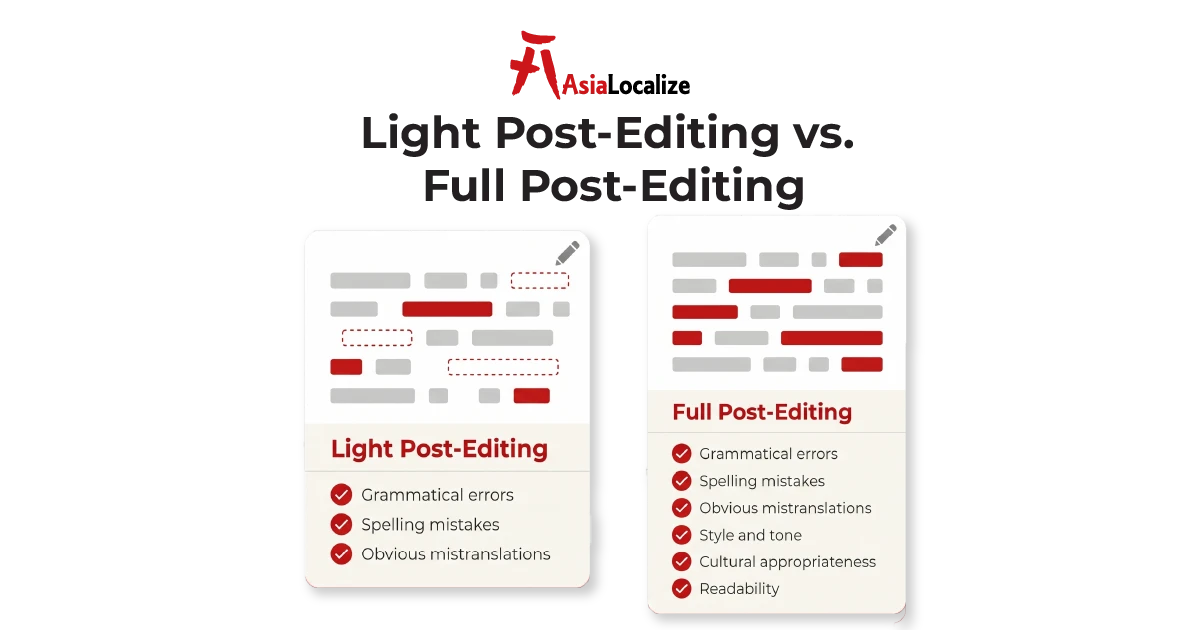
Not every piece of content requires the same level of refinement. One of the most important distinctions in MTPE lies between light post-editing and full post-editing, each designed for different business needs.
Light Post-Editing
Light post-editing focuses on comprehensibility rather than stylistic perfection. The goal involves correcting major errors while leaving minor linguistic imperfections untouched.
Editors typically address:
- mistranslations that distort meaning
- missing words or grammatical breakdowns
- terminology errors that affect understanding
- obvious readability issues
Light post-editing works well for content where speed and comprehension matter more than polished style, such as:
- internal documentation
- user-generated content moderation
- support knowledge bases
- large volumes of informational text
Full Post-Editing
Full post-editing targets publication-ready quality. Linguists refine machine output until the final translation reads as if produced entirely by a human translator.
The process includes:
- stylistic refinement and natural phrasing
- brand voice alignment
- terminology consistency
- cultural and contextual adaptation
- grammar, punctuation, and readability improvements
Full post-editing becomes essential for customer-facing materials, including:
- marketing campaigns
- website content
- product interfaces
- legal and regulatory documents
When applied carefully, full MTPE can achieve quality comparable to traditional human translation while still improving turnaround times.
Use our Machine Translation Evaluation framework to benchmark quality and reduce risk.
Machine Translation Post-Editing Workflow: 5 Practical Steps
Machine translation post-editing succeeds or fails long before the linguist touches the text. The difference between efficient MTPE and frustrating clean-up work often comes down to preparation, terminology control, and quality assurance processes.
Successful MTPE programs follow a structured workflow that prepares content for automation while preserving the linguistic precision global audiences expect.
Step 1: Prepare Localization Files and Formats for MTPE
Effective machine translation post-editing starts with clean, structured source files. Poorly prepared localization files create confusion for both machines and linguists, often introducing errors that require manual correction later.
Before sending content through MT systems, localization teams typically verify several structural elements:
UI strings and segmentation
Short interface strings often lack context. Provide notes or screenshots so post-editors understand where the text appears within the product interface.
Placeholders and variables
Dynamic elements such as {username}, %d, or {count} must remain intact. These placeholders should be protected during translation to prevent functional errors.
Tags and markup
HTML tags, XML structures, and formatting elements must stay consistent. Broken tags can damage layouts or disrupt product interfaces.
Structured content formats
Files extracted from JSON, XLIFF, YAML, or CMS environments require segmentation that keeps structure intact while allowing machines to process text safely.
Step 2: Choose the Right MT Engine and Define Terminology Rules
Machine translation performs best when guided by clear linguistic rules. Without terminology control, even strong neural MT engines may produce inconsistent vocabulary across large projects.
That risk becomes especially visible in product documentation, legal text, or brand messaging.
A well-configured MTPE workflow, therefore, begins with clear linguistic guidance.
Select the right MT engine for the language pair
Different engines perform better across different domains. Engines trained on technical documentation behave differently from those optimized for conversational content.
Build a terminology base (termbase)
Terminology management ensures key terms remain consistent across languages. Product names, technical terms, and brand expressions should follow predefined translations.
Style rules guide tone, voice, and grammar preferences. These guidelines help post-editors maintain consistent messaging across large content sets.
Define “do-not-translate” lists
Brand names, product identifiers, or technical commands should remain unchanged. Protecting these terms prevents unnecessary corrections later.
Step 3: Post-Edit Machine Translation with a Clear QA Checklist
Once machine output enters the post-editing stage, linguists focus on transforming raw translation into clear and culturally appropriate content.
Rather than rewriting everything, professional post-editors evaluate the output through a structured quality lens.
A practical MTPE checklist often includes the following review points:
Meaning accuracy
Verify that the translation preserves the intent of the source text. Machines sometimes misinterpret ambiguous phrases or domain-specific expressions.
Terminology consistency
Ensure key terms match the approved glossary or termbase.
Grammar and readability
Improve sentence flow, punctuation, and natural phrasing so the text reads smoothly for native speakers.
Style and tone alignment
Adjust language to match brand voice, audience expectations, and regional communication styles.
Formatting and placeholders
Confirm variables, tags, and formatting remain intact.
User interface constraints
UI elements often have strict character limits. Post-editors must keep translations concise while preserving meaning.
Localization teams also pay attention to language-specific technical issues:
CJK languages (Chinese, Japanese, Korean)
These languages require careful spacing, line-break handling, and font rendering to ensure readability in interfaces.
RTL languages such as Arabic and Hebrew
Bidirectional text and layout mirroring require additional QA checks to maintain proper display across UI elements and documents.
Scale Your Content Faster with Our Machine Translation & AI Services.
Machine Translation Post-Editing Playbooks for Localization Teams
MTPE delivers value only when supported by clear content tiering and structured TMS workflows. Below are two practical playbooks used by mature localization teams.
A Content-Tiering Playbook: Deciding What Gets MT, MTPE, or Human Translation
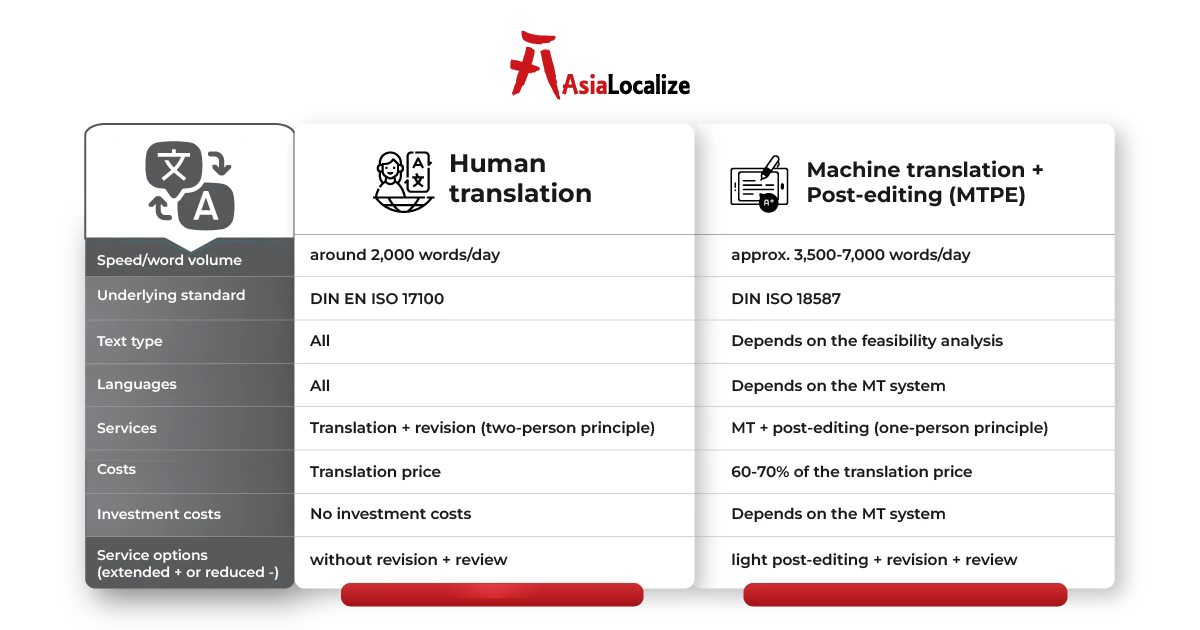
Not all content carries equal risk or business impact. A disciplined content-tiering model allows teams to align translation strategy with content importance.
A practical way to evaluate content involves three variables:
- Risk (legal, regulatory, reputational impact)
- Visibility (internal vs public-facing exposure)
- Shelf Life (temporary vs long-term content)
| Risk | Visibility | Shelf Life | Recommended Approach |
| Low | Internal | Short-term | MT-only (with light QA) |
| Medium | Public-facing | Short to medium | MT + Light or Full MTPE |
| High | Public-facing | Long-term | Full Human Translation or Full MTPE with rigorous QA |
MT-Only
Appropriate for:
- Internal documentation
- Informational content with limited exposure
- User-generated content moderation
MT + MTPE
Best suited for:
- Product support articles
- App content updates
- E-commerce descriptions
- Marketing assets with moderate risk
Post-editing ensures tone, terminology, and clarity meet publication standards.
Full Human Translation
Reserved for:
- Legal contracts
- Regulatory filings
- High-visibility brand campaigns
- Executive communications
How a TMS Supports Machine Translation Post-Editing at Scale
A TMS does far more than store files. It governs routing, assignments, review cycles, and quality gates across distributed teams.
Here is how leading teams structure MTPE workflows inside a TMS environment:
1. Automated Routing
Content is automatically categorized by tier and routed accordingly:
- MT-only content flows directly to delivery with light QA.
- MTPE content routes to post-editors.
- High-risk content routes to senior linguists or full TEP workflows.
2. Smart Assignments
Linguists are selected based on:
- Domain expertise
- Language pair specialization
- Familiarity with approved terminology
3. QA Gates
Structured QA checkpoints verify:
- Terminology adherence
- Formatting and tag integrity
- UI constraints
- Linguistic accuracy
Automated QA tools flag inconsistencies before final approval.
4. Handoffs with Context
Clear context—screenshots, audience details, tone guidelines—travels with the content through each stage. This minimizes ambiguity and accelerates review.
5. Feedback Loops
Post-edit corrections feed back into:
- Translation memories
- Terminology databases
- MT engine training
Over time, machine output improves, reducing editorial effort in future cycles.
Why Do Leading Localization Teams Rely on Translation Memory?
Read This to Learn More.
Machine translation post-editing works best when treated as part of a broader localization strategy rather than a quick efficiency shortcut. The organizations seeing real results approach MTPE with structure: clear content tiering, strong terminology management, well-prepared localization files, and linguists who understand both the target language and context. Technology accelerates the process, while human expertise protects meaning, tone, and cultural nuance.
That balance matters because global communication rarely follows a single model. Some content benefits from rapid MT workflows. Other materials demand careful post-editing. High-risk or brand-critical content may require full human translation from the start. The challenge for most teams lies in choosing the right approach for each content type without slowing down international growth.
At AsiaLocalize, this is exactly where our role begins. Rather than applying one rigid workflow, we design localization strategies around how your content actually moves across markets. Our linguists, engineers, and project managers evaluate the nature of your material, the languages involved, and the level of risk or visibility attached to each asset. From there, we build a workflow that combines the right mix of technology and human expertise.
If you are exploring how machine translation post-editing fits into your localization strategy, our team can help you build a solution tailored to your content and growth plans.
Explore our MTPE Services.