Before anyone argues about tone, terminology, or “style preferences,” Translation Quality Assurance quietly decides whether your content will work—or fail—once it leaves your source language.
Because poor translation doesn’t usually explode on launch day. It leaks. It shows up as customer hesitation, compliance questions, internal rework cycles, and brand messages that sound almost right but not quite trustworthy.
The risk is measurable. In a 2020 CSA Research survey of 8,709 consumers, 76% of online shoppers said they prefer to buy products with information in their native language, and 40% said they never buy from websites in other languages.
A single missed nuance can trigger legal review delays, regulatory pushback, or expensive post-launch corrections, often costing more than getting it right before release.
If you’ve ever fixed the same translation twice—or wondered why “approved” content still feels off, this checklist will give you the answer.
Translation Quality Assurance by Content Type
Not every translation needs the same QA depth. A product UI, legal document, medical label, and marketing page each carry different risks. The best translation quality assurance process adjusts the review level based on content visibility, complexity, and potential business impact.
| Content Type | Main QA Risk | Recommended QA Level |
|---|---|---|
| Website content | Tone, SEO meaning, cultural fit, formatting | Linguistic review + locale review + SEO checks |
| Software and app UI | Truncation, placeholders, broken strings, poor context | In-context review + functional localization QA |
| Legal documents | Ambiguity, clause meaning, jurisdiction-specific wording | Expert legal review + terminology validation |
| Medical and life sciences content | Safety, terminology, regulatory meaning | Subject-matter review + strict LQA scoring |
| Marketing content | Brand voice, persuasion, cultural relevance | Transcreation review + native market validation |
| Technical documentation | Terminology, consistency, formatting, usability | CAT-tool QA + glossary checks + layout review |
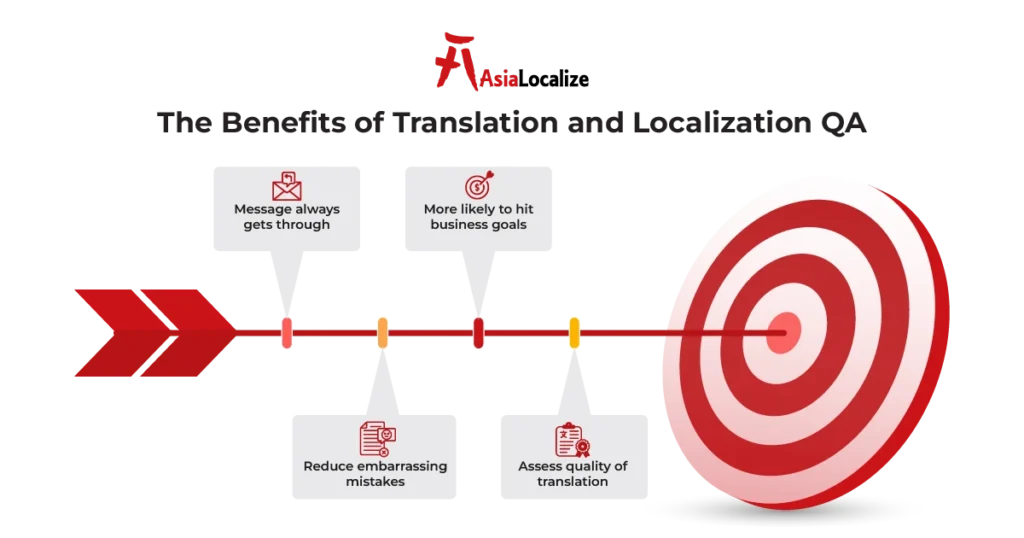
This is where translation quality assurance becomes more than a final proofreading step. It helps teams choose the right level of control before the project begins, so high-risk content receives deeper review while lower-risk content moves faster.
What Is Translation Quality Assurance?
In mature localization programs, TQA serves as the framework that ensures translated content is accurate, consistent, compliant, and relevant to real users in the target market. It’s what turns translation from a deliverable into a reliable business asset.
At its core, Translation Quality Assurance is a structured process used to verify that translated content meets predefined linguistic, technical, and contextual standards before it reaches the end user.
A solid TQA framework typically evaluates whether the translation is:
- Accurate – Faithful to the source meaning, intent, and tone
- Consistent – Terminology, style, and phrasing align across files, products, and releases
- Fit for purpose – Appropriate for the target audience, culture, and use case
- Technically sound – Free of formatting, truncation, encoding, or UI-related issues
- Compliant – Aligned with regulatory, legal, or brand requirements where applicable
This aligns closely with the quality principles defined in ISO 17100, the international standard for translation services, which emphasizes qualified linguists, defined workflows, and systematic quality control
Translation Quality Control vs. Translation Quality Assurance: Checking the Output vs. Protecting the Outcome
If you’ve worked in localization long enough, you’ve probably heard the terms Quality Control and Quality Assurance used interchangeably. They’re not. And confusing them is one of the fastest ways teams end up fixing the same problems release after release.
At a glance, the difference sounds subtle. In practice, it defines whether quality is reactive or designed into the process.
Quality Control tells you what went wrong.
Quality Assurance helps you understand why it went wrong and how to stop it from happening again.
Translation Quality Control (QC) focuses on the finished output.
It typically involves spot checks or post-translation reviews that look for:
- Linguistic errors (grammar, spelling, mistranslations)
- Terminology mismatches
- Formatting or layout issues
- Missing or truncated content
QC answers an important question:
Does this specific translation meet our basic quality expectations right now?
Instead of only checking results, QA evaluates the entire translation ecosystem:
- Source content readiness
- Briefing quality and context availability
- Terminology governance and style guidance
- Linguist qualifications and specialization
- Tooling, workflows, and handoffs
- Review criteria and feedback loops
QA asks different questions:
- Are translators set up to succeed before they start?
- Are errors traceable to unclear source text, missing glossaries, or poor handover?
- Are reviewer comments being analyzed—or just applied and forgotten?
The Four Types of Localization QA
Translation Quality Assurance rarely works in isolation. In a full localization program, linguistic accuracy is only one of several quality layers, and each one protects a different part of the user experience. Understanding the four main types helps teams scope the right checks for the content in front of them, instead of applying the same review to everything.
1. Linguistic QA
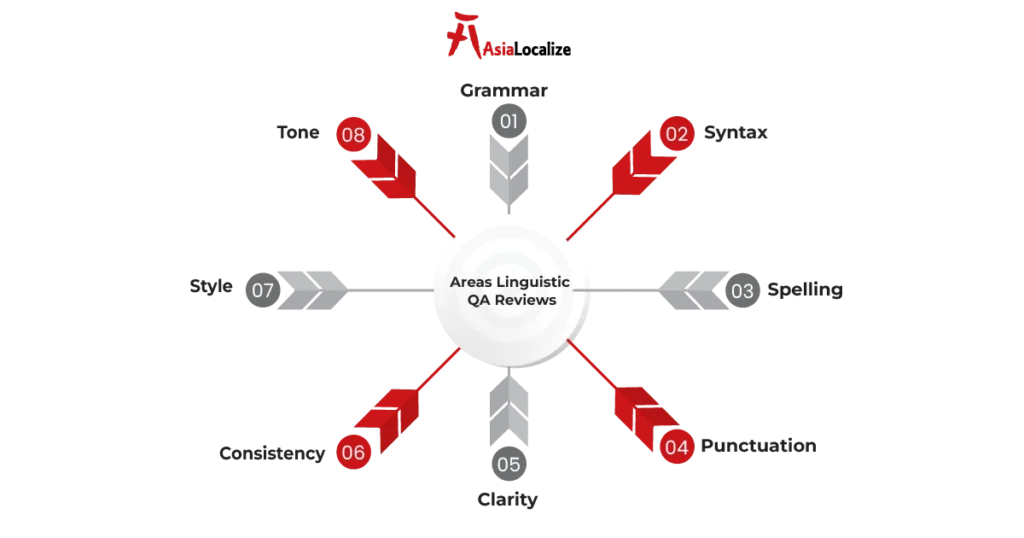
Linguistic QA confirms that the translated text reads naturally for the target audience: linguistically, culturally, and stylistically. A phrase that works in one language can fall flat or mislead in another, so native reviewers assess grammar, spelling, punctuation, syntax, style, tone, and consistency in context rather than word by word.
2. Visual QA
Visual QA checks that the localized design still works once translated text is in place. It reviews formatting, imagery, icons, color choices, fonts, and layout for both cultural fit and technical correctness. Text embedded in images has to match the translation, and right-to-left languages such as Arabic and Hebrew require the layout to be mirrored so the interface does not appear misaligned.
3. Functional QA
Functional QA verifies that the localized product behaves exactly like the original. Reviewers test buttons, menus, navigation, links, forms, and input fields, and confirm the build renders correctly across the devices and operating systems that matter in the target market. The goal is identical usability, regardless of language or locale.
4. Cultural Adaptation
Cultural adaptation makes sure text and visuals match local expectations and avoid unintended offense. Colors, symbols, gestures, and imagery can carry very different meanings from one market to the next, so reviewing them early prevents missteps that are far more expensive to fix after launch.
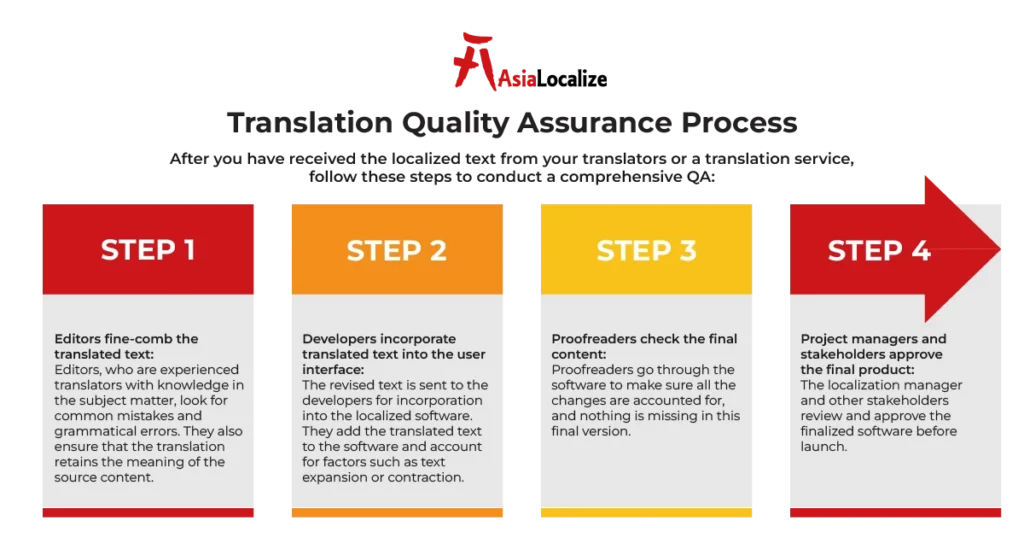
The Translation Quality Assurance Workflow
When translation quality breaks, it rarely fails at a single point. It fails across a chain of decisions—some made before translation begins, others during production, review, or handoff. By the time a problem is visible to stakeholders or users, it has usually passed through several stages unchecked.
The process below breaks Translation Quality Assurance into practical stages that reflect how professional localization teams actually work. Each step has a clear purpose, a specific risk it addresses, and a measurable impact on consistency, cost, and brand credibility.
Once you see how the pieces connect, the checklist stops feeling like bureaucracy and starts feeling like control.
1. Preparation: Where Most Quality Is Won—or Lost
The most common QA failure happens before translation even starts.
Preparation ensures translators aren’t forced to guess—and guessing is where inconsistency, rework, and tone drift begin.
A strong prep stage includes:
- Source content cleanup: resolving ambiguity, inconsistencies, or last-minute copy changes
- Style guides that define tone, formality, punctuation, and brand voice
- Approved terminology aligned with product, legal, and marketing teams
This stage directly supports the quality principles defined in ISO 17100, which emphasize clear specifications and reference materials as prerequisites for quality outcomes.
2. Production: Quality at Scale with the Right Guardrails
During production, quality depends on controlled reuse, not repetition.
Professional teams rely on:
- CAT tools to enforce terminology and structural consistency
- Translation memory (TM) to reuse validated segments and reduce variation
- In-context constraints that protect formatting, tags, and variables
For high-volume or time-sensitive content, machine translation post-editing (MTPE) extends this stage: linguists refine machine-generated output so it meets professional, culturally aligned standards without sacrificing terminology consistency or speed.
3. Review: Linguistic Validation
Review works best when it’s targeted.
Instead of reviewing everything the same way, mature QA programs apply:
- Editing and proofreading by qualified native reviewers
- LQA sampling, using defined error categories and severity levels
- Objective scoring models to track trends over time—not subjective preferences
Because Quality Is Earned in the Details.
Explore our editing and proofreading services.
4. Final Checks: Automated QA and Layout Validation
Before delivery, automated QA acts as a final safety net.
This stage typically includes:
- Automated checks for numbers, tags, punctuation, and consistency
- Encoding and character validation (critical for non-Latin scripts)
- DTP and layout checks to catch truncation, overflow, or UI breakage
These checks don’t replace human review—they protect it. They ensure that approved linguistic quality survives real-world formats and platforms.
5. The Feedback Loop: Where QA Becomes Strategy
This is the step many teams skip—and the one that separates QA from QC.
A real Translation Quality Assurance process closes the loop:
- Reviewer feedback feeds back into terminology and translation memory updates.
- Recurring issues trigger rule adjustments, tooling changes, or training.
- Quality data is tracked across releases to identify areas for improvement.
Our structured translation process aligns people, tools, and QA checks.
Linguistic Quality Assurance: How LQA Measures Translation Quality
At some point, every localization team hits the same wall: “We know something feels off—but how bad is it, really?”
LQA is the measurement layer inside Translation Quality Assurance. It takes subjective feedback, “this sounds wrong,” “the tone is off,” “terminology isn’t consistent,” and turns it into structured data that teams can analyze, compare, and act on.
LQA exists to catch those issues before users do and to explain why they happen.
What Linguistic Quality Assurance Actually Measures
Most professional LQA frameworks measure errors across three dimensions:
1. Error Categories
Errors are classified by type so teams can see patterns. Widely adopted models group issues into categories like:
- Terminology – incorrect or inconsistent use of approved terms
- Accuracy – mistranslations, omissions, or additions that distort meaning
- Fluency – grammar, syntax, or unnatural phrasing in the target language
- Locale conventions – date formats, numbers, cultural norms, regulatory usage
- Style and tone – deviations from brand voice or audience expectations
2. Severity Levels
Not all errors carry the same weight. LQA distinguishes between:
- Critical errors that change meaning or introduce legal, safety, or reputational risk
- Major errors that significantly affect clarity or user trust
- Minor errors that don’t block understanding but reduce polish
3. Scoring and Thresholds
Once errors are categorized and weighted, LQA produces a quality score. This allows teams to:
- Track quality trends across languages, vendors, or releases
- Set acceptance thresholds for different content types
- Identify recurring weak points that require process changes
Translation QA Checklist: The Non-Negotiables to Check Every Time
This checklist distills the essentials. It’s what you should verify every single time, across languages and content types.
Terminology & Glossary Alignment
- Approved terms are used consistently across files
- No unauthorized synonyms for product, legal, or brand-critical terms
- Updates from recent releases are reflected in the glossary and TM
Numbers, Dates, Units, and Measurements
- Numbers match the source exactly (including decimals and separators)
- Dates, currencies, and units follow local conventions, not source habits
- No hardcoded values carried over incorrectly
Tags, Placeholders, and Formatting
- All tags, variables, and placeholders are intact and correctly positioned
- No broken strings, missing brackets, or reordered variables
- Formatting survives copy expansion or contraction
Consistency Across Files and Screens
- Repeated strings read the same way everywhere they appear
- Tone and phrasing are stable across modules, screens, or documents
- No unexplained variation caused by parallel translation or rushed updates
Locale and Cultural Fit
- Content respects local norms, formality levels, and expectations
- No culturally awkward phrasing, imagery references, or metaphors
- Regulatory or market-specific wording is appropriate
Final DTP and Visual Checks
- No text overflow, truncation, or layout breaks
- Line breaks, alignment, and reading order make sense in context
- Visual hierarchy still works after translation
The difference between content that passes review and content that earns trust is almost always the same: a Translation Quality Assurance process that’s intentional, repeatable, and grounded in how real users read, buy, and decide.
At AsiaLocalize, Translation Quality Assurance is embedded across our workflows, from source preparation and terminology governance to CAT-tool-driven consistency, structured linguistic QA, and feedback loops that actually reduce rework over time. Our teams design processes that prevent them from recurring.
Professional Translation Services Backed by Real QA.