
Most teams chasing global reach make the same mistake. They swing too far toward cookie-cutter global strategy models — or splinter into hyper-local chaos. Either way, they miss that sweet spot in between: the transnational path.
Actually, the language services market is booming — estimated at USD 71.7 billion in 2024, growing at ~5.6 % year on year. Separately, in marketing and retention, the math is compelling: a 5 % lift in retention often translates into 25–95 % more profit.
In the next seven minutes, you’ll get clarity: what transnational strategy truly means, how it compares with global, international, and multidomestic approaches, when to use it, and how to bring it to life.
What Transnational Strategy Really Means?

A Transnational Strategy is what happens when a global system grows roots. It’s the balance between keeping what makes you strong and flexing where markets breathe differently — one shared backbone, many local hearts.
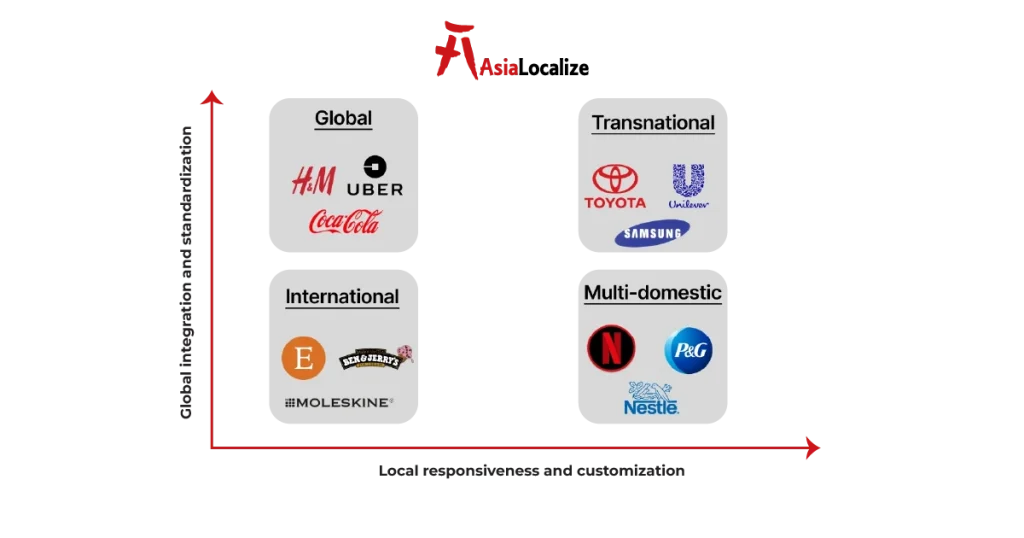
On the integration–responsiveness grid, it lives in the top-right corner — the point where global integration meets local responsiveness. And that’s exactly where the world’s fastest-growing brands now play.
Across industries, the data keeps repeating the same truth. Companies that localize their customer experience generate up to 1.5× more revenue per user than those that don’t. Meanwhile, organizations that maintain centralized operations within an integrated global management workflow reduce costs by 25%.
Beyond Labels — How Transnational Strategy Outgrows the Old Models

For long, strategists tried to pick sides: pure standardization or pure local freedom. But each major model has its blind spots — and the numbers tell those stories.
Global Strategy
Uniformity wins scale, but can dull local soul. Consumers are more likely to trust a brand when it “authentically reflects today’s culture.” 73% of people say a brand’s credibility increases when it shows cultural awareness rather than doing “product-only” messaging.
International Strategy
Here, headquarters steers the show, and local tweaks are minimal. It’s predictable, but often misaligned with market nuance, which is what customers feel, not always see.
Multidomestic Strategy
Go full local, lose the thread. This route gives adaptation, but often kills cross-market synergies.
Transnational Strategy
This is the balance: governed adaptation plus economies of scale. You get a global backbone and local wings — the infrastructure holds, the local autonomy speaks.
When to Choose a Transnational Strategy
The signs appear quietly at first:
Your audiences stop behaving like one market. What delights customers in Tokyo barely moves the needle in Dubai. Regulatory frameworks start to diverge. Pricing, payment methods, even humor — everything feels slightly off unless it’s tailored.
That’s the moment when a transnational strategy stops being optional and starts being inevitable.
Data backs this shift:
According to CSA Research, 76% of global consumers prefer to buy from brands that speak their language, and 40% won’t purchase at all from websites that aren’t localized. Companies that respond to these cues early see 1.5–2× higher engagement and revenue per user than those that rely on uniform global campaigns.
A transnational model fits when your world looks like that —
- Markets with personality: high cultural contrast and distinctive consumer signals.
- Regulated terrain: data residency, labeling, or sector-specific compliance that resists one-size-fits-all.
- Operational muscle: enough shared infrastructure to keep control without crushing creativity.
But it’s not for everyone. If your market volumes are small or your governance is still forming, the model will strain before it scales. In those cases, stay global or international — until your systems can truly synchronize.
Scale faster with our IT & software translation services.
The Operating Model — Turning Strategy into Motion
A transnational strategy only matters when it moves.
The difference between theory and transformation lies in how you build the machine — one global core, many adaptive layers, all connected by a single rhythm of measurement and refinement.
1. Define the Global Core
Every strong transnational strategy starts with a clear heartbeat — a defined global core.
That includes product specifications, brand voice, and playbooks — the rules that hold your ecosystem together.
The most effective global teams operate through a center of excellence, setting shared decision rights (RACI) so that subsidiaries can move fast without losing alignment.
2. Build Local Adaptation Layers
This is where global relevance becomes real. Each layer — marketing, tech, compliance, CX — adapts intelligently without fragmenting the brand.
Marketing & SEO:
Transcreation, keyword localization, hreflang optimization, and pricing/currency alignment ensure that your campaigns don’t just translate — they convert.
Read the full breakdown on Multilingual SEOand how global visibility really works.
Product & Tech:
i18n, l10n, resource files, ICU, RTL, feature flags, and release trains keep your code multilingual by design.
Compliance & CX:
From accessibility (WCAG) to data residency, labeling, and localized support, this layer makes your operations trustworthy — and that’s the ultimate competitive edge.
3. Tooling & Quality Assurance
Technology turns consistency into muscle memory. A well-integrated TMS/CAT ecosystem — with translation memory, termbases, style guides, and live LQA — keeps your multilingual operations precise and predictable. Even more striking, studies show that incorporating Translation Memory (TM) into localization workflows drives productivity gains of 10–70% and reduces delivery time by nearly 50% on average.
4. Measure, Learn, and Iterate
No transnational model is ever “done.” The smartest teams run experimentation/A-B testing, use dashboards to track CVR uplift and retention, and keep both a global PM and a local owner accountable.
The KPIs That Prove Your Strategy Works
A transnational strategy only works if the data says it does. Four lenses matter more than the rest:
1. Acquisition
The first test of relevance is whether people can find you in their own language. Localized content and multilingual SEO consistently outperform global templates.
Across industries, brands that localize web and search experience record a 40% rise in local organic traffic within a single year.
2. Conversion
Here, you measure intent turned real: cart completion, trial-to-paid flow, checkout drop-off.
Even minor cultural or linguistic friction shows instantly in the numbers.
CSA Research found that 65% of consumers prefer content in their language even if quality is lower.
3. Engagement
When customers feel a brand speaks their way, satisfaction rises sharply. Research shows that experience-led growth strategies—those that raise customer satisfaction by at least 20%—can deliver tangible financial results: a 15–25 % increase in cross-sell rates, a 5–10 % boost in share of wallet, and an overall 20–30 % improvement in engagement and satisfaction.
4. Operations
The silent indicators: time-to-market, rework rate, cost per word or feature. These show whether your system scales smoothly or drags under its own weight.
Teams using integrated TMS workflows with translation memory and centralized terminology experience 15–25 % fewer revision cycles on average, thanks to version control and unified linguistic assets
A transnational strategy matters only when it holds under pressure. When teams in different markets move at different speeds yet remain aligned, and when language connects operations instead of dividing them.
This is the ground we have worked on for years. We build systems that let global direction and local instinct exist in the same frame. We refine the details that most people never see — the workflows, the glossaries, the reviews that keep everything coherent.
Over time, that kind of consistency changes how a company feels from the inside. Decisions become faster, messages stay intact, and growth stops depending on luck.
That is the work we do every day: keeping global companies understandable everywhere they choose to belong.
Set the global standard with our professional translation services!