Legal translation rates commonly fall around US$0.10–$0.20 per source word for business documents or US$25–$60 per page for straightforward certified documents. These are planning benchmarks drawn from publicly available provider guides—not a universal tariff or an AsiaLocalize quote. Your final legal translation cost depends on the language pair, destination jurisdiction, legal complexity, certification, formatting, security, and deadline.
A one-page birth certificate does not carry the same linguistic, legal, or compliance requirements as a cross-border merger agreement, patent portfolio, or court filing. The receiving authority may also require a certified, sworn, notarized, or legalized translation, and those terms are not interchangeable.
This 2026 pricing guide explains how per-word, per-page, hourly, and project fees work; what a quote should include; and how businesses can control costs without increasing legal risk.
What Does Legal Translation Cost? A Practical Pricing Guide

There is no universal price tag for legal translation. A fair quote reflects the level of expertise, quality assurance, and legal precision your documents require rather than applying a flat fee across every project.
Across the market, simple certified documents, such as birth certificates, marriage certificates, academic transcripts, and driver’s licenses, are commonly priced per page.
More complex legal materials—including contracts, court filings, litigation bundles, compliance documents, and corporate agreements—are typically quoted per source word or as a custom project, allowing translation providers to account for legal complexity, terminology research, formatting, multilingual review, and certification requirements.
Industry surveys also show that professional translation rates vary significantly depending on language pair and specialization, with legal work consistently commanding higher rates because of its technical nature and the risk associated with inaccuracies.
Rather than asking “What’s the average price?” a better question is: What exactly am I paying for? The answer often determines whether your translation will simply read correctly or stand up to legal scrutiny.
Typical Legal Translation Pricing Models
While every translation provider has its own pricing model, publicly available pricing guides offer a general idea of what you can expect when budgeting for legal translation services.
| Pricing Model | Best Suited For | How It Works |
| Per Page | Birth certificates, marriage certificates, diplomas, passports, affidavits | A fixed fee is charged per page, making it easy to estimate costs for standardized official documents. |
| Per Word | Contracts, commercial agreements, court documents, compliance files, legal correspondence | Pricing is based on the source-language word count, offering greater accuracy for documents that vary in length and complexity. |
| Per Project | Multi-document legal matters, due diligence, mergers and acquisitions, multilingual litigation, ongoing legal support | A customized quote reflects the project’s scope, legal specialization, formatting, review process, confidentiality requirements, and delivery schedule. |
Legal Translation Pricing at a Glance
Although pricing differs between providers, publicly available market data suggests the following general benchmarks:
| Document Type | Common Pricing Approach | 2026 Planning Benchmark |
| Certified civil documents, such as birth or marriage certificates | Per page or per document | About US$25–$60 per page |
| Contracts, agreements, and business legal documents | Per source word or custom project | About US$0.10–$0.20 per source word |
| Litigation, patents, due diligence, and multilingual matters | Project or hourly quote | Quoted after scope, risk, review, formatting, and security are assessed |
Methodology and disclaimer: The ranges above were reviewed in September 2026 and converted to broad US-dollar planning bands from public pricing guides. They do not represent a regulated global average or AsiaLocalize pricing. The American Translators Association notes that there is no single standard “going rate”; language availability, subject difficulty, jurisdiction, minimum fees, certification, formatting, confidentiality, and turnaround all affect the final quote. Always request an itemized estimate for the actual files and intended use.
How Legal Translation Rates Are Calculated
The pricing model depends largely on the document itself, how it will be used, and the amount of linguistic and legal work involved.
Professional translation providers typically choose one of three pricing models: per word, per page, or per project. Each approach offers a different level of flexibility depending on the document format, complexity, and scope of work. Understanding how these models work makes it easier to compare quotes, budget accurately, and know what you’re paying for before a project begins.
Per-Word Pricing: The Standard for Editable Legal Documents
Per-word pricing remains the most common approach for legal documents that can be edited electronically. Contracts, terms and conditions, corporate policies, compliance documentation, shareholder agreements, NDAs, employment contracts, court submissions, and legal correspondence typically fall into this category.
Charging by the source-word count provides a transparent pricing structure because the project scope can be measured before translation begins. It also allows translation providers to estimate the effort required for terminology research, legal consistency, quality assurance, and multilingual review.
This model works particularly well for businesses handling recurring legal documentation, where document volumes fluctuate but word counts remain easy to calculate.
Per-Page Pricing: Best for Official and Certified Documents
Per-page pricing is commonly used for standardized legal documents with predictable layouts. Birth certificates, marriage certificates, passports, driver’s licenses, academic transcripts, police clearance certificates, immigration paperwork, and other official records are frequently quoted this way.
For clients, this pricing model offers simplicity. Since these documents generally follow a consistent format, a fixed page rate makes estimating costs straightforward without counting every word.
That said, not every page requires the same amount of work. A densely formatted certificate containing handwritten notes, multiple stamps, seals, annotations, or poor scan quality often demands additional time for careful interpretation, formatting, and quality checks. Documents requiring certified translation may also involve certification statements or jurisdiction-specific formatting requirements, which can influence the final quote.
Project or Hourly Pricing: Built for Complex Legal Work
Some legal projects extend well beyond straightforward translation. Large-scale litigation support, multilingual eDiscovery, due diligence documentation, merger and acquisition files, arbitration bundles, formatting-intensive PDFs, multilingual contract review, and ongoing legal support often require project-based or hourly pricing instead.
Rather than measuring a project solely by word count, this model reflects the complete scope of work. That may include terminology management, desktop publishing, multilingual coordination, legal review, repeated revisions, secure file handling, dedicated project management, and expedited delivery across multiple jurisdictions.
This pricing structure also provides greater flexibility for law firms and multinational organizations managing evolving legal matters, where documents are added, revised, or reviewed continuously throughout the engagement.
The table below outlines how different legal document types are commonly priced and the factors that typically influence their overall cost.
| Document Category | Common Examples | Typical Pricing Approach | Key Cost Factors |
| Simple civil documents | Birth certificates, marriage certificates, passports, national IDs, police clearance certificates | Usually per page or per document | Language pair, certification requirements, document condition, and turnaround time |
| Contracts and agreements | Commercial contracts, NDAs, employment agreements, supplier agreements, lease contracts | Usually per source word or per project | Legal terminology, document length, consistency, multilingual review, and formatting |
| Court and litigation files | Judgments, pleadings, witness statements, depositions, evidence bundles | Typically custom quoted | Confidentiality, legal complexity, document volume, expedited deadlines, and review requirements |
| Corporate legal documents | Articles of association, board resolutions, powers of attorney, business licenses, shareholder resolutions | Per source word or custom project | Certification, notarization requirements, layout preservation, regulatory compliance, and multilingual formatting |
| Intellectual property (IP) documents | Patent applications, patent claims, trademark filings, licensing agreements, IP disputes | Usually higher per-word rates or custom pricing | Combined legal and technical terminology, terminology consistency, specialist expertise, and precision |
| Immigration legal documents | Visa applications, affidavits, civil records, supporting evidence, immigration forms | Commonly per page or per document | Certified translation requirements, jurisdiction-specific wording, completeness, and formatting accuracy |
Why Legal Translation Costs Vary from Project to Project
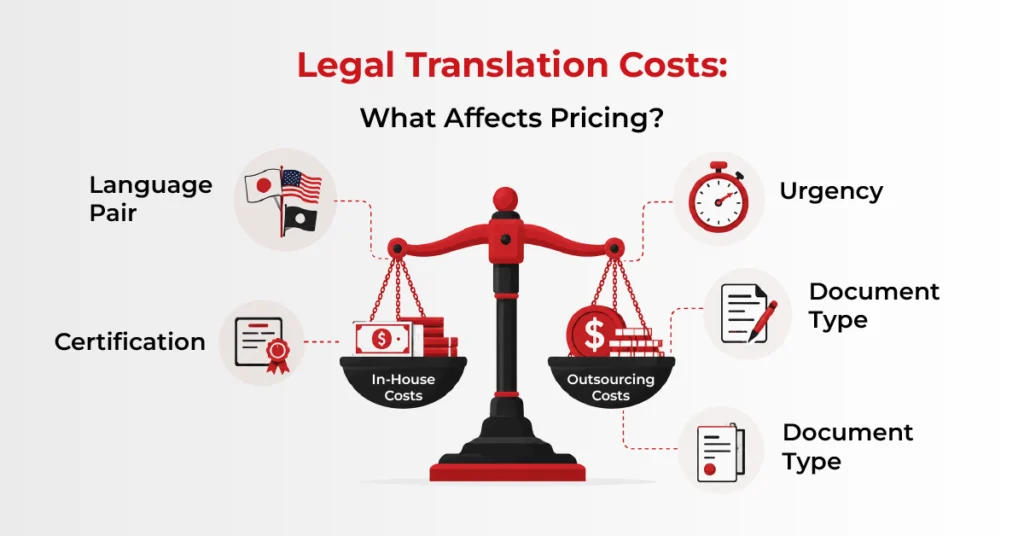
Two legal documents with the same word count can receive very different quotes. Every project carries its own combination of legal risk, linguistic complexity, formatting requirements, and quality expectations, all of which shape the time, expertise, and review process involved.
| Factor | Why It Affects Cost |
| Language pair | Common language combinations generally offer a larger pool of qualified legal translators. Less common pairs often require highly specialized professionals with expertise in both legal systems, increasing availability challenges and project costs. |
| Legal complexity | Documents involving patents, litigation, financial regulations, compliance frameworks, arbitration, or cross-border commercial law require subject-matter expertise and meticulous terminology management, often adding time for research and quality review. |
| Certification requirements | Certified, sworn, notarized, or legalized translations may involve additional administrative procedures, jurisdiction-specific wording, official declarations, or coordination with authorized translators, depending on the destination country’s requirements. |
| Turnaround time | Expedited delivery often requires dedicated translators, parallel review workflows, after-hours scheduling, or additional project management resources to meet strict legal deadlines without compromising quality. |
| Document formatting | Scanned PDFs, handwritten annotations, stamps, seals, tables, signatures, and complex layouts frequently require desktop publishing (DTP) or manual formatting to preserve the appearance and integrity of the original document. |
| Quality assurance level | High-stakes legal documents commonly undergo a multi-step quality process that includes translation, editing, proofreading (TEP), terminology validation, and, where appropriate, review by a legal subject-matter expert. The international standard ISO 17100 defines requirements for professional translation processes and resources, including revision by a second qualified person. Raw machine-translation output is outside the standard’s scope. |
| Confidentiality and security | Legal files often contain privileged or commercially sensitive information. Secure workflows may include non-disclosure agreements (NDAs), encrypted file transfers, restricted-access environments, secure storage, or dedicated project teams, all of which contribute to the overall scope of the project. |
Smart Ways to Lower Legal Translation Costs
Whether you’re translating a single contract or managing multilingual legal documentation across multiple jurisdictions, the following practices can help optimize your investment while maintaining the level of precision legal documents demand.
Start with Editable Files Whenever Possible
Whenever available, provide documents in their original editable format—such as Microsoft Word, Excel, or PowerPoint—instead of scanned PDFs or image files.
Editable files allow translators to focus on the translation itself rather than reconstructing layouts, manually extracting text, or recreating tables and formatting. They also reduce transcription errors and shorten desktop publishing (DTP). For complex file preparation, see our document translation services.
Combine Related Documents into One Project
If you’re translating several legal documents for the same transaction, case, or regulatory filing, submit them together whenever possible.
Working from a single project allows translators to maintain consistent terminology, company names, clause references, defined terms, and formatting across every file. It also minimizes duplicate work and streamlines quality assurance, particularly when multiple reviewers are involved.
Share Existing Reference Materials
Existing bilingual contracts, approved translations, legal glossaries, style guides, or preferred terminology provide valuable context before translation begins. A structured terminology management process is especially useful for recurring clauses and defined terms.
Rather than researching established legal terms from scratch, translators can build on previously approved language, resulting in greater consistency and faster production.
Plan Ahead to Avoid Rush Fees
Urgent legal matters are sometimes unavoidable, but advance planning almost always leads to a more efficient—and often more cost-effective—translation process.
Rush projects may require dedicated linguists, parallel editing workflows, after-hours coordination, or priority project management to meet strict filing or closing deadlines. Allowing sufficient time gives translation teams greater flexibility to allocate the most suitable legal specialists without compressing the quality assurance process.
Confirm Certification Requirements Before the Project Begins
Different courts, government agencies, universities, and immigration authorities may require different forms of certification.
Before requesting a translation, verify whether the receiving authority requires a certified, sworn, notarized, or legalized translation. A certified translation normally includes a signed statement of accuracy; notarization verifies the signer’s identity; a sworn translation must be completed by an authorized translator in jurisdictions that use that system; and an apostille authenticates a public document for use in another Hague Convention country. Requirements vary, so ask the receiving authority first. Learn what a certificate of translation accuracy includes.
Match the Level of Review to the Level of Risk
Separating high-risk legal content from lower-risk supporting documents allows translation providers to allocate the appropriate level of linguistic expertise and quality assurance to each file.
This approach helps organizations invest where accuracy matters most while avoiding unnecessary costs on documents with lower legal exposure. A documented translation quality assurance workflow also makes quote comparisons more meaningful.
Accuracy Delivers the Greatest Long-Term Savings
The most effective way to control legal translation costs is to prevent avoidable work before it begins. Clear project requirements, editable source files, consistent terminology, realistic timelines, and early confirmation of certification needs all contribute to a smoother translation process—and often a more predictable budget.
Ultimately, legal translation should be viewed as a safeguard rather than a simple line item. Investing in accuracy from the outset reduces the risk of revisions, rejected submissions, compliance issues, and costly misunderstandings, helping organizations save both time and resources over the life of a project.
What Information Is Needed for an Accurate Quote?
Send the actual files whenever confidentiality rules allow, or provide a representative sample through an approved secure channel. A reliable quote should confirm:
- source and target languages, including regional variants;
- source word, page, or character count—Chinese, Japanese, and Korean content may be priced by source character;
- document type, legal subject, destination country, and receiving authority;
- whether certification, sworn translation, notarization, legalization, or an apostille is required;
- deadline, editable-file availability, layout recreation, hard-copy delivery, and revision scope;
- security requirements, including NDA, encryption, access controls, and retention rules;
- what the fee includes: translation, second-person revision, proofreading, project management, formatting, and taxes.
Ask whether the quote is based on source words or target words and whether minimum charges, rush fees, certification, courier fees, or DTP are separate. For repeated content, an approved translation memory may reduce duplicate effort, but discounts should never remove required legal review.
Legal Translation Rates: Frequently Asked Questions
How much does legal translation cost per word?
Public provider guides commonly show planning ranges around US$0.10–$0.20 per source word for business legal documents. Specialist patents, litigation, rare language pairs, rush work, and enhanced review can cost more.
How much does a certified translation cost per page?
Straightforward certificates are often advertised around US$25–$60 per page, but dense text, handwriting, poor scans, stamps, formatting, notarization, and hard-copy delivery can change the price.
Is legal translation priced by source words or target words?
Most editable documents are quoted by the source-language count because it is known before work begins. Confirm the unit in writing; some Asian languages are measured by source characters rather than words.
Do certified, notarized, sworn, and apostilled translations cost the same?
No. They are different processes, and the required process depends on the destination authority and jurisdiction. Administrative, notary, legalization, apostille, and courier fees may be quoted separately.
What causes rush fees?
Urgent delivery may require reserved linguists, parallel workflows, after-hours coordination, or priority review. Ask for the fastest realistic deadline that retains the necessary quality checks.
Can AI reduce legal translation costs?
Technology can assist terminology and repetition management, but confidential or high-risk documents require an approved secure workflow and qualified human review. Do not upload privileged files to public AI tools without authorization.
Protect Every Word That Matters
Legal documents leave little room for interpretation. Every clause, defined term, and jurisdiction-specific requirement must be translated with precision to preserve its legal meaning and intended effect.
At AsiaLocalize, we combine legal expertise with native-speaking linguists, rigorous quality assurance, and industry-specific terminology management. Explore our legal translation services for contracts, compliance files, court documents, corporate records, and multilingual legal matters.
Tell us about your project, and we’ll prepare a customized quote based on your document type, certification needs, and delivery timeline.