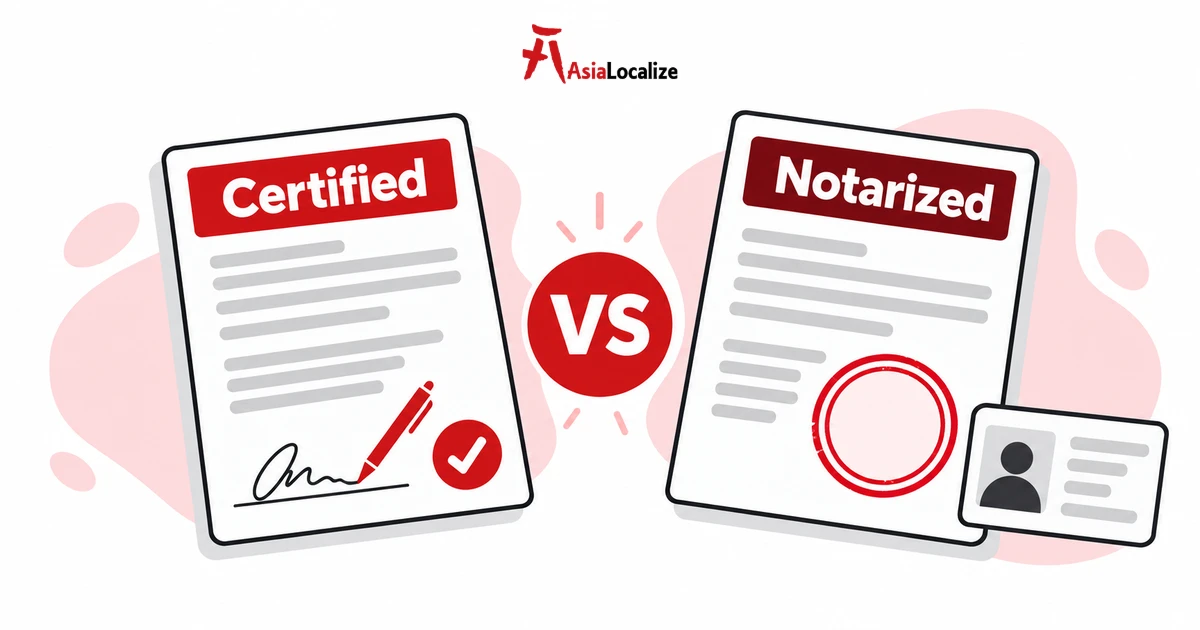
Certified vs notarized translation, in short: a certified translation is a complete translation with the translator’s signed statement that it is accurate and that they are competent in both languages. A notarized translation is that same certified translation signed in front of a notary, who confirms the signer’s identity but never checks the translation. The office receiving the document decides which one you need.
A visa file comes back because the consulate wanted a notarized translation and you sent a certified one. Or you paid a notary for a document that only needed the translator’s signed statement. Both mistakes come from the same confusion.
In the certified vs notarized translation question, the two are not grades of the same product. Notarization adds a check on who signed the translator’s statement, not on the quality of the translation.
This guide covers what each one is, a side-by-side comparison, and who asks for which. It also explains sworn translations and apostilles, how nine Asian countries handle official translations, and the order of steps for documents crossing borders.
Key takeaways
- Certified means the translator signs a statement of accuracy and competence. That is all USCIS asks for under 8 CFR 103.2(b)(3).
- Notarized adds a notary who confirms who signed. The notary never reads or checks the translation.
- Sworn translations and apostilles are different things. Sworn translators are officially appointed in many civil-law countries; an apostille authenticates a signature or seal, not the content.
- The receiving office decides. Ask it in writing what it accepts before you order, and keep the reply.
What Is a Certified Translation?
So what is a certified translation? It is a complete translation plus a signed statement from the translator or translation company. The statement declares that the translation is complete and accurate, and that the translator is competent in the language pair. This certified translation statement is often called a Certificate of Translation Accuracy, and its wording matters more than its layout.
A typical statement gives the translator’s or company’s name and contact details, the language pair, declarations of accuracy and competence, a signature, and a date.
“Certified translation” describes the document, not the person. A “certified translator” holds a personal credential, such as ATA certification. The American Translators Association, a professional association, advises that a translator does not need to be certified to provide a certified translation. Its guidance also says the US has no federal or state licensing for translators.
Does a certified translation need a stamp? The US immigration rule, 8 CFR 103.2(b)(3), asks only for the translator’s certification and does not mention a seal. Some Asian countries expect a seal or an appointed translator, as shown below. A certification of translation sample shows the usual format, but the receiving office’s own wording rules come first.
What Is a Notarized Translation? The Notary Checks the Signer, Not the Words
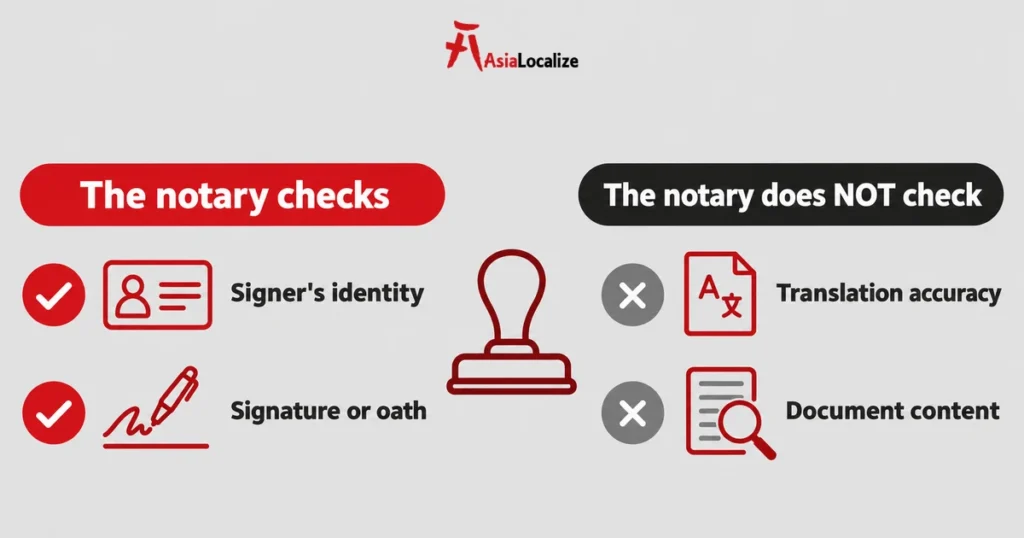
A notarized translation is a certified translation whose accuracy statement is signed in front of a notary public. The translator often signs it as a sworn statement, called an affidavit of translation. The notary confirms the signer’s identity and witnesses the signature or oath.
The notary does not read the translation or judge its accuracy. California requires its jurat form to carry a boxed notice saying the notary verifies only the signer’s identity, not the document’s truthfulness, accuracy, or validity. The American Translators Association, a professional association, gives the same guidance for translations: the notary is not attesting to accuracy.
That is why the certified notarized translation is what most people actually receive. Notarization sits on top of a certification; it does not replace it. An office that asks you to translate and notarize usually means two steps: certify the translation, then notarize that certification. A notarized translation sample shows the translation, the signed statement, and the notary’s certificate and seal.
Some US states allow remote online notarization. Texas, for example, lets online notaries work over two-way audio and video, with the signer located anywhere. Whether a foreign authority accepts it is a question for that authority.
Is notarized better because it looks more official? It adds a check on identity, not quality. Notarize only when the receiving office requires it, and save the cost and the extra step everywhere else.
What Is the Difference Between Certified and Notarized Translation?
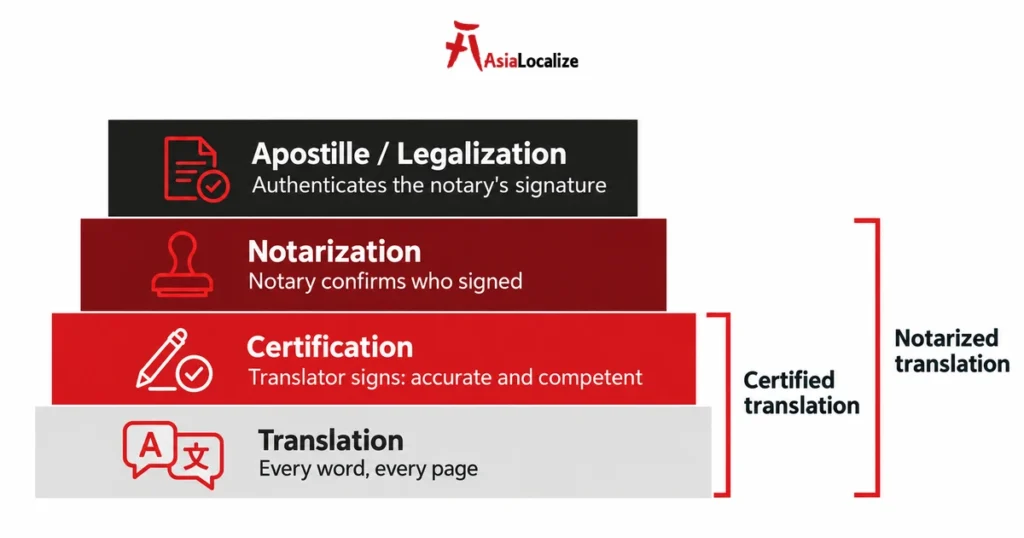
Notarized vs certified is rarely a choice you make on preference: the receiving authority sets the requirement. The certified translation vs notarized translation difference comes down to who signs, what each proves, and who checks what. The last row is the one most comparisons leave out.
| Certified translation | Notarized translation | |
|---|---|---|
| Who signs | The translator or a company representative | The translator, before a notary who adds a notarial certificate |
| What it proves | The translation is complete and accurate, and the translator is competent | The same, plus who signed it |
| Who checks it | The receiving office reviews the translation | The notary checks the signer’s ID, never the translation |
| Typical cost | Translation fee; varies by provider | Translation fee plus notary fee; varies by provider and location |
| Typical turnaround | Translation time only | Translation time plus a notary appointment |
| Common requesters | USCIS and offices whose rules say “certified” | Offices, courts, or counterparties whose rules name notarization |
| Accepted abroad on its own? | Not automatically. The destination may want an apostille, legalization, or a local sworn translator | Not automatically. The notarization may still need an apostille or legalization |
Who Requires a Certified vs Notarized Translation?
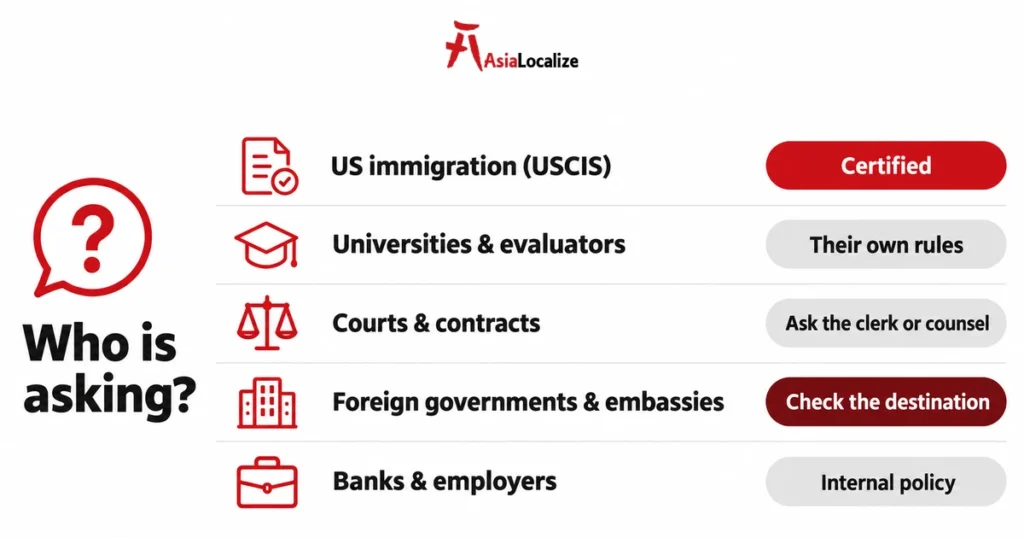
Start from who will receive the document, not from the translation. The same birth certificate can need a certified translation for one office and a notarized one for another.
| Who is asking | What to expect | How to confirm |
|---|---|---|
| USCIS (US immigration) | Certified: a full English translation with the translator’s certification of accuracy and competence. No notarization in the rule. | 8 CFR 103.2(b)(3) |
| US universities, credential evaluators | Their own rules. Some accept only their own translators or forms. | Read the institution’s published requirements. |
| US courts, contracts, real estate | Varies by court, state, and counterparty. | Ask the clerk or the other party’s counsel in writing. |
| Foreign governments, embassies, consulates | Set by the receiving country. Some accept an applicant’s own translation, some require notarization, and some designate translators. | See the MOFA Japan FAQ; ask the destination agency. |
| Banks, employers, HR, global mobility | Internal policy, which differs by institution and document. | Ask the compliance or HR contact. |
The USCIS certified translation rule is short, and the USCIS Policy Manual adds that a summary is unacceptable. Anyone who needs to translate a birth certificate, a marriage certificate, or a court record for USCIS must translate every line.
If a court or counterparty requires a notarized translation, ask whether the translator must sign an affidavit of translation. Providers of Legal Translation Services can tell you what they are able to supply, but the court or the other party decides what it accepts.
The golden rule: ask the receiving office in writing what it accepts before you order, and keep the reply.
“Should I just get it notarized to be safe?” It adds cost and time. For use abroad it is often not the last step, because the notarization may need an apostille or legalization.
What Are Sworn Translations and Apostilles?
Sworn translation. Many civil-law countries appoint sworn translators whose signature and seal make a translation official without a notary. In Spain, the foreign ministry grants the title, and sworn translations have official character before courts and administrative bodies. Indonesia’s law ministry appoints a sworn translator (penerjemah tersumpah) under Ministerial Regulation 29 of 2016.
Apostille. Under the 1961 Hague Apostille Convention, an apostille certifies the authenticity of a signature, the signer’s capacity, and any seal on a public document. The HCCH states plainly that an apostille does not authenticate the document’s content. Notarial acts count as public documents under Article 1, which is why a notarized translation can receive an apostille.
Legalization. Article 2 of the Convention defines legalization as the destination country’s diplomatic or consular agents certifying the signature and seal. In practice it takes several steps, usually your own foreign ministry first, then the destination’s embassy. Countries outside the Convention still use it.
So what is the apostille and notary difference? A notary witnesses a signature; an apostille authenticates the notary’s or official’s signature for use in another member country. Neither checks the translation, so apostille translations and the apostille itself are separate steps.
How Do Asian Countries Handle Certified and Notarized Translations?
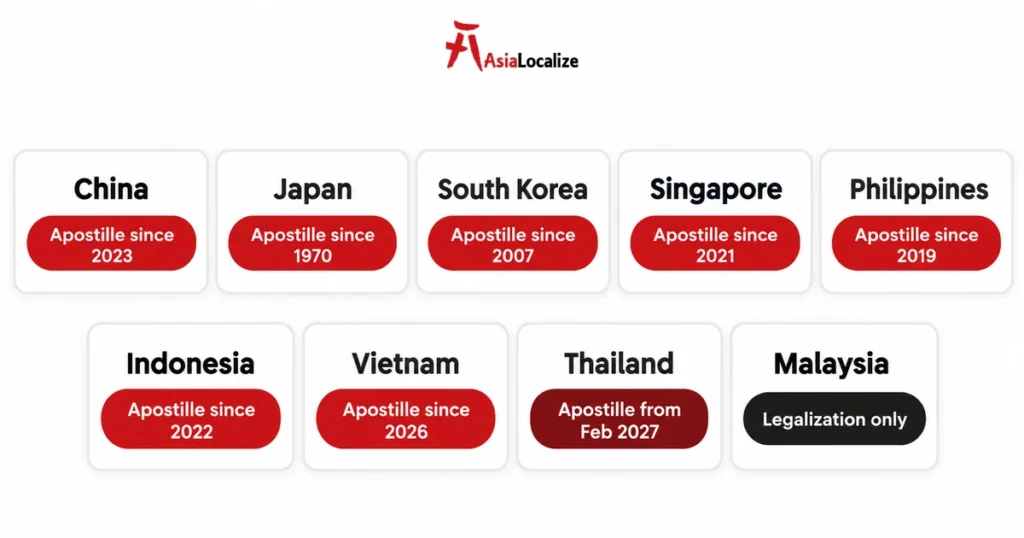
The same document can need a notarial certificate in China, a sworn translator in Indonesia, and attestation at Wisma Putra in Malaysia. Several countries joined the Apostille Convention recently, so check the date on any advice you read.
Apostille status from the HCCH status table. Last checked: 5 October 2026.
| Country | Apostille Convention | How it works |
|---|---|---|
| China | In force 7 Nov 2023 | Documents are usually notarized, then apostilled; CCPIT and other authorities also certify some commercial papers. Notary offices cover facts such as birth and marriage (Art. 11). |
| Japan | In force 27 Jul 1970 | Private documents need a notary and the Legal Affairs Bureau before MOFA certifies them. Some destinations require a notarized translation. |
| South Korea | In force 14 Jul 2007 | The Ministry of Justice apostilles notarial acts. Korea’s Kuala Lumpur embassy witnesses translation affidavits without vouching for accuracy. |
| Singapore | In force 16 Sep 2021 | The Singapore Academy of Law issues apostilles. Non-government documents are notarized first. |
| Philippines | In force 14 May 2019 | The DFA’s Authentication Division issues apostilles. |
| Indonesia | In force 4 Jun 2022 | The Ministry of Law issues apostilles and appoints sworn translators. |
| Malaysia | Not a party | Wisma Putra attests stamps and signatures; foreign missions then endorse. |
| Vietnam | In force 11 Sep 2026 | The foreign ministry issues apostilles. |
| Thailand | Acceded 30 Jun 2026; enters into force for Thailand 28 Feb 2027 | Legalization applies until then. The Department of Consular Affairs legalizes Thai-English translations and requires the translator’s ID. |
For the Philippines and Vietnam, confirm translation rules with the receiving office. Some parties objected when China, the Philippines, and Vietnam joined, and under Article 12 the Convention does not apply between an objecting state and the newly joined state.
Malaysia shows how local the rules get. Wisma Putra lists specific venues where documents needing Bahasa Malaysia or English translation “can be translated,” including Malaysian Court Translators and translators appointed by foreign embassies. Check the current list on kln.gov.my before ordering an official Malay to English translation for endorsement.
In What Order Should You Translate, Notarize and Apostille?
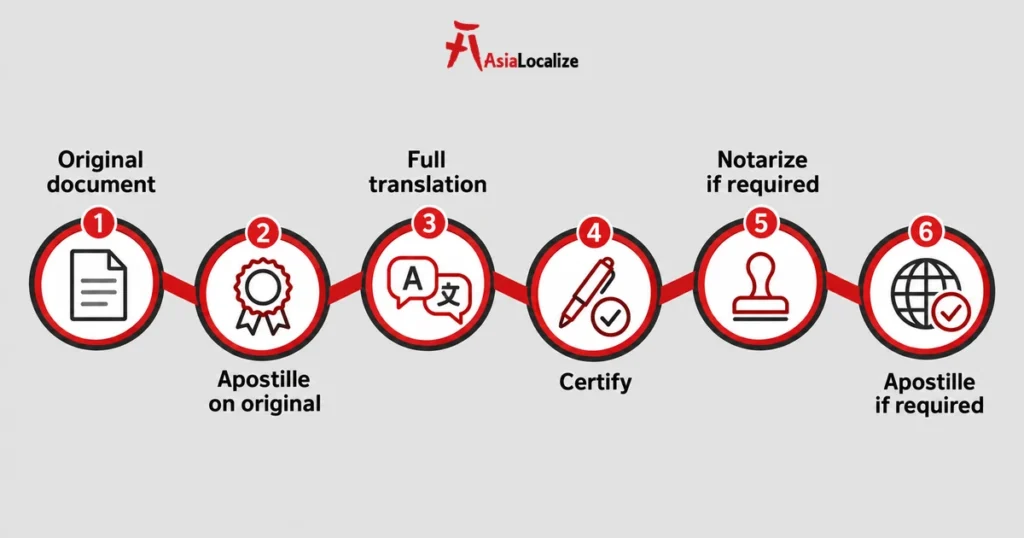
Order matters, and the exact sequence depends on the destination. A typical chain looks like this:
- Get the original document or an official certified copy.
- If the destination requires it, get the apostille or legalization on the original first.
- Translate the whole document, including stamps, seals, and the apostille if the receiving office cannot read it.
- Certify the translation.
- Notarize the certification, only if the receiving office asks for it.
- Apostille or legalize the notarization, if the destination requires that too.
Common reasons documents come back:
- Translating before the apostille is attached, so the translation misses part of what the destination sees.
- Partial translations that skip stamps, seals, or margin notes. USCIS treats a summary as unacceptable.
- Name spellings that differ from the passport.
- Documents older than the destination allows. Japan’s MOFA certificates have no expiration date, but destinations may set their own validity periods.
“Can I translate it myself and notarize my own signature?” The USCIS rule does not address self-translation directly. Some foreign agencies accept an applicant’s own translation, while others do not. Notarizing your own signature only proves that you signed, so an independent translator is the safer choice unless the office confirms otherwise.
Certified vs Notarized Translation: Checklist Before You Order
- Ask the receiving office in writing what it accepts, and keep the reply.
- Confirm whether it wants certification, notarization, a sworn translator, an apostille, or legalization.
- Check the destination country’s status on the HCCH Apostille table.
- Get the apostille on the original before translating, if one is required.
- Make sure every stamp, seal, and annotation is translated.
- Match every name spelling to the passport.
Get a Certified Translation Prepared for Your Receiving Office’s Requirements
Once you know which side of the certified vs notarized translation question your document falls on, upload it and tell us the language pair, deadline, purpose and where it is going. Our certified document translation includes a signed Statement of Accuracy for official, legal, immigration and academic use, and our legal translation services handle contracts and court files. Requirements vary by receiving authority, so share them when you request a quote. AsiaLocalize is ISO 17100 certified, works in 120+ languages and has completed 8,000+ projects. Request a quote.
Frequently Asked Questions
Is a notarized translation better than a certified translation?
No. Notarization adds a check on who signed the translator’s statement, not on the quality of the translation. Notarize only when the receiving office requires it, and save the cost and the extra step everywhere else.
Does USCIS require a notarized translation?
No. 8 CFR 103.2(b)(3) asks for a full English translation with the translator’s certification that it is complete and accurate and that they are competent in both languages. The rule does not mention notarization.
Does a certified translation need a stamp or seal?
Not under the US immigration rule, which asks only for the translator’s certification. Some Asian countries expect a seal or an appointed translator, so follow the receiving office’s own rules.
Do you need to be a certified translator to provide a certified translation?
No. The American Translators Association advises that a translator does not need to be certified to provide a certified translation, and notes that the US has no federal or state licensing for translators.
What is the difference between a sworn translation and a notarized translation?
A sworn translator is appointed by a government, for example by Spain’s foreign ministry or Indonesia’s law ministry, and their own signature and seal make the translation official without a notary. A notarized translation relies on a notary who witnesses the translator’s signature.
Does an apostille certify the translation?
No. The HCCH states that an apostille authenticates the signature, the signer’s capacity and any seal on a public document, not its content. Because notarial acts are public documents, a notarized translation can receive an apostille.
Which Asian countries are in the Apostille Convention?
As of October 2026, the Convention is in force for China, Japan, South Korea, Singapore, the Philippines, Indonesia and Vietnam. Thailand acceded in June 2026 and the Convention enters into force for it on 28 February 2027. Malaysia is not a party and still uses legalization.
Can I translate my own documents and notarize my signature?
Notarizing your own signature only proves that you signed. The USCIS rule does not address self-translation directly, and some foreign agencies accept an applicant’s own translation while others do not, so an independent translator is the safer choice unless the office confirms otherwise.