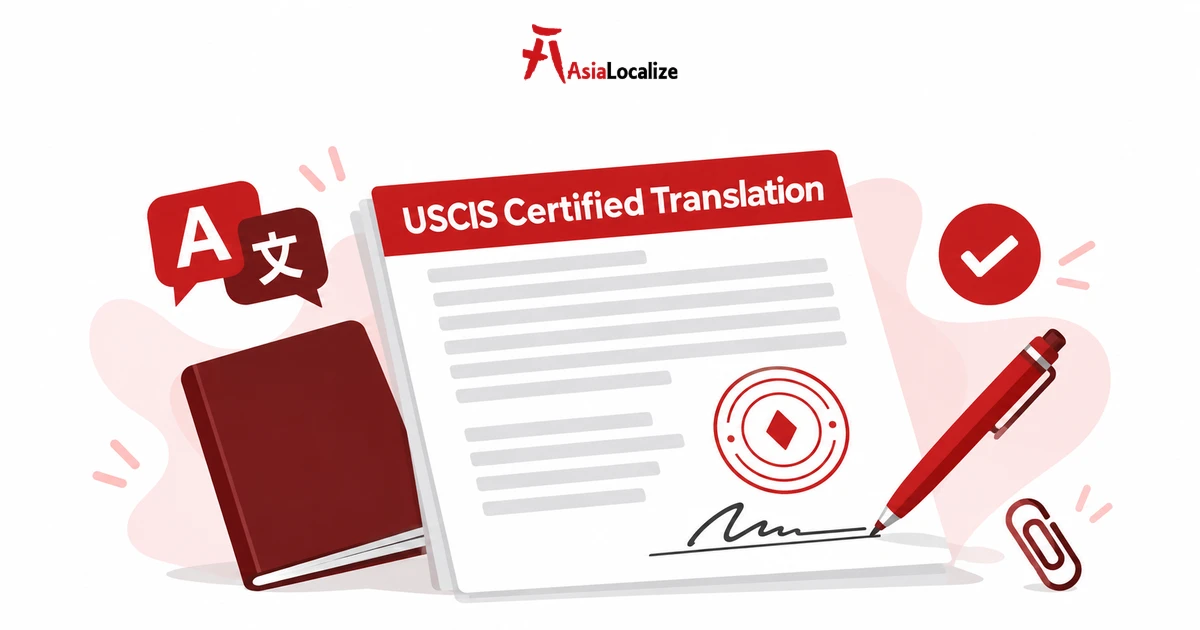
A USCIS certified translation is a full English translation of a foreign-language document, attached to the translator’s signed statement that they are competent in both languages and that the translation is complete and accurate. That is the whole rule in 8 CFR 103.2(b)(3). USCIS does not require notarization, a “USCIS-approved” translator or ATA certification.
A single missing line in a translation certificate can stall an immigration case for weeks. If a foreign-language document arrives with a partial translation or an incomplete certificate, USCIS can send a Request for Evidence (RFE) and the case waits for your answer. In some situations, USCIS can deny a request without sending an RFE first.
Getting it right is easier than most applicants think. This guide explains the USCIS translation requirements in plain English, gives you a sample certification you can adapt, lists the mistakes that trigger an RFE, and shows how to handle Asian civil documents such as koseki registers and Chinese notarial certificates.
Last checked: October 5, 2026. This article is general information, not legal advice. Rules and form editions change, so read the current instructions for your form on uscis.gov before you file, and ask an immigration attorney about your specific case.
USCIS certified translation: key takeaways
- Three requirements: a full translation, an accuracy statement and a competence statement, signed with the translator’s printed name, date and contact details.
- No notary, no USCIS approval: USCIS keeps no list of approved translators and does not ask for notarized translations.
- Every word counts: stamps, seals, handwriting and the back of each page must be translated too. Summaries are rejected.
- Asian records need extra care: convert era dates, follow the passport’s name order and use the passport spelling.
What Are the USCIS Translation Requirements? 8 CFR 103.2(b)(3) in Plain English
The rule sits in the federal regulations at 8 CFR 103.2(b)(3). Here is the full text, as published on eCFR:
“(3) Translations. Any document containing foreign language submitted to USCIS shall be accompanied by a full English language translation which the translator has certified as complete and accurate, and by the translator’s certification that he or she is competent to translate from the foreign language into English.”
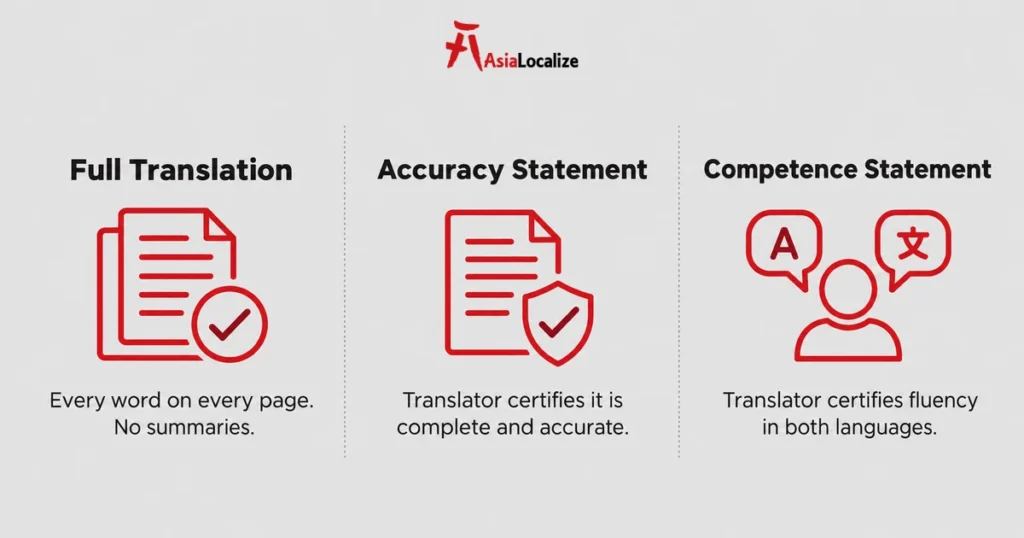
That sentence contains three separate USCIS certified translation requirements:
- A full translation. Every foreign-language document needs a complete English version, not an extract.
- An accuracy statement. The translator certifies that the translation is complete and accurate.
- A competence statement. The translator certifies that they are competent to translate from that language into English.
USCIS repeats the rule in its own guidance. The USCIS Policy Manual, Volume 1, Part E, Chapter 6 restates all three points. It also says that “a summary of a document prepared by a translator is unacceptable.” The Form I-485 instructions and Form I-130 instructions go one step further. They say the certification must also include the translator’s signature, printed name, signature date and contact information.
With the exact wording in front of you, you can check any provider’s promise against the regulation and spot a non-compliant translation before you file.
What Must a USCIS Translation Certification Say? (Sample Wording)
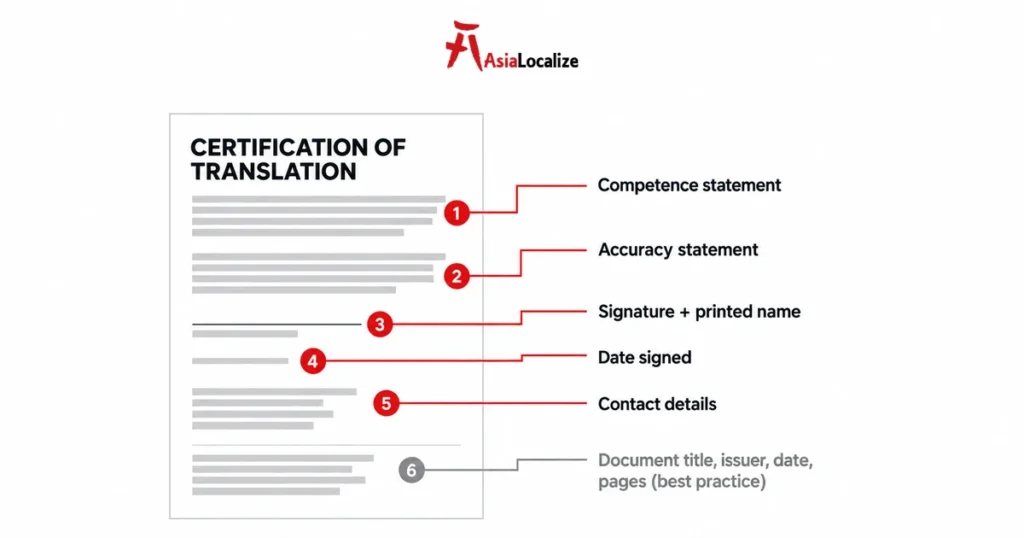
The USCIS certification of translation is the page an officer reads to decide whether a translation meets the rule. The regulation and the I-485 and I-130 instructions require these elements in a USCIS translation certification statement:
- A competence statement covering the source language and English
- An accuracy statement saying the translation is complete and accurate
- The translator’s signature and printed name
- The date signed
- The translator’s contact information, such as address, phone and email
As a recommended best practice, not a requirement in the regulation or the instructions, also identify the document: its title, issuing authority, date and page count.
The instructions we reviewed don’t include a fill-in USCIS translation certification form. They describe the contents instead, so clarity matters more than layout. Use the certification of translation sample below as a starting point. It is an example, not official USCIS wording.
CERTIFICATION OF TRANSLATION

I, [Translator's full name], certify that I am competent to translate
from [source language] into English.

I further certify that the attached English translation of
[document title, e.g. "Notarial Certificate of Birth No. ______"],
issued by [issuing authority] on [date of issue], consisting of
[number] page(s), is complete and accurate to the best of my
knowledge and ability.

Signature:     ______________________________
Printed name:  [Translator's full name]
Date signed:   [Month DD, YYYY]
Address:       [Street, city, postal code, country]
Phone:         [Phone number with country code]
Email:         [Email address]
Attach each certification to the translation it covers, with a copy of the original document. If one statement covers several documents, list each one by title so every translated page traces back to a signature.
If you were told to get an “affidavit of translation” for USCIS, note that the rule asks for a signed certification, not a sworn affidavit. For a broader look at how these certificates work outside immigration, see our guide to the Certificate of Translation Accuracy.
Checking a certified English translation for USCIS against this list takes two minutes. It is the simplest way to avoid an RFE caused by a missing element.
Does a USCIS Translation Need to Be Notarized? 5 Myths, Debunked
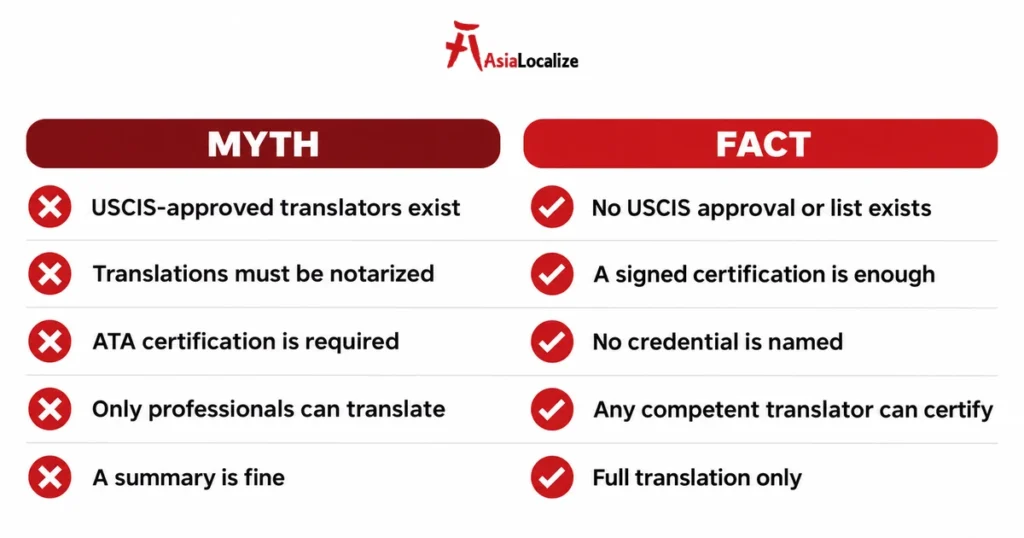
These five claims don’t match the regulation or USCIS guidance.
Myth 1: “USCIS-approved translators” exist. Nothing in 8 CFR 103.2(b)(3), the Policy Manual chapter or the form instructions creates a USCIS approval, license or list for translators. “USCIS approved translation services” is a marketing phrase, not a status. An immigration certified translation is one the translator certifies, with no USCIS stamp involved.
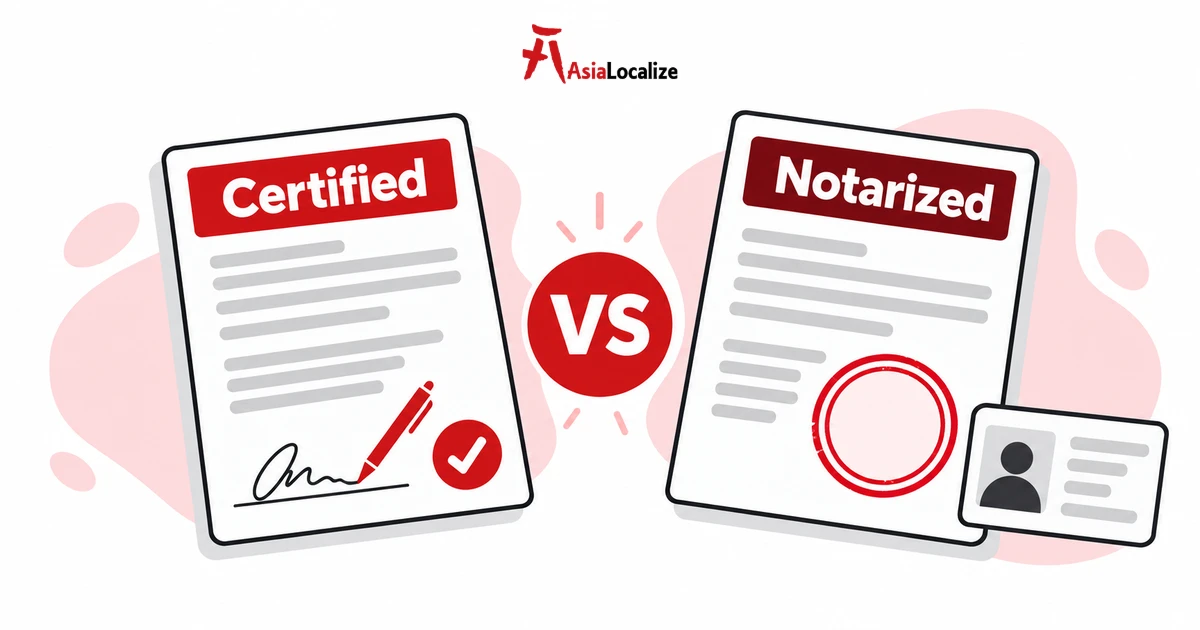
Myth 2: The translation must be notarized. The regulation and the I-485 and I-130 instructions don’t mention notarization for translations. They ask for a signed certification of accuracy and competence. A USCIS notarized translation adds cost without meeting any extra requirement.
Myth 3: The translator must hold ATA certification. The rule asks translators to certify their own competence. It names no credential from the American Translators Association or anyone else.
Myth 4: Only a professional translator can do it. 8 CFR 103.2(b)(3) requires a translator who is competent in both languages and who certifies the translation as complete and accurate. In a 2018 letter, then-Director L. Francis Cissna wrote that USCIS does not require a professional translation service. USCIS guidance for congressional casework, as quoted in a March 2024 letter from Director Ur M. Jaddou, goes further. It says “anyone (paid or unpaid, including congressional staffers or family members) can provide a translation” if they certify their competence “under penalty of perjury or similar language.”
That guidance doesn’t specifically address applicants translating their own documents. We recommend an independent translator so the translation’s objectivity is never in question.
Myth 5: A summary is good enough. The Policy Manual calls a translator’s summary “unacceptable.” A footnote there cites a 1994 Federal Register notice in which the agency rejected requests to accept extracts or partial translations.
Knowing these myths saves you from paying for labels, stamps or credentials USCIS never asked for.
Here is how the three document types people mix up compare for a USCIS filing:
| Certified translation | Notarized translation | Sworn affidavit of translation | |
|---|---|---|---|
| What it is | The translator’s signed statement of competence and accuracy | A certified translation plus a notary’s stamp on the signature | A translator’s statement sworn before an official |
| Required by USCIS? | Yes, under 8 CFR 103.2(b)(3) | No | No |
| What it proves | The translator vouches for the full translation | The notary confirms who signed, not the translation | The translator vouches for it under oath |
| Accepted by USCIS? | Yes | Yes, if it includes the required certification | Yes, if it includes the required certification |
What Does a “Full Translation” Mean for USCIS?
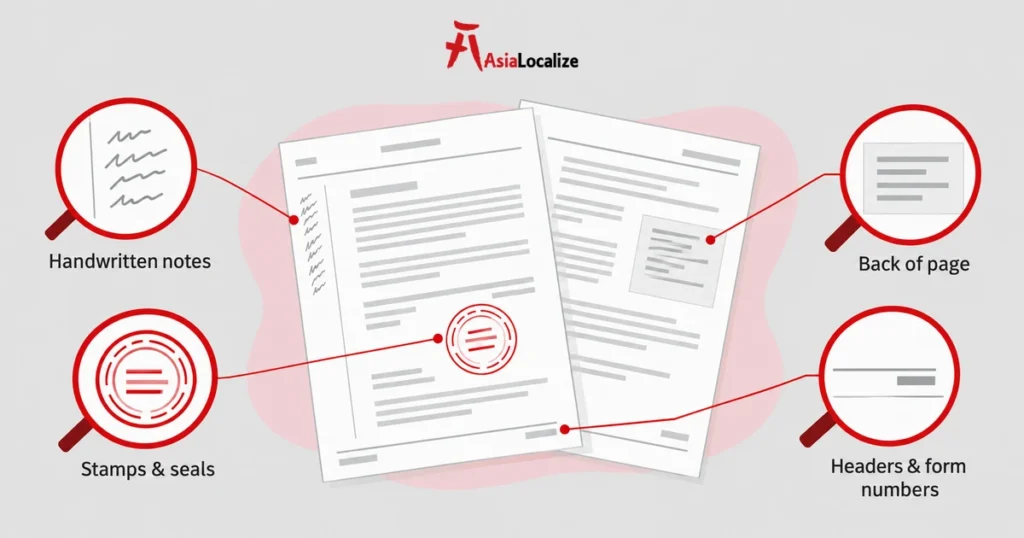
A full translation covers every word on every page, not just the main body of the document. In practice, the parts most often skipped are:
- Stamps, seals and their surrounding text
- Handwritten notes, signatures with printed names, and margin annotations
- The back of each page, including registry notes and later amendments
- Headers, footers, form numbers and printed instructions
Translate each of these. Describe non-text elements in brackets, for example “[round red seal: Notary Public Office of …].” If something can’t be read, mark it “[illegible]” instead of guessing.
Mirror the original layout so an officer can match each translated line to its source in seconds. This applies to every translation of documents for immigration, and it makes a USCIS document translation quick to verify.
Keep names, dates and places consistent with the passport and the forms in your filing. The regulation also allows USCIS to ask for the native form of a name when a document uses an anglicized version, under 8 CFR 103.2(b)(5).
“It’s just a stamp” is a common objection. But stamps often carry the issuing office, a number or a date, and leaving one untranslated makes the translation incomplete.
How to Translate Asian Civil Documents for USCIS
Applicants from Asia rarely file a simple “birth certificate.” The Form I-485 instructions send applicants to the State Department’s Visa Reciprocity and Civil Documents by Country pages to learn how to get one. They also say USCIS only accepts a birth certificate that lists at least one parent. Check your country’s page before ordering, because entries change.
| Country | Birth / marriage record listed by the State Dept | Watch-out |
|---|---|---|
| China | Notarial certificate (Gong Zheng Shu) from a Notary Public Office | Check that its attached English version meets all three USCIS translation requirements above |
| Japan | Family register (koseki) extract, or a birth or marriage acceptance certificate | Convert era dates; translate every entry |
| South Korea | Basic and Family Relations Certificates, filed together; Marriage Relations Certificate | Use the detailed (“Sang Sae”) versions |
| Vietnam | Giấy khai sinh; Giấy chứng nhận kết hôn | Keep tonal marks; dates follow the solar calendar |
| Philippines | PSA birth and marriage certificates | Older Spanish-language versions need translation |
| India | Municipal birth certificate; registrar or religious marriage certificate | Births before April 1, 1970 count as unavailable |
| Thailand | Sutibat; Tabien Somros | District offices can issue English versions |
| Indonesia | Akta Kelahiran; Akta Perkawinan or Buku Nikah | Translate all printed text and seals |
| Malaysia | Sijil Kelahiran; Daftar Perkahwinan or Surat Perakuan Nikah | Translate every non-English field |
When you translate a birth certificate to English for immigration, watch for three traps:
- Dates. Japanese registers use era years, so “Heisei 5” becomes 1993.
- Name order. Chinese, Japanese, Korean and Vietnamese records usually put the family name first. Follow the passport’s order.
- Romanization. Pinyin, Hepburn and Revised Romanization can give different spellings. The passport spelling wins.
Chinese notarial certificates mix legal terms, seals and name romanizations, which is why applicants often turn to Chinese translation services that handle civil documents regularly. Our guide to Chinese document translation covers these records in more detail. The same care applies to Japanese, Korean, Vietnamese, Tagalog, Hindi, Thai, Indonesian and Malay records.
Which Translation Problems Trigger a USCIS RFE?
An RFE is a notice asking you to send more evidence before USCIS decides your case. Under 8 CFR 103.2(b)(8)(iv), the notice states the deadline, which can’t exceed twelve weeks, and USCIS can’t grant extra time.
Translation problems that put a case at risk are simple to catch:
- No competence statement, or one that doesn’t name the language pair
- A partial or summary translation
- Untranslated stamps, seals or handwritten notes
- Names or dates that differ from the passport and forms
- No signature, printed name, date or contact details on the certification
- A translation filed without a copy of the foreign-language original
Will USCIS reject the whole application? Not automatically. The Policy Manual explains that officers may issue an RFE, but USCIS also has discretion to deny a request without one when the evidence doesn’t establish eligibility. Checking these six items before you file keeps your case moving.
Can You Bring an Interpreter to a USCIS Interview?
Translation and interpreting are separate jobs. A translator works on documents; an interpreter speaks for you at an interview.
If you are eligible to bring your own interpreter to a domestic USCIS interview, bring Form G-1256, Declaration for Interpreted USCIS Interview. The interviewing officer completes the form, and you and the interpreter both sign it in the officer’s presence, not beforehand. The G-1256 instructions set out the main USCIS interpreter requirements:
- Fluent in English and in a language you understand, and impartial throughout
- At least 18 years old and not a witness in your case, unless USCIS grants a good-cause exception
- Not your attorney or accredited representative acting in both roles at once
The officer can decline an interpreter who doesn’t meet these criteria. Read your interview notice before the appointment so the interview is covered as well as the paperwork.
USCIS Certified Translation Checklist: 6 Checks Before You File
- Translate every page in full, including stamps, seals, handwriting and the back of each page.
- Attach a signed, dated certification of accuracy and competence with the translator’s printed name and contact details.
- Match every name and date to the passport and the forms.
- Check the State Department country page for the right civil document.
- Submit a copy of the original with each translation.
- Read the current instructions for the form you are filing.
USCIS Certified Translation Services, Checked Before You File
Need USCIS translation services? Upload your documents and tell us which form you are filing. An AsiaLocalize specialist will return a scoped quote for a full translation with a signed certification. For a full USCIS filing, certified document translation that covers every page, stamp and annotation is the simplest way to avoid a translation-related RFE. For divorce decrees and court records, see our legal translation services.
AsiaLocalize is ISO 17100 certified, works in 120+ languages, and has completed 8,000+ projects. Request a quote.
Frequently Asked Questions
Does a USCIS translation need to be notarized?
No. 8 CFR 103.2(b)(3) and the Form I-485 and I-130 instructions ask for a signed certification of accuracy and competence, not a notary’s stamp. A notarized translation is accepted if it includes that certification, but notarization alone adds nothing USCIS requires.
Who can certify a translation for USCIS?
Any translator who is competent in the foreign language and English can certify a translation for USCIS by signing a statement of competence and accuracy with their printed name, date and contact details. USCIS keeps no list of approved translators and asks for no ATA or other credential.
Can a family member translate my documents for USCIS?
USCIS congressional-casework guidance, quoted in the 2024 Director’s letter above, says family members can translate if they certify their competence under penalty of perjury or similar language. That guidance doesn’t address applicants translating their own documents, so an independent translator is the safer choice.
What are the USCIS birth certificate translation requirements?
A birth certificate translation for USCIS follows the same rule as any document: a full English translation plus the translator’s signed certification of accuracy and competence. The I-485 instructions add that USCIS only accepts a birth certificate listing at least one parent. They also ask for a photocopy rather than the original, unless USCIS requests the original.
Does a marriage certificate translation need anything extra?
No separate translation rule applies. A marriage certificate translation must meet the same three requirements. If either spouse was married before, the I-485 instructions also ask for proof that earlier marriages ended, such as a divorce decree, and that document needs its own translation.
Do I need to translate a document that is partly in English?
Yes. Translate every part that isn’t in English, including stamps, seals and annotations on bilingual certificates.
Should I send the original document or a copy to USCIS?
Send a copy. The Form I-485 instructions ask for photocopies of supporting documents unless USCIS requests the original. File the copy of the foreign-language document together with its full English translation and signed certification.
How long do I have to answer a translation-related RFE?
The deadline is stated in the RFE notice. Under 8 CFR 103.2(b)(8)(iv) it can’t exceed twelve weeks, and USCIS can’t grant extra time, so correct the translation and certification and respond before the date shown.