Chinese speaking countries and markets are not limited to Mainland China. Mandarin Chinese is widely used across Mainland China, Taiwan, Singapore, Malaysia, and global Chinese communities, while Cantonese, Hokkien, Hakka, and other Chinese varieties remain important in specific regions and diaspora markets.
For businesses, this matters because “Chinese” is not a single localization choice. The right strategy may involve Simplified Chinese, Traditional Chinese, Mandarin-focused content, Cantonese-sensitive messaging, or multilingual support depending on the target market.
This guide explains where Mandarin and other Chinese varieties are widely used, and how businesses can choose the right Chinese translation and localization approach for each audience.
Mandarin Chinese has major global business importance across Mainland China, Taiwan, Singapore, Malaysia, international business networks, and Chinese communities worldwide.
The growing influence of Chinese-speaking markets offers vast opportunities for businesses to grow and thrive. However, success in these regions requires more than ambition; it calls for a thoughtful strategy that aligns with the cultural and linguistic preferences of these communities.
In this guide, we’ll explore the key countries where Mandarin Chinese is prevalent, equipping you with the insights you need to build strong partnerships and achieve sustainable success.
Quick Answer: What Are the Main Chinese Speaking Countries?
The main Chinese speaking countries and markets include Mainland China, Taiwan, Singapore, Malaysia, Hong Kong, Macau, and global Chinese communities in countries such as the United States, Canada, Australia, Thailand, Indonesia, and Vietnam.
Malaysia is a particularly layered case. Our guide to the languages spoken in Malaysia covers how Malay, Mandarin, English, and Tamil operate side by side in one market, and what that means for localization scope.
For business content, the most important distinction is not only where Chinese is spoken, but which written form and language variety the audience expects. Mainland China usually requires Simplified Chinese. Taiwan, Hong Kong, and Macau usually require Traditional Chinese. Singapore and Malaysia may require Mandarin Chinese alongside English, Malay, Tamil, or other local languages depending on the audience.
| Market | Common Chinese Use | Business Localization Note |
|---|---|---|
| Mainland China | Mandarin / Simplified Chinese | Best for national websites, e-commerce, apps, product content, legal, technical, and marketing content |
| Taiwan | Mandarin / Traditional Chinese | Needs Taiwan-specific terminology, tone, and Traditional Chinese localization |
| Hong Kong | Cantonese spoken / Traditional Chinese written / English | Traditional Chinese and English are important for business, finance, legal, and customer-facing content |
| Macau | Cantonese / Traditional Chinese / Portuguese influence | Traditional Chinese is usually needed, with Portuguese or English depending on sector |
| Singapore | Mandarin + English, Malay, Tamil | Multilingual content may be needed for business, government, education, and consumer markets |
| Malaysia | Mandarin and Chinese varieties + Malay, English, Tamil | Mandarin may work for broad written content, but community campaigns may need more local language planning |
| U.S., Canada, Australia | Chinese diaspora communities | Audience may require Simplified Chinese, Traditional Chinese, Cantonese, or bilingual English-Chinese messaging |
What Are the Main Chinese Speaking Countries?
Mainland China and Taiwan: Two Distinct Localization Markets
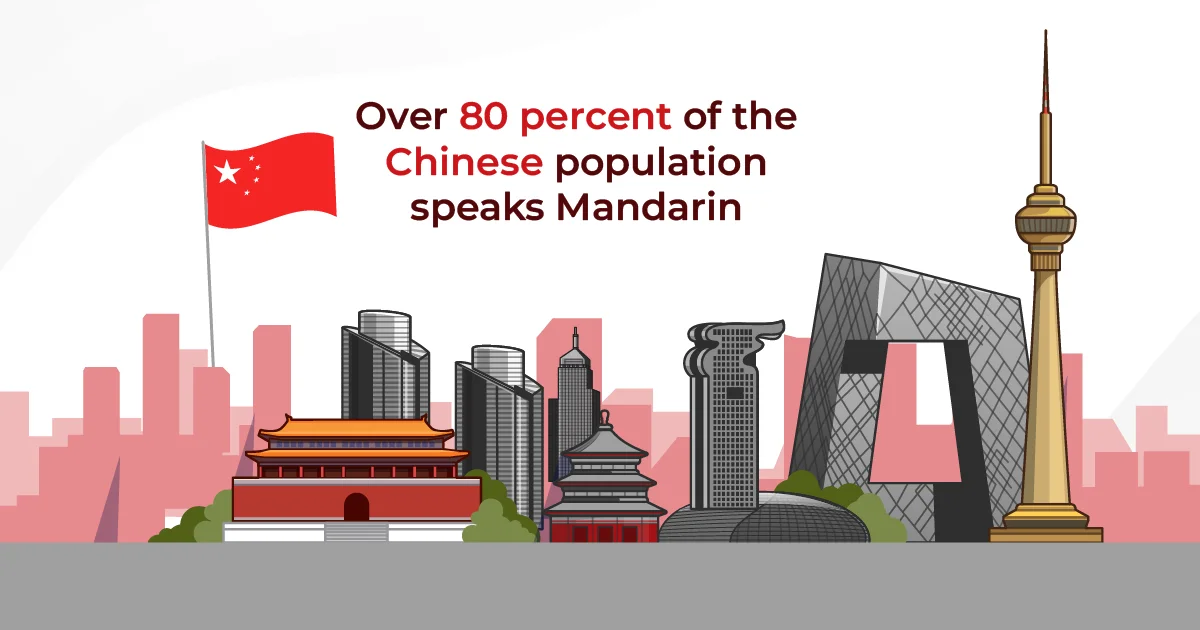
Mainland China uses Standard Mandarin (Putonghua) and Simplified Chinese for national communication, education, media, and most business content. For the complete country-level language picture, see our guide to languages spoken in China.
Taiwan widely uses Mandarin with Traditional Chinese, Taiwan-specific terminology, Taiwanese Hokkien, and Hakka. For the local distinctions businesses need, see languages spoken in Taiwan.
Hong Kong and Macau: Cantonese, Traditional Chinese, and Mandarin

Hong Kong primarily uses spoken Cantonese and written Traditional Chinese, while English and Mandarin are also important in business and education. See languages spoken in Hong Kong for the complete market-specific guide.
Macau also uses Cantonese and Traditional Chinese, with Portuguese and English relevant in government, tourism, legal, and commercial contexts.
Chinese Speaking Countries in the Southeast Asian Region
Mandarin Chinese in Singapore and Malaysia
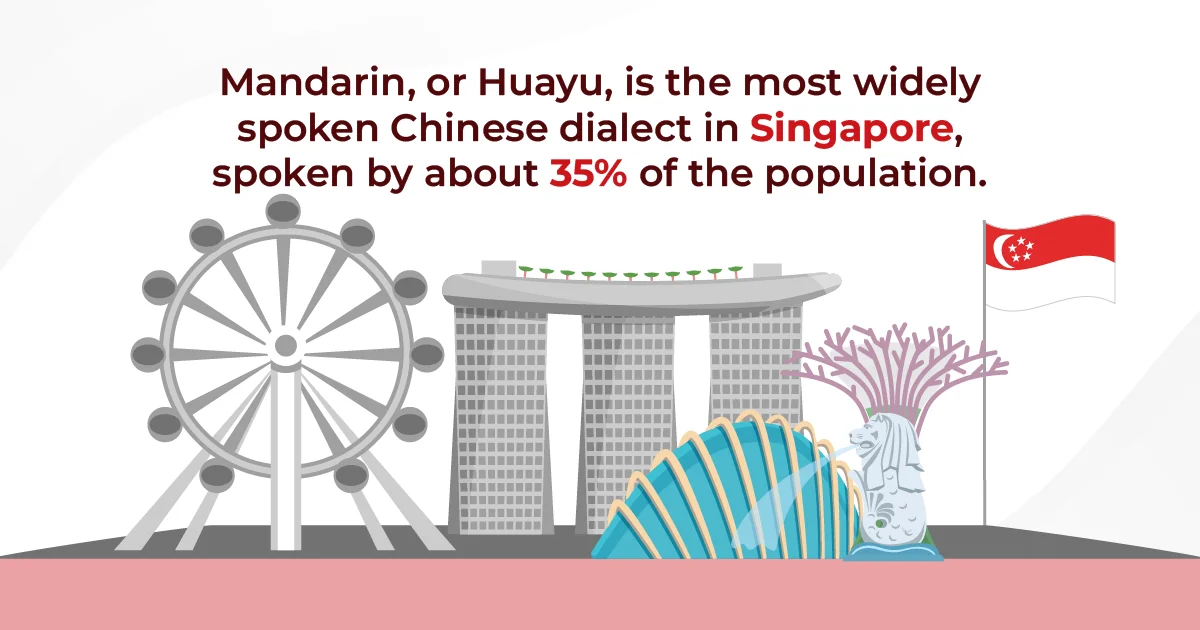
Mandarin Chinese is one of the official languages in Singapore, alongside English, Malay, and Tamil. The promotion of Mandarin Chinese language is a significant aspect of Singapore’s bilingual education system, which strives to uphold both English and a mother tongue language. As a result, Mandarin is taught in schools, enabling students to achieve proficiency in the language from an early age.
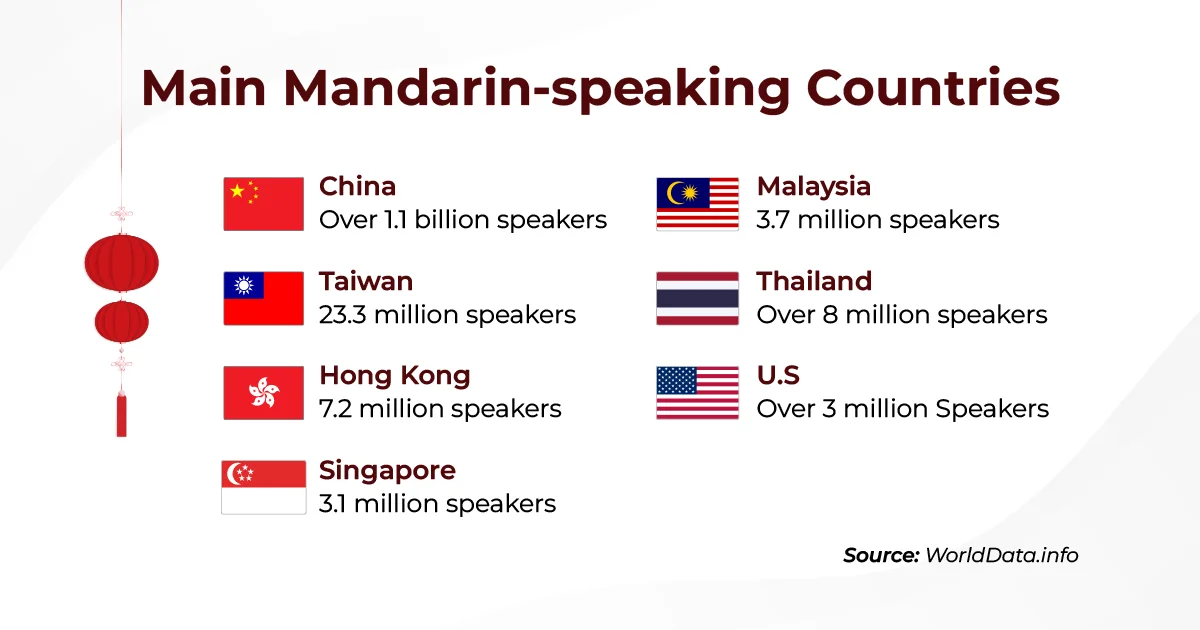
In Singapore, Mandarin is one of the four official languages. According to Singapore’s 2020 Census, Mandarin was the language most frequently spoken at home by 29.9% of residents aged 5 and over, while English reached 48.3%.
In Malaysia, Mandarin is also widely spoken, particularly among the ethnic Chinese population. The presence of Mandarin can be attributed to a long history of Chinese migration to the region.
Within Malaysia, Mandarin coexists with various regional Chinese varieties, such as Hokkien and Cantonese.
Thailand, Indonesia, and Beyond

Thailand is home to over 8 million Chinese speakers, many of whom are ethnically Chinese.
Mandarin is commonly spoken within Chinese communities, and many families actively maintain their linguistic heritage through language schools and community programs.
In Indonesia, a substantial Chinese community has existed for centuries, resulting from various waves of migration. Here, Mandarin is spoken alongside a variety of regional Chinese varieties, such as Hokkien and Cantonese.
The Chinese-Indonesian population, despite facing historical challenges, has significantly influenced Indonesia’s economy, cuisine, and cultural practices.
Vietnam also hosts a notable Chinese community, particularly in urban areas like Ho Chi Minh City and Hanoi. Mandarin and regional dialects thrive within these communities, often used in familial and cultural contexts.
Mandarin Chinese in the United States

The Chinese-speaking population in the United States has been steadily growing, with over 3 million Chinese speakers across the country. Significant concentrations can be found in major metropolitan areas such as New York and California.
In addition to the United States, there are other countries with significant Chinese-speaking communities. Canada, for instance, is home to approximately 450,000 Chinese speakers. The largest populations are found in cities like Vancouver and Toronto.
Australia also boasts a notable Chinese-speaking population, exceeding 700,000 speakers.
Chinese Translation and Localization for Global Markets
Understanding Chinese speaking countries is only the first step. For businesses, the bigger challenge is adapting the right version of Chinese for each market, platform, and audience.
Chinese translation services help businesses adapt documents, websites, product pages, legal content, technical materials, customer support resources, and marketing campaigns with accurate terminology and market-specific language choices.
Website localization services are especially important when entering Chinese-speaking markets because user expectations, search behavior, forms, calls to action, payment flows, and visual preferences can differ from one region to another.
Marketing localization services can also help brands adapt campaign messages, slogans, creative assets, and cultural references so the content feels natural instead of directly translated.
For example, content prepared for Mainland China in Simplified Chinese may need to be adapted into Traditional Chinese before it is used in Taiwan, Hong Kong, or Macau. A campaign written for Mandarin-speaking audiences may also need adjustment if the target audience is Cantonese-speaking or part of a multilingual market such as Singapore or Malaysia.
FAQs About Chinese Speaking Countries and Localization
What are the main Chinese speaking countries?
The main Chinese speaking countries and markets include Mainland China, Taiwan, Singapore, Malaysia, Hong Kong, and Macau, along with large Chinese-speaking communities in the United States, Canada, Australia, Thailand, Indonesia, and Vietnam.
Is Mandarin spoken in all Chinese speaking countries?
Mandarin is widely used in Mainland China, Taiwan, and Singapore, and it is also used by many Chinese communities worldwide. However, Cantonese, Hokkien, Hakka, and other Chinese varieties remain important in specific regions and communities.
Do businesses need Simplified or Traditional Chinese?
It depends on the target market. Mainland China usually requires Simplified Chinese, while Taiwan, Hong Kong, and Macau usually require Traditional Chinese. Some markets may also require English-Chinese bilingual content.
Why does Chinese localization matter for business?
Chinese localization helps businesses adapt terminology, writing system, tone, user experience, calls to action, visuals, and marketing messages for each Chinese-speaking audience.
Are Mandarin and Cantonese the same?
No. Mandarin and Cantonese are different Chinese varieties. Mandarin is widely used in Mainland China, Taiwan, and Singapore, while Cantonese is especially important in Hong Kong, Macau, Guangdong, and many overseas Chinese communities.