Global content moves at a pace that traditional, fully manual translation workflows can no longer support on their own. Product updates roll out continuously, customer support operates in real time, and marketing teams launch campaigns across multiple markets simultaneously. In this environment, Machine Translation Tools have become a core enabler of speed and scale.
Market expectations reinforce this shift. A 2020 CSA Research survey of 8,709 consumers found that 76% of online shoppers prefer to buy products with information in their native language, while 40% never buy from websites in other languages.
Meeting these expectations across growing content volumes requires automation at the right points in the localization process.
The challenge is not simply whether to use machine translation tools, but how to choose tools that match the content risk, workflow, and quality target.
Yet widespread adoption has introduced a new challenge. Machine translation is now embedded in browsers, content platforms, and enterprise tools, which often leads to use by default rather than by design. Engines get selected for convenience, quality thresholds remain undefined, and integration decisions happen without a clear understanding of risk or suitability.
This blog outlines how to evaluate machine translation options based on content type, delivery speed, quality requirements, and system integration. The goal is not to replace human expertise, but to show how automation and professional localization work together to support scale without compromising accuracy and brand integrity.
What Are Machine Translation Tools?
Before choosing a workflow, an engine, or an integration model, it helps to clarify what machine translation tools actually cover today because the category has expanded far beyond “paste text, get translation.”
At their core, machine translation tools are software solutions that automatically translate text from one language to another. They appear in different forms, serve different operational needs, and vary significantly in quality, control, and scalability. What unites them is automation at scale.
In practice, machine translation tools fall into three broad types:
- End-user applications
These include browser-based or desktop tools designed for immediate, ad-hoc translation. They prioritize speed and accessibility, often at the expense of consistency, terminology control, or domain accuracy. Useful for comprehension. Risky for publishable content.
- Machine translation engines and APIs
This category powers most professional workflows today. MT engines expose translation capability through APIs that integrate directly with CMSs, CAT tools, helpdesk platforms, and localization pipelines. Providers such as Google, Microsoft, DeepL, and Amazon fall here, alongside specialized engines trained for specific domains.
- Enterprise MT platforms
These solutions sit at the program level. They combine multiple engines, routing logic, quality evaluation, security controls, and workflow automation. Enterprise platforms allow teams to decide which engine translates which content, when human review applies, and how output flows into downstream systems.
The Technology Behind Today’s MT
Most modern machine translation tools rely on Neural Machine Translation (NMT). NMT uses deep neural networks trained on vast bilingual datasets to translate entire sentences as units, rather than word by word. This shift dramatically improved fluency and contextual accuracy compared to earlier statistical approaches.
Independent evaluations confirm the impact.
Neural machine translation can reduce post-editing effort in some workflows, but results vary by language pair, content type, domain complexity, terminology control, and the quality threshold required for publication.
More recently, some platforms have begun blending large language models (LLMs) into specific stages of the MT process. These models support tasks such as terminology normalization, adaptive rewriting, or quality estimation rather than replacing NMT entirely. The result is more flexible handling of context, tone, and variation when properly constrained.
Improve Machine Translation Quality with our MTPE services.
To choose machine translation tools correctly, teams first need to separate engines from the platforms that manage workflows around them.
Machine Translation Engines: The Technology Behind the Output
Before comparing features or pricing, it helps to separate two concepts that often get blurred together: machine translation engines and machine translation tools. Tools manage workflows. Engines do the translating.
A machine translation engine is the core linguistic technology that converts text from one language to another. Google Translate, DeepL, Microsoft Translator, and Amazon Translate all fall into this category. They operate as standalone services or APIs and are typically embedded inside localization tools, CAT tools.
Engine vs. Tool: Why the Distinction Matters
Think of the engine as the “brain” and the tool as the “operating system.”
- Engines generate the translation output.
- Tools and platforms decide when to use an engine, which engine to apply, where the output goes next, and whether human review is required.
Not All Engines Perform the Same
Modern machine translation engines rely on Neural Machine Translation (NMT), yet performance varies significantly depending on language pair, domain, and text structure.
A few practical distinctions matter in real workflows:
- Language coverage
Google and Microsoft offer the broadest language coverage, which supports large-scale multilingual programs. DeepL focuses on fewer languages, yet often delivers higher fluency for European language pairs. Amazon Translate aligns well with cloud-native environments and scalable architectures.
- Domain sensitivity
Engines trained on general data perform well for neutral informational text. Domain-specific content such as healthcare, legal, or financial material benefits from engines that support customization or terminology control.
- Consistency and tone
Some engines prioritize fluency, others favor literal accuracy. Neither approach fits every use case. Marketing copy, UI strings, and technical documentation each respond differently to engine behavior.
AI Translators vs. Machine Translation Software: What the Difference Really Means
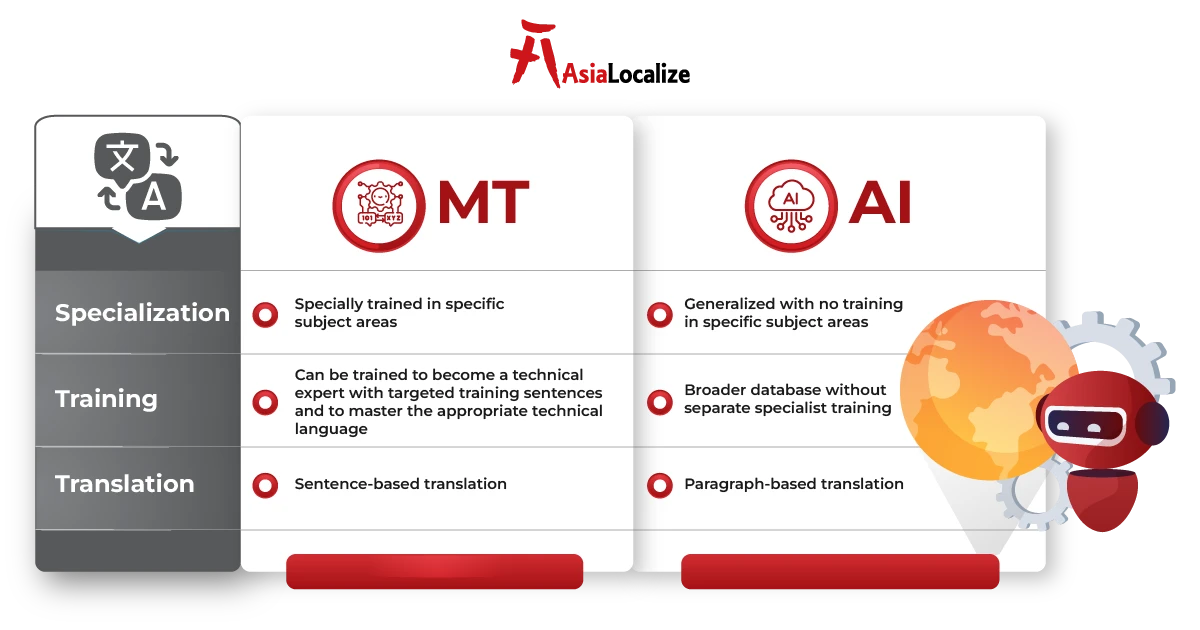
The term “AI translator” has become a catch-all. It shows up in browser extensions, mobile apps, chat interfaces, and even meeting tools. For everyday comprehension, that works. For organizations moving real content across markets, the distinction between a consumer AI translator and machine translation software becomes critical.
Both rely on automation. Both generate text instantly. The similarity largely ends there.
Consumer AI Translators: Built for Convenience
Consumer-facing AI translators focus on immediacy. They translate single inputs on demand, with minimal setup and no operational overhead. That simplicity explains their popularity, yet it also defines their limits.
Typical characteristics include:
- No content ownership guarantees or enterprise-grade security controls
- No administrative visibility into who translated what, when, or where data traveled
- No terminology enforcement, review stages, or quality thresholds
- No integration with CMSs, helpdesk tools, repositories, or development pipelines
For casual use, that trade-off feels acceptable. For regulated industries, branded content, or large-scale localization programs, it introduces risk.
Business-Grade Machine Translation Software: Built for Control
Machine translation software designed for professional use solves a different problem. Speed still matters, yet governance matters more.
Enterprise MT software typically includes:
- Security and compliance safeguards, including data isolation and access controls
- Administrative oversight, with user permissions, usage tracking, and auditability
- Workflow integration, connecting MT output to CAT tools, CMSs, CI/CD pipelines, and support platforms
- Quality gates, such as glossary enforcement, post-editing requirements, and review routing
When Machine Translation Meets TMS
Machine translation delivers speed. A Translation Management System (TMS) turns that speed into a controlled, repeatable process. On its own, MT produces output. Inside a TMS, it becomes part of a governed localization workflow where quality and consistency stay intact as volume scales.
Why MT Gains Real Power Inside a TMS
A TMS provides the structural layer that machine translation lacks by design. Once integrated, MT output flows through defined stages rather than stopping at generation.
Key capabilities include:
- Smart routing
Content gets routed based on language pair, content type, risk level, or turnaround time. Technical documentation can move through MT plus light post-editing, while customer-facing copy triggers full linguistic review.
- Workflow control and review steps
Automated translation enters structured workflows that include post-editing, in-context review, linguistic QA, and final approval. Each step exists for a reason and leaves a trace.
- Terminology and glossary enforcement
TMS platforms apply approved glossaries and translation memories before and after MT runs. This dramatically improves consistency and reduces rework, especially for product and brand terminology.
- Reporting and visibility
Usage, quality metrics, turnaround times, and cost savings become measurable. Teams gain evidence rather than assumptions.
Machine translation tools become more reliable when they operate inside a TMS with routing, review steps, and quality gates.
Scale Localization with a centralized Translation Management System.
Glossaries and Style Guides
A glossary defines how key terms must appear across languages. Product names, feature labels, regulated terminology, and brand-specific phrases belong here. Without that reference point, even strong machine translation engines drift—choosing synonyms that look correct yet subtly undermine clarity or trust.
Well-maintained glossaries reduce that risk by:
- locking approved translations for critical terms
- preventing inconsistent naming across markets
- reducing post-editing time and reviewer friction
In machine-assisted workflows, glossaries feed directly into MT engines and CAT tools, guiding output before it ever reaches a human reviewer.
Style guides codify tone, formality, punctuation, capitalization, and cultural preferences—elements that shape brand perception just as strongly as terminology.
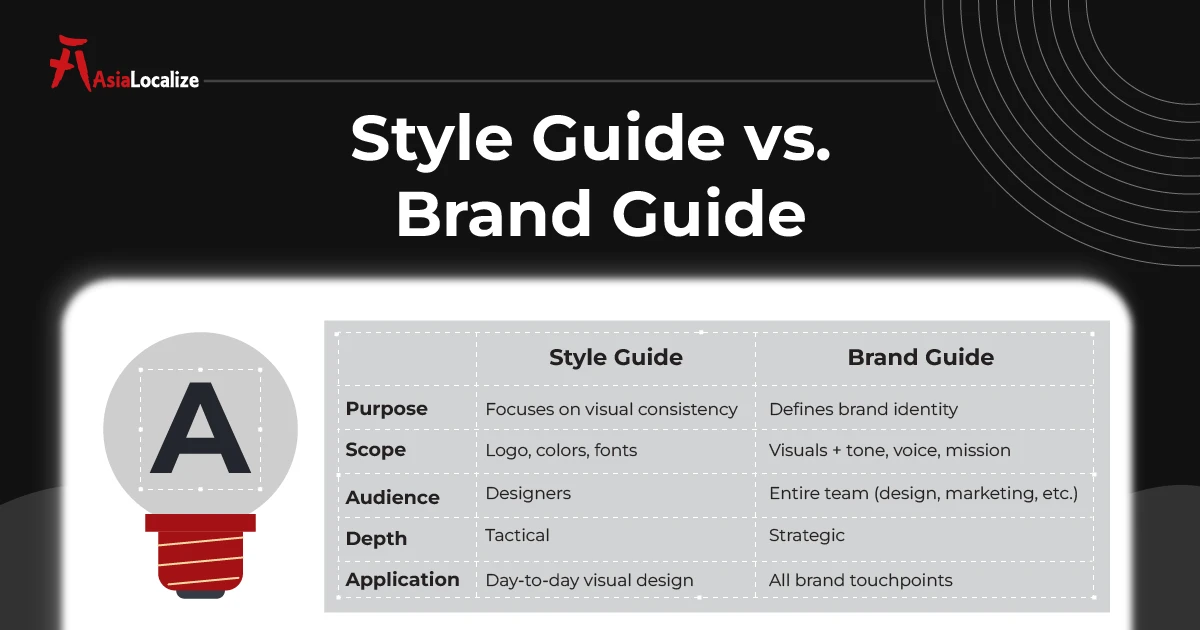
Style guides also provide clarity for:
- tone alignment across marketing, product, and support content
- consistent treatment of UI strings and microcopy
- culturally appropriate phrasing for target markets
When enforced within a TMS, style rules act as guardrails, flagging deviations early instead of after publication.
Translation Memories
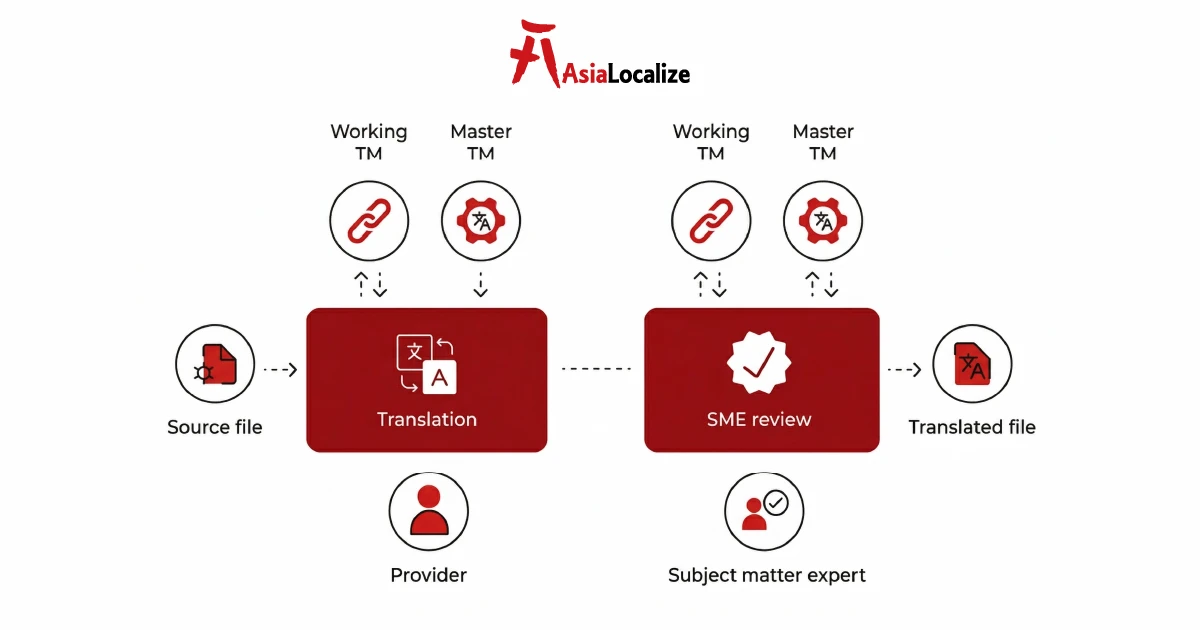
Machine translation accelerates output. Translation Memories (TM) preserve what already works. Together, they form the most cost-efficient and consistent foundation for professional localization.
A translation memory is a linguistic database that stores previously approved translations as source–target pairs. When new content matches or closely resembles existing segments, the system retrieves those translations automatically.
When to Combine TM and MT
Modern localization workflows rarely choose one over the other. They prioritize order.
A common, effective sequence looks like this:
- Translation Memory first: exact and fuzzy matches get reused automatically.
- Machine Translation next: remaining new segments receive MT output.
- Post-editing and QA: linguists focus on what truly needs attention.
Evaluating Machine Translation Quality
Translation quality determines whether machine translation supports growth or quietly introduces risk.
Before approving machine-translated content, a focused review should cover a few non-negotiable areas:
- Terminology accuracy
Product names, feature labels, and industry terms must match approved glossaries. Inconsistent terminology remains one of the leading causes of rework in professional localization.
- Numbers, dates, and units
Prices, measurements, currencies, and dates require careful verification. Locale-specific formats matter as much as numeric accuracy.
- Tone and intent
Informational content tolerates more literal phrasing. Marketing, UX, and customer support content require tone alignment with brand voice and audience expectations.
- Locale and cultural rules
Punctuation, capitalization, formality levels, and cultural references must fit the target market, not the source language logic.
Best Machine Translation Tools by Business Use Case
| Business Need | Best-Fit Tool Type | Examples | Human Review Needed? |
|---|---|---|---|
| Quick internal understanding | Consumer AI translator | Google Translate, DeepL, ChatGPT-style tools | Usually no |
| High-volume support content | MT engine + glossary | Google Cloud Translation, Microsoft Translator, Amazon Translate | Light MTPE recommended |
| Website or app localization | TMS + MT engine | Crowdin, Lokalise, Phrase, Smartling-style workflows | Yes |
| Brand-sensitive marketing | MT + style guide + human review | TMS with glossary and MTPE workflow | Yes, full review |
| Legal, medical, or regulated content | Secure MT workflow + expert linguist | Enterprise TMS, custom MT, subject-matter review | Always |
| Repetitive product documentation | TM-first workflow + MT | TMS + translation memory + MT engine | Review new segments |
| Enterprise localization at scale | Business-grade MT software | TMS, APIs, QA gates, reporting | Based on risk level |
The best machine translation tools are not always the tools with the highest raw output speed.
For business localization, the better choice is usually the tool that connects MT output with terminology control, translation memory, workflow routing, security, and human review when risk is high.
Which Tool Should You Choose?
| Primary Need | Best-Fit Tool Type | Why It Works |
| Immediate understanding, zero setup | Consumer AI translator | Optimized for speed and convenience, suitable for personal or internal comprehension |
| High volume, low-risk content | Machine Translation engine | Delivers rapid scale when quality tolerance remains flexible |
| Publishable content under tight timelines | MT + MTPE workflow | Balances automation with human control for accuracy and tone |
| Repetitive or update-heavy content | Translation Memory + MT | Reuses approved segments first, reduces cost and consistency drift |
| Brand-sensitive or regulated content | TMS with MT, TM, QA gates | Enforces terminology, review stages, and auditability |
| Enterprise security and integration | Business-grade MT software | Supports permissions, reporting, and system-level integration |
Improve Translation Quality with CAT Tools.
Machine translation has matured. The real differentiator today no longer sits in whether teams use MT, but in how thoughtfully it gets deployed. Engines, tools, glossaries, translation memories, and TMS platforms each solve a specific problem. Value emerges when they work together—guided by content intent, quality thresholds, and business risk.
At AsiaLocalize, we help teams move beyond ad-hoc translation by designing end-to-end localization systems—from machine translation and MTPE workflows to translation memory optimization, terminology management, and TMS integration. Every workflow aligns with real content needs.
The best machine translation tools are not chosen by popularity alone; they are selected according to language coverage, content risk, integrations, and review needs.
Design a Complete Machine Translation Workflow.
Explore our Machine Translation & AI Services.
What are machine translation tools?
Machine translation tools are software systems that automatically translate text between languages. They can include simple AI translators, MT engines, APIs, or enterprise platforms connected to localization workflows.
What is the difference between machine translation tools and MT engines?
An MT engine produces the translation output. A machine translation tool or platform manages how that output is used, reviewed, routed, integrated, and approved.
Are machine translation tools accurate?
They can be accurate for some language pairs and content types, but quality depends on terminology, context, domain, language pair, and whether human review is applied.
When should businesses use machine translation tools?
Businesses can use machine translation tools for high-volume, low-risk, repetitive, or time-sensitive content. Public-facing, regulated, or brand-sensitive content should include human review.
Do machine translation tools replace human translators?
No. They support speed and scale, but human linguists are still needed for quality control, cultural nuance, regulated content, and brand-sensitive communication.