Machine translation errors happen when automated output changes, omits, invents, or misapplies meaning—even when the sentence sounds fluent. The most dangerous mistakes are often not obvious grammar problems. They are convincing translations that use the wrong term, reverse an instruction, break a software variable, or deliver the wrong message for the audience.
Machine translation (MT) can still be an efficient part of a global content program. According to the 2024 Nimdzi 100 report, 83.3% of language service providers offer machine translation and post-editing (MTPE). The lesson is not to avoid AI translation; it is to match automation, human review, and quality assurance to the risk of the content.
This guide explains the 10 most common machine translation failures, shows where they create business risk, and provides a practical workflow for preventing them before publication.
Key Takeaways
- Fluent output is not proof of accurate meaning.
- The right workflow depends on content risk, visibility, language pair, and shelf life.
- Glossaries, context, protected variables, and clean source content prevent errors before translation begins.
- Customer-facing and regulated content requires qualified bilingual review.
- Quality should be measured with severity-based error data, not subjective impressions alone.
What Counts as a Machine Translation Failure?
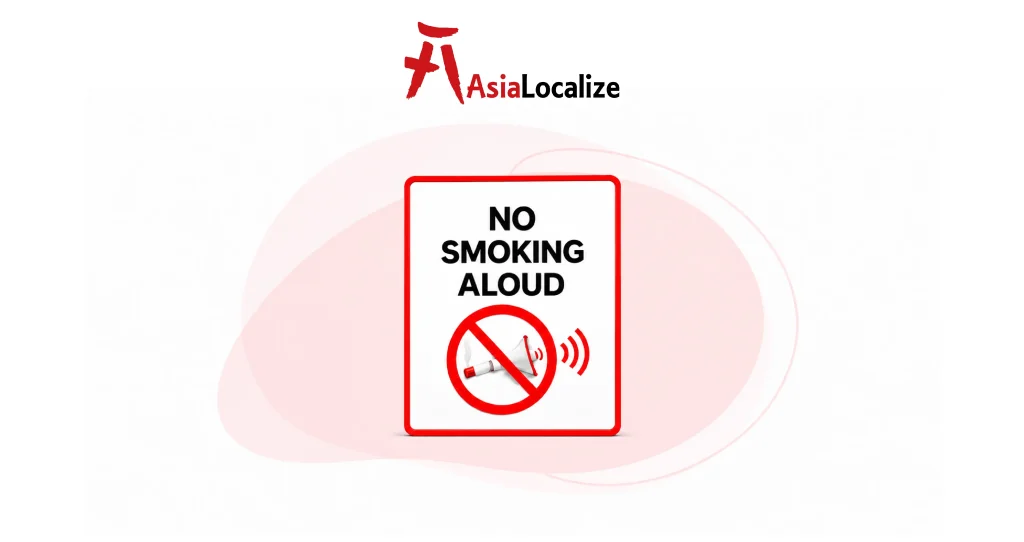
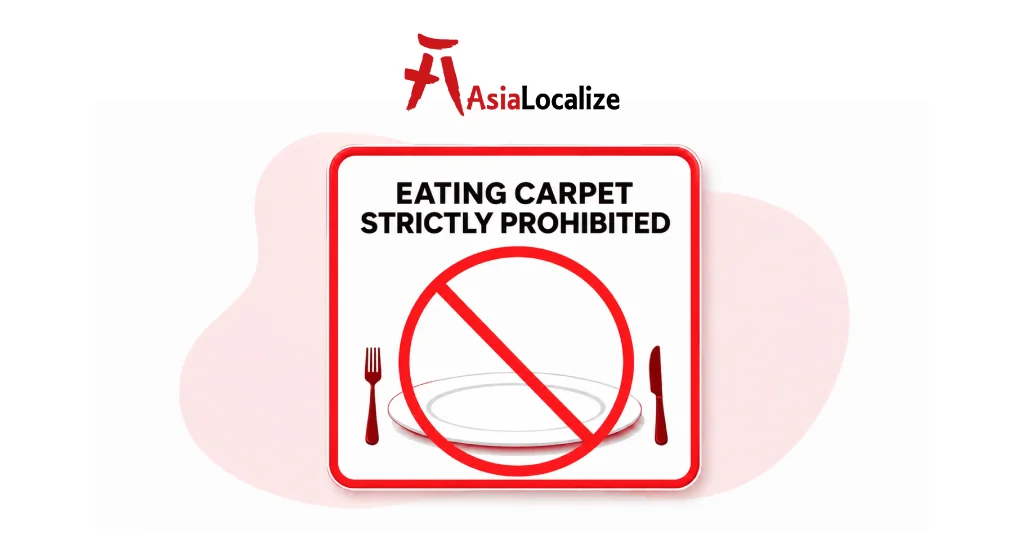
A machine translation fails whenever the target audience does not receive the same meaning, instruction, or experience as the source audience. The output may be grammatically polished and still be factually inaccurate, culturally inappropriate, terminologically inconsistent, non-compliant, or unusable in its final environment.
| Error | Why it matters | Typical control |
|---|---|---|
| Mistranslated warning | May create safety, legal, or compliance exposure | Subject-matter review and full bilingual QA |
| Omitted negative | Can reverse an instruction or contractual meaning | Source-to-target accuracy review |
| Inconsistent UI term | Confuses users and increases support demand | Approved glossary and in-context testing |
| Broken placeholder | May cause a functional defect or display error | Tag protection and automated QA |
| Literal idiom | Weakens clarity, credibility, and brand perception | Native-language localization or transcreation |
10 Common Machine Translation Errors
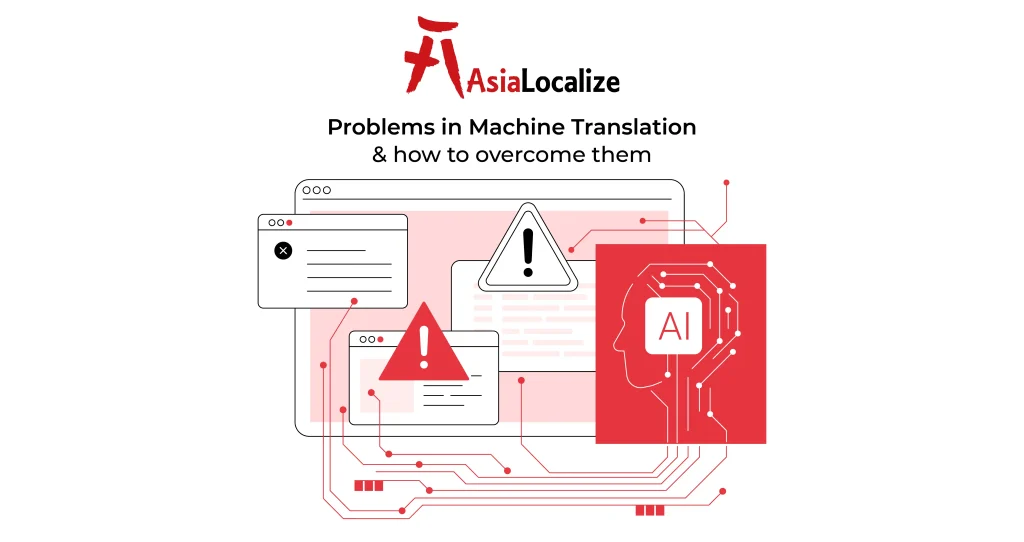
1. Mistranslation and Meaning Shifts
An engine can select a plausible word that does not express the intended meaning. Ambiguous verbs, specialized terms, and words with several senses are frequent triggers. A “charge” could refer to a payment, an electrical property, or an instruction depending on context.
Prevention: provide domain information and surrounding context, then require source-to-target review for content where a meaning shift could affect a decision.
2. Omissions, Additions, and Hallucinations
Machine output may drop a qualifier, repeat information, or introduce content that the source never stated. Missing words such as “not,” “unless,” or “maximum” can change the instruction completely. Added details can be equally dangerous because fluent language may conceal the invention.
Prevention: compare the target against the source, check numbers and named entities separately, and use automated completeness checks as a safety net—not as a substitute for bilingual review.
3. Missing Context
Short strings such as “Home,” “Save,” or “Order” are difficult to translate without knowing whether they are a menu label, command, noun, or verb. Engines process patterns, but they do not automatically know the screen, user journey, audience, or business objective behind every segment.
Prevention: attach screenshots, character limits, content descriptions, speaker information, and adjacent strings. For digital products, integrate this step with a documented software localization process.
4. Inconsistent or Incorrect Terminology
Without an approved termbase, the same feature, medical device, or legal concept may receive several translations. The result is not merely stylistic inconsistency: users may believe different labels refer to different things.
Prevention: maintain a glossary with approved, forbidden, and do-not-translate terms. Apply it before MT, enforce it during QA, and update it from validated reviewer feedback.
5. Literal Idioms and Cultural Errors
Humor, slogans, metaphors, politeness, and cultural references rarely transfer word for word. A literal version may be understandable yet sound insensitive, unnatural, or emotionally flat in the target market.
Prevention: use native linguists for audience-facing material and choose localization or transcreation when the intended reaction matters as much as the literal information.
6. Weak Output for Low-Resource Languages
Quality varies by language pair and domain. Languages with less reliable bilingual training data may produce more unstable grammar, terminology, transliteration, and named-entity handling. Performance in a major European language does not prove equivalent performance in an Asian or African language.
Prevention: pilot every language pair, evaluate a representative sample, and budget for more extensive post-editing or human translation where the evidence requires it.
7. Fluent but Factually Wrong Output
Modern systems can generate natural sentences that subtly distort a fact, relationship, or instruction. This “fluency trap” increases risk because reviewers may read quickly and trust polished language.
Prevention: instruct reviewers to verify meaning before improving style. A research study on MT error types found that meaning shifts, coherence problems, and structural issues are strong indicators of post-editing effort, supporting a fine-grained review rather than a fluency-only check.
8. Broken Tags, Variables, Numbers, and Formatting
HTML, XML, placeholders such as {username}, product codes, measurements, dates, and currency formats require controlled handling. A translation can read perfectly while a changed variable breaks the page or sends the wrong value to a user.
Prevention: lock non-translatable elements, validate tag pairs, compare numbers, and use format-specific QA rules before integration.
9. UI, Layout, and Functional Failures
Translated text may overflow a button, clip on mobile, display in the wrong direction, or fail to match the action on screen. These problems only become visible when language is reviewed in its real environment.
Prevention: run in-context linguistic and functional checks using a repeatable translation testing checklist.
10. Privacy and Data-Governance Failures
The translation itself may be acceptable while the workflow is not. Uploading contracts, patient information, unreleased product details, or customer records to an unapproved consumer tool can conflict with confidentiality commitments and internal data policies.
Prevention: classify data before translation, approve vendors and storage locations, define retention rules, restrict access, and document whether content may be used for model training. When requirements are unclear, do not upload sensitive material until the responsible security or legal owner approves the workflow.
How Risk Changes by Content Type
| Content type | Typical risk | Recommended workflow |
|---|---|---|
| Internal research and temporary summaries | Low, if access is controlled and decisions are verified | Raw MT or light post-editing |
| Support articles and knowledge bases | Medium; inaccurate steps affect customers | MT plus full post-editing and terminology QA |
| E-commerce catalogs | Medium; incorrect attributes drive returns | MTPE, glossary enforcement, and sampling |
| SaaS and user interfaces | Medium to high; functional defects harm adoption | MTPE, in-context review, and localization testing |
| Marketing campaigns | High visibility and reputational impact | Human localization or transcreation |
| Legal, medical, financial, and regulatory content | High legal, safety, or compliance impact | Qualified human translation with independent review |
A practical routing decision considers four variables: impact if the meaning is wrong, visibility of the material, language-pair performance, and shelf life. High-impact or long-lived public content deserves stronger controls than short-lived internal material.
How to Prevent Machine Translation Errors
1. Prepare Clean Source Content
Resolve ambiguity, split overloaded sentences, standardize terminology, and remove obsolete content before translation. Better input reduces avoidable post-editing.
2. Test Engines with Representative Content
No single engine is best for every language, domain, and content type. Compare candidates using real samples that include terminology, names, numbers, UI strings, and difficult sentence structures. Re-evaluate after major engine or content changes.
3. Supply Terminology, Style, and Context
Connect approved glossaries, translation memories, style guides, do-not-translate lists, screenshots, and audience notes. These assets should travel with the content through the entire localization workflow.
4. Automate What Machines Can Check Reliably
Automated QA is effective for missing text, inconsistent terminology, duplicate words, number mismatches, broken tags, placeholders, punctuation, and character limits. It should surface probable defects for review rather than make the release decision alone.
5. Route by Risk and Confidence
Quality-estimation or confidence signals can help prioritize review, but business impact remains the controlling factor. A high-confidence safety instruction may still require human verification, while a low-risk internal note may not need publication-level polish.
6. Apply the Right Level of Human Review
- Light post-editing: correct errors that block understanding; suitable for controlled, low-risk use.
- Full post-editing: verify meaning, terminology, grammar, tone, formatting, and usability for publication.
- Retranslation: start again when structural or meaning errors are so extensive that repairing the output is slower or less reliable.
- Human translation: use from the outset for highly regulated, safety-critical, legally binding, or creatively important content.
See the complete machine translation post-editing workflow for a detailed implementation model.
7. Test in Context and Close the Feedback Loop
Review the translation inside the website, app, document, or device where people will use it. Record validated corrections in translation memories, termbases, engine rules, and reviewer guidance. This converts each release into better input for the next one.
How to Measure Machine Translation Quality
A useful quality program combines automated signals with human evaluation. Classify defects by type and severity: critical errors create safety, legal, or severe business risk; major errors materially change meaning or usability; and minor errors affect polish without blocking the purpose.
- Critical and major errors per 1,000 words
- Terminology compliance rate
- Post-editing time and edit distance
- Percentage of segments requiring retranslation
- Defects found during in-context testing
- Rework, support tickets, returns, or other downstream impact
Track results by engine, language pair, domain, and content type. A single average score can conceal a serious weakness in one market. AsiaLocalize’s translation quality process combines preparation, specialist translation, independent review, proofreading, and final QA.
Machine Translation Error Prevention Checklist
- Classify the content’s business, safety, legal, and privacy risk.
- Clean and standardize the source.
- Test the engine for the exact language pair and domain.
- Attach a glossary, style guide, context, and protected-term list.
- Protect tags, variables, numbers, names, and formatting.
- Choose raw MT, light MTPE, full MTPE, or human translation according to risk.
- Run automated linguistic and technical checks.
- Complete qualified bilingual review where required.
- Test the translation in its final environment.
- Record errors and feed approved corrections back into the system.
Frequently Asked Questions
What are the most common machine translation errors?
Common errors include mistranslations, omissions, invented content, inconsistent terminology, literal idioms, wrong names or numbers, broken tags, and text that is linguistically correct but unusable in its final interface.
Why does machine translation make mistakes?
Errors occur when the system lacks context, reliable language-pair data, domain terminology, or information about the audience and purpose. Ambiguous source writing and unsupported file structures can make the problem worse.
Is AI translation accurate enough for business content?
It can be suitable for selected content, but accuracy varies by language, domain, engine, and risk. Customer-facing, regulated, or high-impact content should not be published solely because the output appears fluent.
When is human review required?
Human review is essential when an error could affect safety, legal obligations, compliance, purchasing decisions, brand reputation, or product functionality. It is also important for creative copy and low-resource language pairs.
How can a company reduce machine translation errors?
Use clean source content, approved terminology, contextual information, tested engines, automated QA, qualified post-editors, in-context testing, and a feedback loop that improves future projects.
Is it safe to translate confidential information with public AI tools?
Not by default. Confirm the organization’s privacy policy, vendor agreement, data location, retention settings, access controls, and model-training terms before submitting confidential or regulated information.
Turn Machine Output Into Business-Ready Content
Machine translation becomes valuable when it operates inside a controlled process. AsiaLocalize combines tested technology, terminology management, native subject-matter linguists, and multilingual QA to match the workflow to your content, audience, and level of risk.
Need speed without sacrificing meaning? Explore our machine translation post-editing services or contact AsiaLocalize to design a scalable, risk-based translation workflow.