How to choose a translation agency, in short: send every vendor the same requirements sheet with one pricing unit, cut the long-list to three with pass/fail gates, score the finalists on a weighted scorecard, check the evidence behind each score, add tests for your Asian languages and scripts, and run a paid pilot scored against criteria you set in advance.
You send the same request, “please quote for Japanese and Thai,” to three translation agencies. One prices per word, one per hour, and one per page with a minimum fee. All three promise native linguists.
With no way to compare them, the choice falls to price and a free sample. By month two you find inconsistent terms, a broken Thai layout and a translation vendor whose production team you never met. What was missing was a process, not information.
This guide shows how to choose a translation agency in six steps, with two reusable tools: a weighted scorecard and a pilot protocol you design and score yourself.
Key takeaways
- Compare like with like: one requirements sheet and one pricing unit, usually per source word, for every vendor.
- Score evidence, not claims: define what a 1, 3 and 5 look like before reading proposals, and verify certificates such as ISO 17100 with the certification body.
- Test where Asian content breaks: locale precision, scripts without word spaces, text expansion, CJK pricing units and honorific register.
- Decide with a paid pilot: your real files, the named production team and an error-score threshold set in advance.
Step 1: Write a Requirements Sheet Every Vendor Receives
Before you contact any translation service provider, write one page describing the work and send it to every vendor. It covers five inputs:
- Locales, named precisely: Simplified or Traditional Chinese, Malay or Indonesian.
- Content types, such as contracts, product UI or campaign copy.
- Volume and rhythm: yearly word count, and whether files arrive weekly or in launch bursts.
- Risk level: regulated or legal content versus marketing.
- Delivery format: Word files, a CMS connector, app strings or print-ready DTP.
Add one line asking every vendor to quote on the same pricing unit, usually per source word. That line solves the three-quotes problem.
The sheet also shows which type of language service provider fits. A freelancer works alone, usually in one language pair. A single-language vendor (SLV) focuses on one target language, and a multi-language vendor (MLV) manages teams across many.
A good agency will still ask questions. But quotes built on different assumptions cannot be compared, and a shared sheet makes any price gap reflect the offer, not the scope.
Step 2: Cut the Long-List to Three With Knock-Out Gates
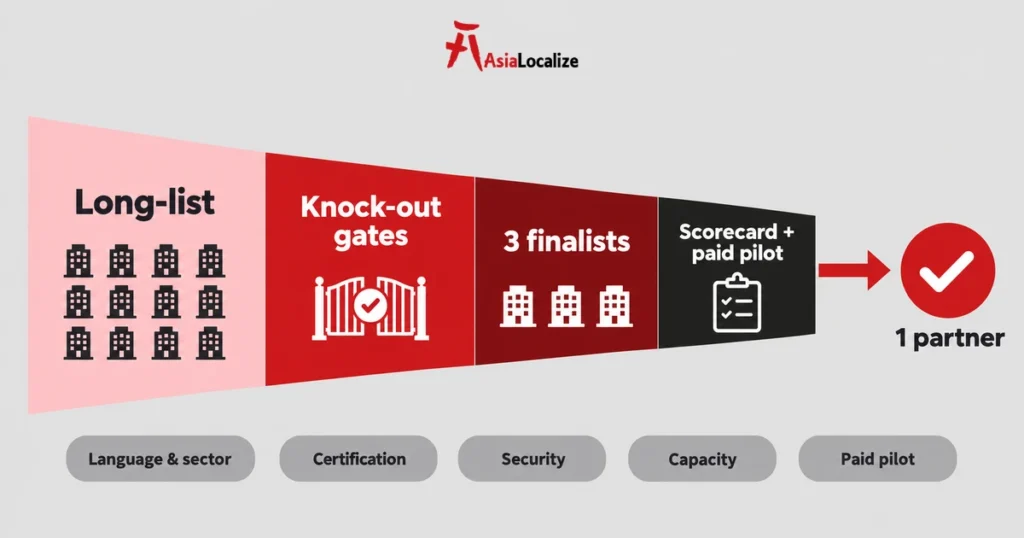
Apply pass/fail gates before you score anyone, in one email round. If you are starting from zero, our list of top translation services companies is one place to build a long-list. It also explains the evaluation dimensions, which this guide does not repeat.
| Gate | Pass if the vendor can |
|---|---|
| Language pair and sector | Show recent work in your pair and sector |
| Certification | Show the certificate your content needs, such as ISO 17100, or work within your ISO 13485 system for medical devices |
| Security | Meet your NDA, access and data-storage minimums |
| Capacity | Handle your peak month with the same team |
| Paid pilot | Agree in writing to the pilot in Step 6 |
Anyone who fails a gate drops out. As a working rule, not a benchmark, take three vendors into scoring: enough to compare, and few enough to review properly.
The gates matter more if you are deciding how to choose a localization services partner for a multi-year program. Glossaries and translation assets build up with a translation partner, so switching later gets harder.
Step 3: Score Finalists on a Weighted Scorecard
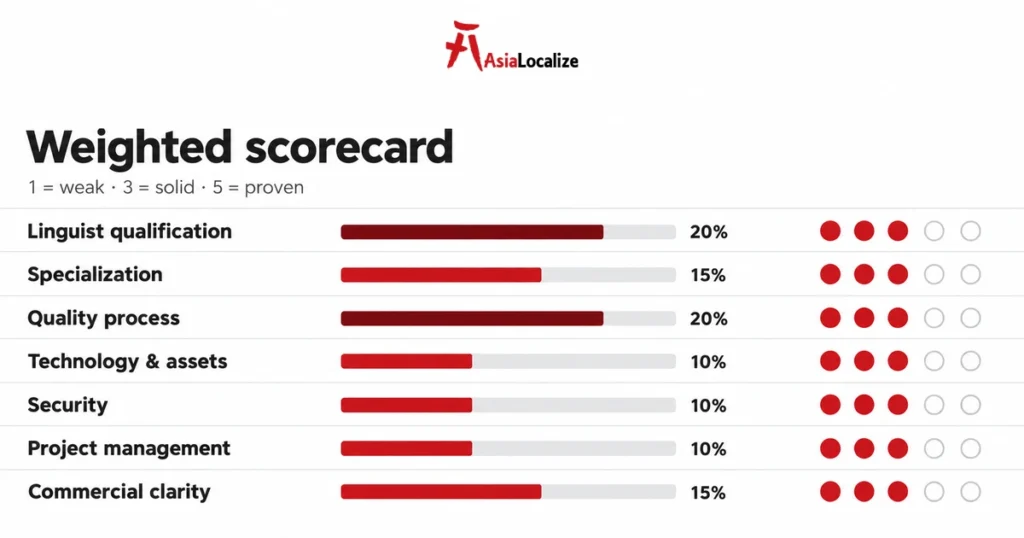
A scorecard only works if two people give the same score for the same evidence. “Strong quality process” means something different to each evaluator, so write down what a 1, a 3 and a 5 look like before you open any proposal. The weights below are illustrative; set yours by what a failure in each area would cost you.
| Criterion | Default weight (illustrative) | Score 1 looks like | Score 3 looks like | Score 5 looks like |
|---|---|---|---|---|
| Linguist qualification and in-market review | 20% | “Native speakers,” no detail | Qualifications stated against ISO 17100 | Qualifications stated, in-market reviewer, CVs under NDA |
| Subject-matter specialization | 15% | Generic samples | Sector samples | Sector samples, domain glossary, sector-trained linguists |
| Quality process | 20% | “Proofread” only | Translation plus independent revision | Written workflow, LQA model, corrective-action log |
| Technology and assets | 10% | No TM, or unclear | TM used | Client owns TM and termbase; written MT/AI policy |
| Security and confidentiality | 10% | NDA only | NDA plus access controls | Plus written retention and deletion policy |
| Project management | 10% | Shared inbox | Named PM | Plus response times and escalation path |
| Commercial clarity | 15% | Unit unclear | Unit stated | Plus TM discounts, minimums and change fees in writing |
Score each row from 1 to 5, using 2 and 4 for evidence between the descriptions. Multiply each score by its weight and add the results for a total out of 5.
Two illustrative presets. For regulated content, such as clinical, legal or medical-device files, raise linguist qualification and quality process to 25% each. Take the ten points from technology and commercial clarity, five from each.
For high-volume marketing, raise technology to 20% and project management to 15%. Set linguist qualification and quality process at 15% each and specialization at 10%. Here, translation memory reuse, scalability and turnaround drive cost and speed.
Score independently. Ask two or three colleagues, ideally from procurement, the content owner’s team and language review, to score alone. Average the results and discuss only rows that differ by two points or more, since a gap usually means unclear evidence. If you issue a translation RFP, build it around these rows so every answer maps to a score.
There is no best translation agency in the abstract, only the best fit for your languages, content and risk. The scorecard shows finance and audit why you chose, and you can re-score yearly on the same rows.
Step 4: Check the Evidence Behind Every Score
Every score needs evidence you have seen, not a sentence in a proposal. Decide in advance what counts for each row.
| Scorecard row | Evidence for a 4 or 5 |
|---|---|
| Linguist qualification | Anonymized CVs or qualification records, shared under NDA |
| Quality process | A real LQA report from a past job, with client details removed |
| Technology and assets | A screen share of the translation management system on a live project, plus the written MT/AI policy |
| Subject-matter specialization | A reference in your sector and language pair |
Certificates. For an ISO 17100 claim, ask for the certificate and confirm it with the certification body named on it, checking scope and expiry. “Compliant with” is a self-description, while “certified to” means an outside auditor checked the vendor. The standard sets requirements for process and resources, including translator and reviser competence and a check of each translation by a second person.
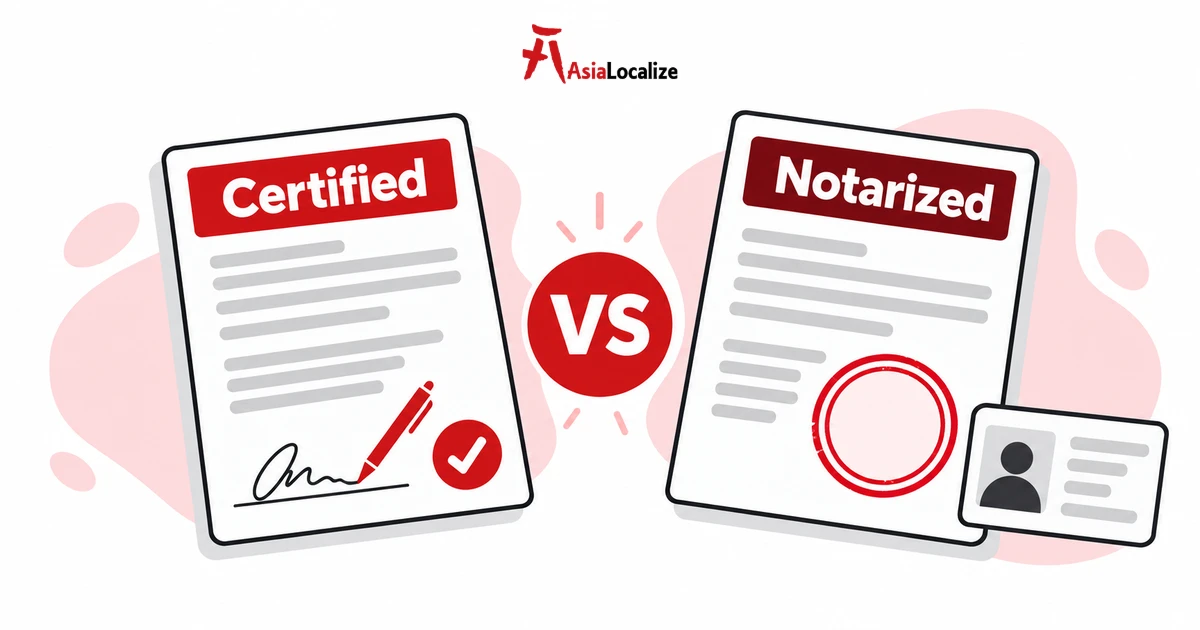
In the US, the phrase “certified translation agency” usually points to something else. There, a certified translation carries the translator’s signed statement that it is complete and accurate, as 8 CFR 103.2(b)(3) requires for USCIS filings.
Quality and references. Ask each finalist to walk through its translation quality assurance steps on a past job, including who revised the work and who signed off. Ask references what went wrong on the account and how the vendor fixed it.
Machine translation. If a vendor offers machine translation post-editing, its policy should say which content it covers and how your data is handled. ISO 17100 leaves raw machine translation plus post-editing out of scope, and ISO 18587 covers post-editing.
Step 5: Add Asian-Language Tests to the Evaluation
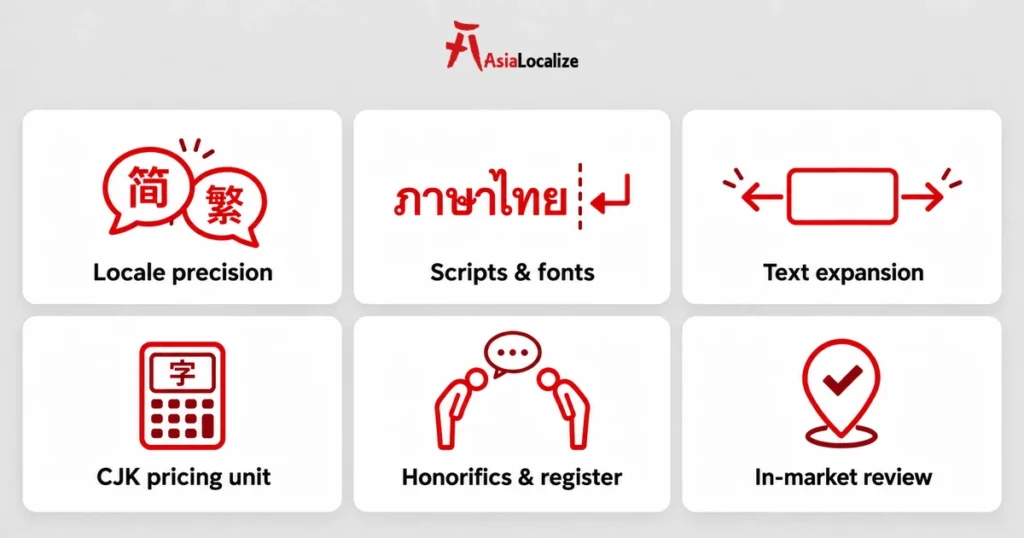
A translation agency can pass every step above and still break a Thai brochure. Turn each check below into a pilot test item for Step 6.
- Locale precision. Simplified and Traditional Chinese serve different markets, and Malay and Indonesian are separate languages. Ask which locale each linguist translates into.
- Script and fonts. Thai, Khmer and Burmese do not mark word boundaries with spaces, so line breaks need software support and a linguist’s check. Indic conjuncts in Hindi or Tamil break in some fonts. Put one layout file in these scripts into the pilot.
- Expansion and contraction. Text length changes in translation. Include UI strings with character limits and check for truncation.
- CJK pricing unit. Chinese and Japanese have no spaces between words, so “per word” needs a definition. Ask whether quotes count source words or target characters, and hold every finalist to one unit.
- Honorifics and register. Japanese keigo and Korean speech levels shift with the reader. Give each vendor an audience brief and check that register stays consistent.
- In-market review. Ask where each reviewer lives; in-market reviewers are more likely to catch dated terms.
These checks target where Asian-language content breaks and generic vetting skips. A translation service provider that passes them in the pilot is less likely to cost you a reprint, a broken interface or rude-sounding copy.
Step 6: Design and Score a Paid Pilot
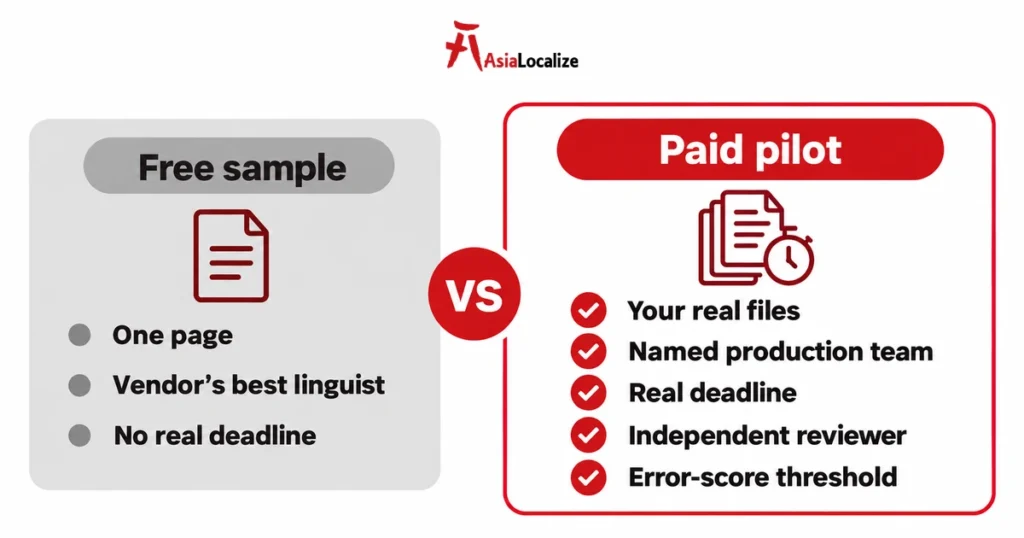
A free sample shows what a vendor’s best linguist does with one page. A paid pilot shows what your actual production team does with your files, glossary and deadline. Write the protocol first and send the same version to every finalist.
| Element | Specify before the pilot |
|---|---|
| Content | Representative files plus the Step 5 test items |
| Size | Roughly 2,000 to 5,000 source words per language (guidance only) |
| Inputs | Glossary, style guide and reference files |
| Team | Named translator, reviewer and PM who will staff production |
| Deadline | A real one |
| Acceptance criteria | Error-score threshold, on-time delivery, file integrity |
| Evaluator | An independent in-market reviewer, not the vendor |
| Decision | Combined score and go/no-go rule, written in advance |
No glossary yet? A short terminology management exercise gives every finalist the same reference.
Score the output. Base the review on ISO 5060:2024, Translation services — Evaluation of translation output — General guidance, approved in February 2024. It describes an analytic method that uses error types and penalty points to produce an error score and a quality rating. As a practical addition, have your independent in-market reviewer also grade each error by severity and divide the penalty total by word count, so files of different lengths compare fairly. That gives you a repeatable answer to how to evaluate translation quality.
Score the process. Translation project management counts too. Record whether the vendor raised queries on ambiguous text, delivered on time, and returned files that open and build correctly.
Decide by rule. Set the acceptance threshold before any files go out. Convert the pilot result to the 1–5 scale and combine it with the Step 3 score, starting from an illustrative 50/50 split. A finalist that misses the error threshold does not win, whatever its scorecard says.
Pilots cost money, but far less than switching vendors mid-program. You also keep the pilot score as a quality baseline.
What Red Flags Appear During a Translation Agency Evaluation?
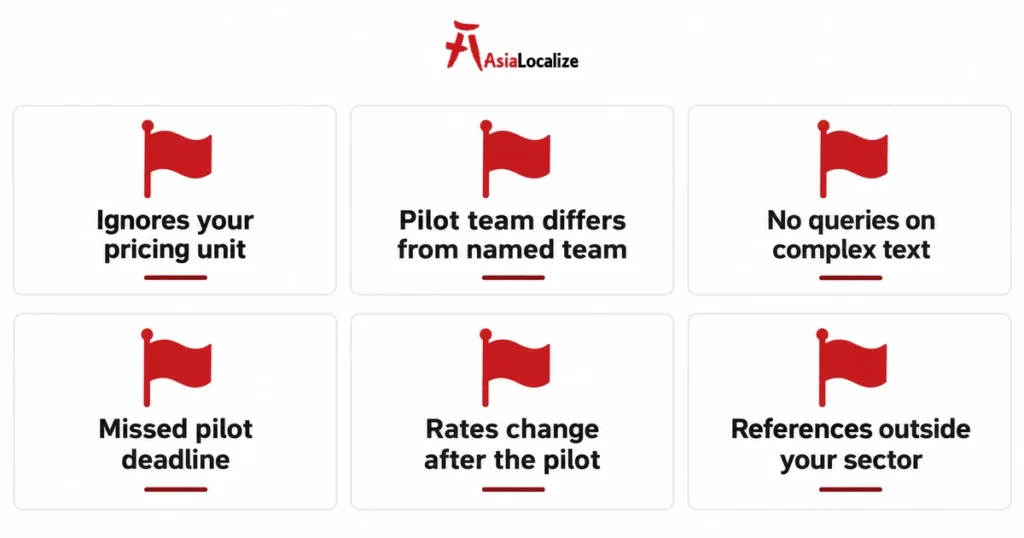
Proposals list claims. Behavior during the evaluation is harder to fake, and it shows how a translation agency will treat you after signing.
| Red flag | Shows in | What to do |
|---|---|---|
| Quote ignores your pricing unit | Step 1 | Ask for a requote, and drop the vendor if it refuses |
| Pilot team differs from the named team | Step 6 | Insist on the named team, or rerun the pilot |
| No queries on complex source text | Step 6 | Review closely; silence often hides assumptions |
| Pilot deadline missed without warning | Step 6 | Treat it as a preview of production |
| Rates or terms change after the pilot | After Step 6 | Ask for the reason in writing before going further |
| References outside your sector or language pair | Step 4 | Ask for a relevant one, or score the row low |
Price questions surface here too. Ask each finalist for a line-item breakdown in your unit: translation, revision, DTP, project management and any minimums. Then compare what each quote covers, not only its total, against common translation rates structures. A lower total sometimes reflects a narrower scope rather than a better price.
How to Choose a Translation Agency: Checklist Before You Decide
- Send one requirements sheet with one pricing unit.
- Apply knock-out gates and keep three finalists.
- Score finalists independently on a weighted scorecard with 1/3/5 guidance.
- Check the evidence behind every score.
- Build Asian-language tests into the pilot.
- Run a paid pilot against criteria set in advance, then decide.
FAQ: How to Choose a Translation Agency
How do you choose a translation agency?
Send one requirements sheet with a single pricing unit, and cut the long-list to three with pass/fail gates. Score finalists on a weighted scorecard and check the evidence behind each score. Add tests for your languages and scripts, then run a paid pilot against criteria set in advance.
What certifications should a translation agency have?
It depends on your content. ISO 17100 sets requirements for translation processes and resources, including translator and reviser competence and a check of each translation by a second person. ISO 18587 covers machine translation post-editing, and medical-device content may need a vendor that can work within your ISO 13485 system. Confirm any certificate with the certification body named on it, checking scope and expiry.
Is a free translation sample enough to choose an agency?
No. A free sample shows what a vendor’s best linguist does with one page. A paid pilot shows what the actual production team does with your files, glossary and deadline, scored against criteria you set before any files go out.
How do I compare translation quotes that use different pricing units?
Ask every vendor to requote in one unit, usually per source word. Per-hour pricing often covers editing or DTP, and per-page pricing may carry a minimum fee. The answer to “how much do translation agencies charge?” depends on that unit, plus memory discounts and minimums, as our pricing guide explains.
Who should own the translation memory and glossary?
You should, and the contract should say so. Ask each finalist to confirm in writing that it will export your translation memory and termbase on request, in standard formats such as TMX and TBX. Without that clause, switching vendors means rebuilding assets you paid for.
What is the difference between an RFI, an RFP and a pilot?
A request for information (RFI) collects the facts you need for the knock-out gates. A request for proposal (RFP) asks finalists for the evidence behind each scorecard row. A pilot measures real performance on your content. Use them in that order.
How long does a translation vendor evaluation take?
As a planning guide, not a benchmark, allow roughly six to ten weeks. The sheet and gates take one or two, and scoring and evidence two or three. The pilot takes longest, because it includes translation, independent review and your decision.
Should I hire a freelance translator or a translation agency?
Hire a translator directly if you need one language pair and can manage projects and revision in-house. An agency suits several languages, with second-person revision and project management built in. Freelancers are a large part of the profession: the US Bureau of Labor Statistics counts self-employed workers as 28% of interpreter and translator jobs in 2025.
Put AsiaLocalize Through Your Scorecard
Knowing how to choose a translation agency means testing every finalist the same way, including us. AsiaLocalize is a Kuala Lumpur translation agency certified to ISO 17100 and ISO 13485, with 8,000+ projects, 10 million words translated and 120+ languages.
Send your requirements sheet and a sample file, and we will reply with a scoped quote. Use the scorecard in Step 3 and the pilot table in Step 6 to judge it. See our professional translation services, or, for ongoing volume, managed translation outsourcing.
Prefer to talk first? Contact our team to discuss a paid pilot with acceptance criteria for your Asian markets.