
Translation vendor management, in short: on the buyer’s side, it means controlling what you send to translation vendors, the standard you hold them to, and how you measure and pay for the work. In practice that is six habits: frozen, editable source files; one written brief per content stream; glossaries, style guides and translation memory that you own; scored client acceptance; a few KPIs reviewed quarterly; and a budget built on drivers you control.
Three months after you sign with a translation vendor, the problems start. The same product term appears three different ways, your reviewer in Tokyo rewrites whole paragraphs, and invoices creep past the quote because the source files kept changing. In most cases the vendor hasn’t gotten worse. Nobody was managing what went in.
This guide covers translation vendor management from the buyer’s side, for companies that have already chosen a vendor and need the work to run well. The sections below deal with file handoff, briefs, glossaries and style guides, acceptance, KPIs, budget drivers, and the failure points behind most problems in a translation workflow.
Key takeaways
- Most problems start with inputs. Source changes, late glossaries and missing context cause more rework than vendor skill does.
- Write it down once. A brief per content stream records locale codes, register, terminology and acceptance criteria, so staff changes on either side don’t reset quality.
- Own your language assets. The contract should say you own the translation memory and termbase, exportable as TMX and TBX.
- Accept by score, not by opinion. Count errors against a threshold and move reviewer preferences into the style guide.
What Is Translation Vendor Management for Buyers?
On the buyer’s side, translation vendor management means controlling what goes to your translation suppliers, the standard you hold them to, and how you measure and pay for the work. Inside a language service provider, the phrase describes a different job: a translation vendor manager or language vendor manager recruits freelance linguists and looks after them. This guide stays with the client’s side of vendor management in translation.
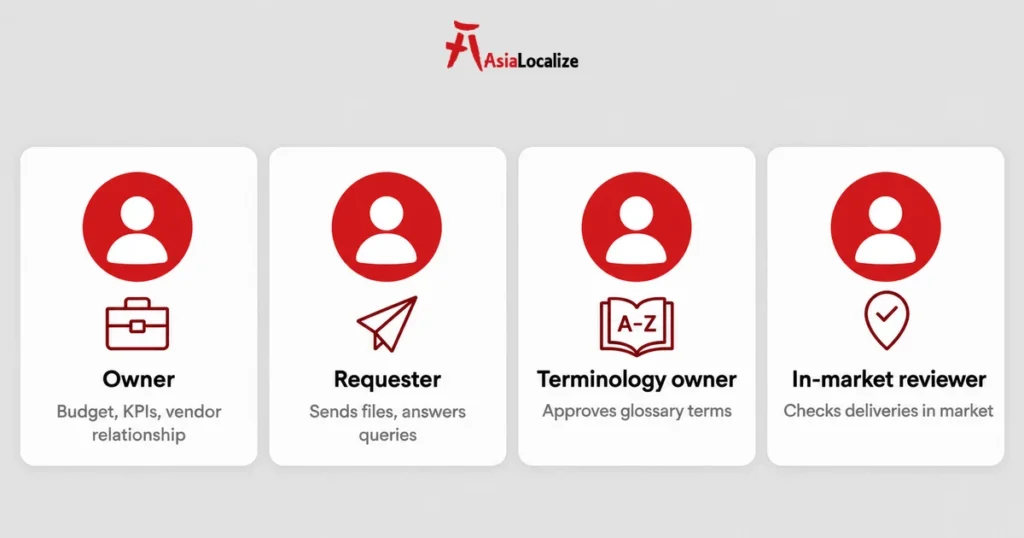
The client’s side needs four named people:
- Owner. Holds the budget, the KPIs and the vendor relationship, often a localization project manager or procurement lead.
- Requester for each content stream. Sends files and answers queries for product UI, marketing, legal or support content.
- Terminology owner. Approves glossary terms and settles disputes about them.
- In-market reviewer. Checks deliveries against the agreed standard from inside the target market.
With these roles named, every query, approval and invoice has an owner, and nothing stalls between departments.
If you have not yet settled on a translation outsourcing model (project-based, dedicated team or fully managed), start there. Everything below applies to all three.
How Should You Prepare Source Files for a Translation Vendor?
Most rework starts at handoff, before a translator opens the file. In translation project management, a short handoff standard applied to every job prevents most of it:
- Editable source files. Send the Word, InDesign, XLIFF or JSON files the text lives in, not PDFs or screenshots.
- A source freeze. Finalize the text before handoff. If it must change later, send a dated change log.
- Context. Add screenshots for interface strings, state character limits, and say where the text appears.
- Reference material. Include previously approved translations, product glossaries and brand guidelines.
Asian scripts need extra notes. Thai, Khmer and Burmese don’t put spaces between words, so line breaks need care, and Chinese, Japanese and Korean layouts behave differently from Latin text. Name the approved font families for each script and say how much room the layout has for text that runs longer or shorter. If you need print-ready files back, the job includes desktop publishing, so scope it from the start.
“The vendor can extract text from a PDF.” It can, but extraction adds engineering time, a step where text can break, and usually a line on the invoice.
With the right version and full context, the vendor translates once instead of twice. You get fewer queries, less rework and lower engineering charges on every job.
How Do You Write a Translation Brief the Vendor Can Act On?
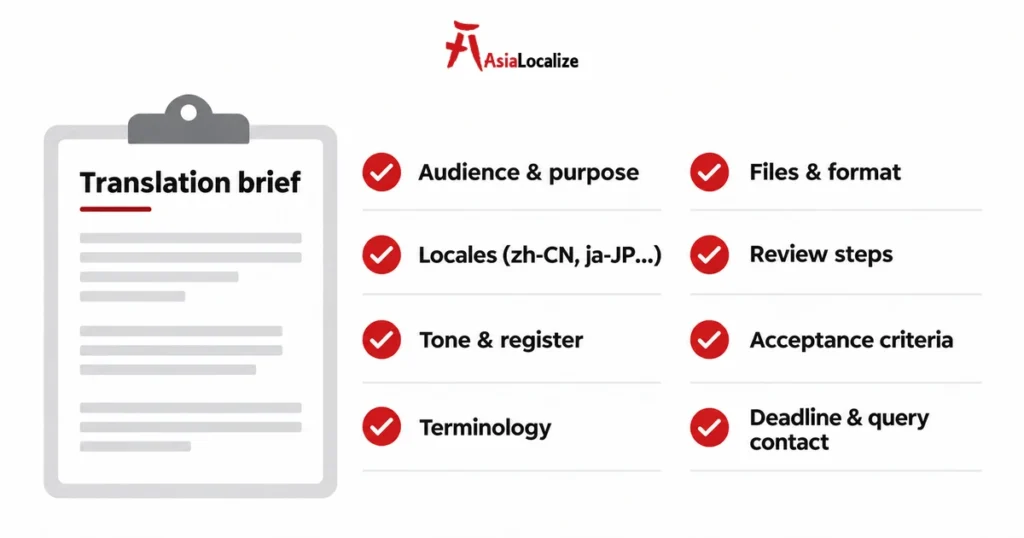
A good translation brief answers the questions a translator would otherwise email you: the reader, the exact locale, the register, the terms that stay in English and the query contact. This is the per-project or per-stream brief you write after choosing a vendor. It is not the request for proposal you used to select one.
ISO’s requirements standard for translation services, ISO 17100:2015, treats this information as pre-production. It places the client-TSP agreement, terminology and the style guide before the translation process starts.
Use these eight fields:
| Field | What to write |
|---|---|
| Audience and purpose | Who reads the text, and what they should do after reading it |
| Locales | Exact codes, such as zh-CN, zh-TW, ms-MY, id-ID, ja-JP, ko-KR or th-TH |
| Tone and register | For example, Japanese keigo: polite (desu/masu) or honorific (sonkeigo/kenjōgo); the Korean speech level to use |
| Terminology | A link to the termbase, plus terms that must not be translated |
| Files and format | Source format, delivery format and any desktop publishing needs |
| Review steps | Vendor revision, your in-market review, and who signs off |
| Acceptance criteria | The error-score threshold from your acceptance process (see the next sections) |
| Deadline and query contact | The final date, a deadline for raising queries, and a named person who answers them |
Keep one master brief per content stream and update it when a decision changes, rather than writing a new one for every job. The brief then records each decision once, instead of remaking it on every project. For localization project management on the client side, that record is the main tool you have.
“Our vendor knows us by now” holds only until the translator who knows you moves to another account. Vendor staff change. A written brief keeps output consistent when they do, and it cuts the “is this right?” queries that eat into every deadline.
Which Language Assets Should You Own? Glossaries, Style Guides and Translation Memory
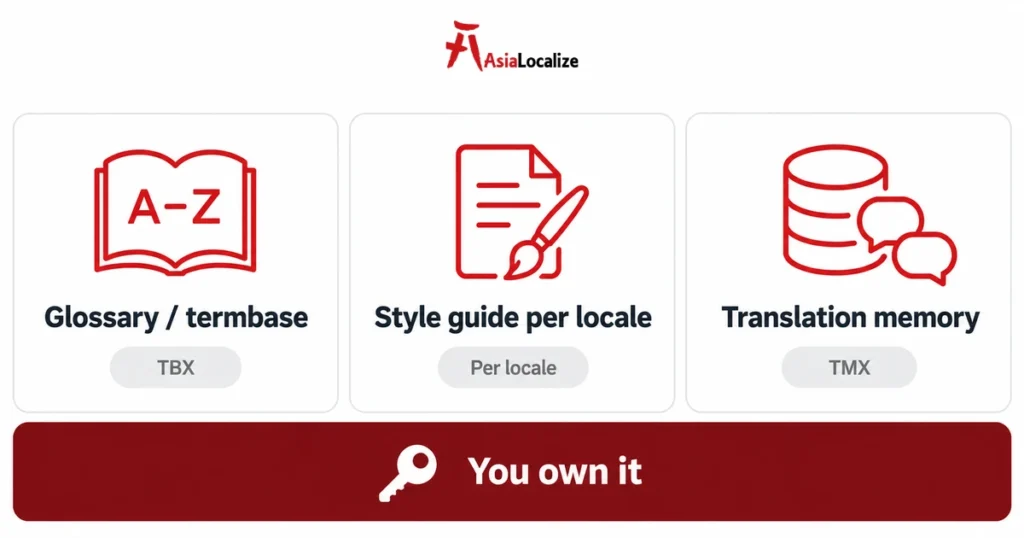
Three assets carry your quality from one job to the next: a translation glossary, a translation style guide for each locale, and translation memory. Give each one an owner inside your company, not inside the vendor.
- Glossary or termbase. List approved terms, forbidden terms and do-not-translate items such as product names. The vendor’s linguists can propose new terms, and your terminology owner approves them. Update it on a fixed cycle, such as monthly. Our post on terminology management explains how to build one.
- Style guide per locale. Cover register, punctuation, numbers, dates and brand voice. For Chinese and Japanese, state how to handle full-width and half-width punctuation, especially next to Latin text. For Malay and Indonesian, say how to treat English loanwords, since the two languages often spell them differently (“kualiti” in Malay, “kualitas” in Indonesian).
- Translation memory. Your translation memory is a company asset, so the contract should say you own it and can export it as TMX whenever you ask. Ask for the termbase in TBX on the same terms.
If you or your vendor use a translation management system, test an export before you need one.
When language assets sit only inside a vendor’s tools, the vendor effectively controls your terminology. Owning them means terms stay consistent across vendors and years, and switching suppliers no longer means starting from zero.
How Do You Accept Translations? Vendor QA vs Client Acceptance
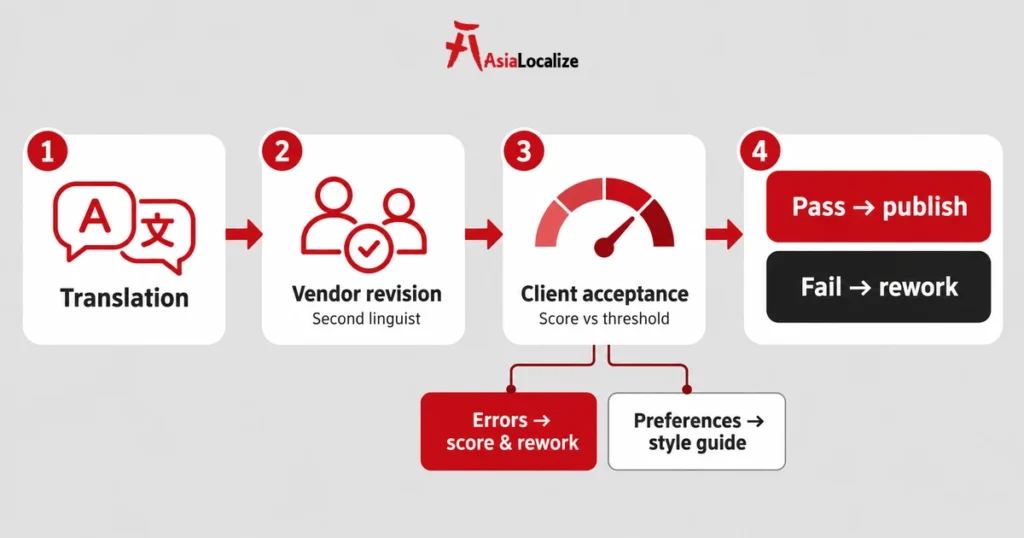
Two checks happen after translation, and they do different jobs. The vendor’s QA comes first: ISO 17100 builds in revision, a bilingual check of the translation against the source. A person other than the translator does it, so every translation passes through at least two people (FIT, ISO 17100 FAQs, 2020). Client acceptance comes second. It is your decision on whether the delivery meets the agreed standard.
Acceptance should be a decision, not an open-ended edit. Your in-market reviewer samples each delivery, logs errors by type and severity, and checks the score against the threshold in the brief. ISO 5060:2024, published in February 2024, gives guidance on this kind of evaluation, using error types and penalty points to produce an error score and a quality rating.
Ask reviewers to sort what they find into two groups:
- Errors: meaning, terminology, grammar or locale conventions such as dates and currency. These count toward the score and go back to the vendor.
- Preferences: wording the reviewer would have chosen differently when the text is still correct. These go into the style guide, not into rework.
Put the acceptance step at a fixed point in your localization workflow, after vendor revision and before publishing, with a set number of days to complete it. Give rework a time limit too.
A scored step gives a clear pass or fail and stops preference changes from being billed as rework. You get faster sign-off, fair rework requests, and per-locale error scores that become the core record for translation quality management and localization vendor management.
How Do You Measure Translation Vendor Performance? 6 KPIs
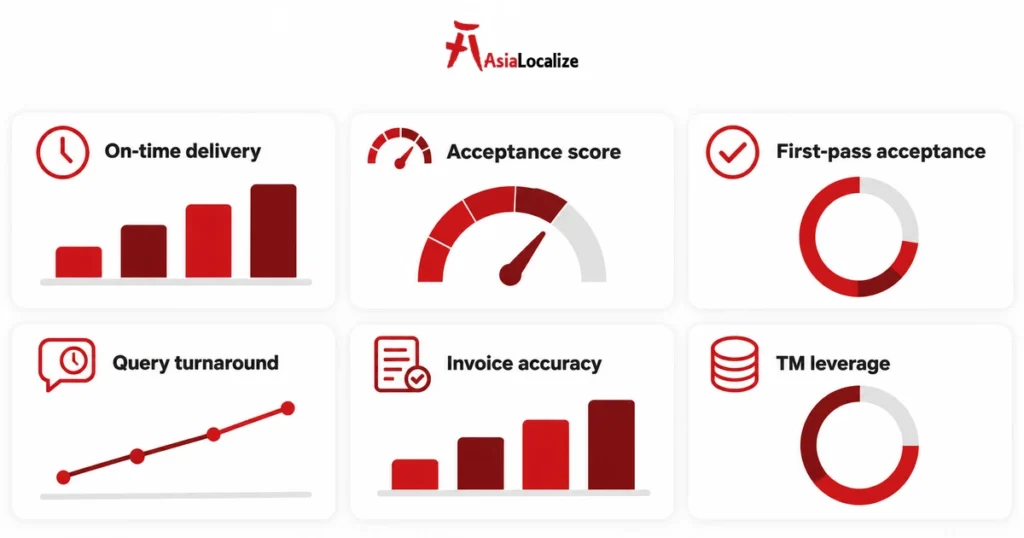
Track a few numbers consistently rather than many occasionally. The six translation KPIs below cover most of what matters. Treat them as examples to agree with your vendor, not industry benchmarks, and set targets that fit your own content and markets.
| KPI | How to measure |
|---|---|
| On-time delivery | Percentage of jobs delivered by the agreed date |
| Acceptance score | Average error score per locale, using your ISO 5060-style method |
| First-pass acceptance | Percentage of jobs accepted without rework |
| Query turnaround | Time for the vendor to raise queries, and for your team to answer them |
| Invoice accuracy | Invoiced amount against the quote, with the reason for any variance |
| TM leverage | Share of words matched from translation memory, which shows the value of your assets |
Two of these measure your side as much as the vendor’s. Slow query answers and late source changes show up in on-time delivery and invoice accuracy, so read the numbers together.
Review the results with the vendor every quarter. Look at trends by locale and content stream, find the root cause of anything that moved, and agree one change to the brief, the assets or the process each time.
If you’re working out how to manage translation vendor relationships at enterprise scale, use the same KPI definitions for every vendor and locale. Judging a vendor on the last complaint tells you little. Comparable trends show whether a problem is a pattern or a one-off, turn language vendor management into a conversation about data, and give you earlier warning before quality drops.
Which Translation Cost Drivers Can You Control?
Rates are only one part of the bill. Your translation budget also depends on how work arrives, and many cost drivers sit on your side:
- Language pair and market: decide which locales need full translation and which content can wait.
- Volume and TM matches: vendors often price repetitions and fuzzy matches differently from new words, so keep the TM clean and reuse approved source wording.
- Subject complexity: send clear source text and reference material for regulatory, legal and technical content.
- File engineering: PDFs, scans and unusual formats need preparation, so send editable files.
- Desktop publishing for Asian scripts: leave room in the design and name approved fonts.
- Turnaround: rush deadlines often carry a surcharge, so build translation time into release plans.
- Review steps: agree the number of rounds once, in the brief.
- Minimum fees: batch small requests into weekly or biweekly drops.
- Project management: fewer, better-prepared jobs need less of it.
- Source changes after handoff: freeze the source, or pay twice for the same text.
To forecast translation cost, estimate annual volume by locale and content stream, adjust for expected TM matches, and apply your own contracted rates. Compare the forecast with actual invoices each quarter. For the wider picture, see our guide to localization cost.
Negotiating rates lowers the price of each word. Better inputs cut the number of billable steps, so the same rate card buys more translation and invoices stop surprising finance.
Why Does Translation Vendor Management Fail? Common Problems and Fixes
When quality drops or costs climb, check the inputs before blaming the output. Most problems in vendor management in localization trace back to a few causes, and each has a fix on the buyer’s side.
| Failure | Usual cause | Fix |
|---|---|---|
| The source changes after handoff | Content was sent before final approval | Freeze the source and send a dated change log for any later edit |
| The glossary arrives after translation has started | Terminology work began too late | Approve core terms before the first job and link the termbase in the brief |
| UI strings come back wrong or truncated | Strings were sent without screenshots or character limits | Send context with every string file |
| The in-market reviewer rewrites for style | No rule separates errors from preferences | Score errors only and move preferences into the style guide |
| Queries go unanswered and deadlines slip | No named query contact or query deadline | Name one person per content stream and set a query deadline in the brief |
| Malay and Indonesian, or Simplified and Traditional Chinese, get mixed up | Locales were described loosely (“Chinese,” “Bahasa”) | Use exact locale codes such as ms-MY, id-ID, zh-CN and zh-TW in every brief |
| The TM isn’t returned when the vendor changes | The contract never covered asset ownership | Write TM and termbase ownership, with TMX and TBX exports, into the contract |
Generic localization best practices tell you to “communicate clearly.” This table names the specific problem and the input that causes it. Your team can diagnose a quality or cost issue quickly and fix the input instead of arguing about the output.
Translation Vendor Management Checklist
- Name an owner, requesters, a terminology owner and in-market reviewers.
- Send editable, frozen source files with context and script notes.
- Keep one written brief per content stream, and update it.
- Own your glossary, style guides and translation memory, with TMX and TBX exports.
- Accept work against a scored threshold, and log preferences separately.
- Review six KPIs and your budget drivers with the vendor every quarter.
Translation Vendor Management FAQ
What does translation vendor management involve for a buyer?
Managing the inputs, briefs, language assets, acceptance, performance and cost of outside translation suppliers. Inside a language service provider, the same term means recruiting and managing freelance linguists. Buyers control quality mainly through what they send and how they accept deliveries.
What should a translation brief include?
Eight fields: audience and purpose, exact locale codes, tone and register, terminology, file and delivery formats, review steps, acceptance criteria, and the deadline with a named query contact. Keep one brief per content stream and update it when decisions change.
Who should own the translation glossary?
A named terminology owner inside your company. The vendor’s linguists can propose terms and flag problems, but your terminology owner approves every change. Terms then stay consistent across vendors, and the glossary stays with you if you change suppliers.
What is the difference between vendor QA and client acceptance?
Vendor QA comes first: under ISO 17100, a second person revises each translation against the source before delivery. Client acceptance comes second. It is your in-market reviewer’s scored decision on whether the delivery meets the threshold agreed in the brief.
Which KPIs should we track for a translation vendor?
On-time delivery, acceptance score, first-pass acceptance, query turnaround, invoice accuracy and TM leverage cover most needs. Agree the definitions with your vendor and set your own targets, since no single benchmark fits every content type. Review trends together every quarter.
How do we handle reviewer changes that are preferences, not errors?
Log them in the style guide and share the update with the vendor. Don’t send them back as rework or count them in the error score, because the delivered text was correct. Over time, reviewers flag fewer of them.
Who owns the translation memory when we work with an outside vendor?
You should, and the contract should say so. Agree that you own the translation memory and termbase, that the vendor exports them as TMX and TBX on request, and that you receive current exports when the relationship ends.
How can we reduce translation costs without cutting rates?
Improve the inputs. Freeze source text before handoff, send editable files instead of PDFs, keep translation memory clean, batch small requests to avoid minimum fees, agree review rounds once in the brief, and build translation time into release plans to avoid rush surcharges.
Let AsiaLocalize Run It With You
Translation vendor management is easier when your vendor works from your brief, assets and acceptance rules. Share yours with us and ask how we would apply them. AsiaLocalize is ISO 17100 and ISO 13485 certified, with 8,000+ projects, 10 million words and 120+ languages.
Request a quote. Send a sample file and your brief, and we will reply with a scoped quote. Request a quote
Prefer to talk first? Contact our team to discuss your brief, glossary and acceptance process for your Asian markets.